
- News
- Business News
- Fairfax buys 33% in Bengaluru airport from GVK for 2,149 crore
Trending
This story is from March 29, 2016
Fairfax buys 33% in Bengaluru airport from GVK for 2,149 crore
Airport operator GVK Power & Infrastructure, which owns the majority stake in the Bangalore International Airport (BIAL), is selling most of its holding to Canadian investor Prem Watsa's Fairfax Group in a bid to reduce its debt.
Airport operator GVK Power & Infrastructure, which owns the majority stake in the Bangalore International Airport (BIAL), is selling most of its holding to Canadian investor Prem Watsa's Fairfax Group in a bid to reduce its debt.
BENGALURU: Airport operator GVK Power & Infrastructure, which owns the majority stake in the Bangalore International Airport (BIAL), is selling most of its holding to Canadian investor Prem Watsa's Fairfax Group in a bid to reduce its debt.
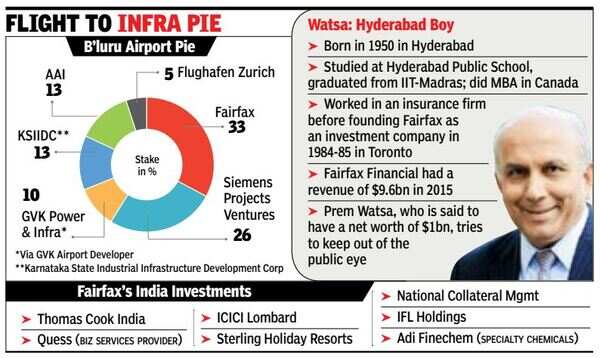
GVK will pare its 43% stake in the company to 10%, divesting 33% for Rs 2,149 crore ($321 million) to Fairfax India Holdings Corp and Fairfax Financial Holdings.
The deal, the largest M&A in the country's airport infrastructure and the broader aviation sector, will help GVK reduce its debt by about Rs 2,000 crore and save interest cost of about Rs 300 crore annually, the company said in a filing.
"This is an important and successful milestone of deleveraging our balance sheet and all the proceeds from the stake sale shall be used to bring down our debt obligation to our lenders. We chose Fairfax as our partner in BIAL as we have a long-standing relationship with its chairman Mr Prem Watsa," chairman and managing director G V K Reddy said. He did not disclose what the long-standing relationship was. But both Reddy and Watsa have strong roots in Hyderabad.

Shares of GVK, which also operates the Mumbai airport, rose about 6.4% to close at Rs 7 on Monday on the BSE while the broader sensex fell about 1.5%. TOI had reported in December that GVK Airport Developers, a wholly owned subsidiary of the listed company, had shortlisted five bidders to sell up to 49% for raising Rs 4,000 crore. The report had also mentioned that the company was looking at a strategic sale, and not an IPO.
GVK Airports could also pursue a similar divestment move in Mumbai International Airport (MIAL) to pare down a total debt of Rs 23,000 crore sitting on its parent GVK Power's books. The standalone debt of GVK Airports is Rs 3,600 crore.
This is Watsa's first big deal in the Indian infrastructure space after buying a 74% stake in commodities storage and services firm National Collateral Management Service last year. The airport deal, expected to be completed by the middle of the year, has been structured as a partnership deal where GVK retains executive management titles. G V Sanjay Reddy will continue to be the managing director and G V K Reddy will be co-chairman of BIAL, Watsa said in a statement.
Watsa, however, will have a significant say in the affairs and Fairfax will pursue opportunities to raise its holding in BIAL but will have no right of first refusal on the remaining 10% stake that GVK still owns.
Post the deal, which was advised by Bank of America Merrill Lynch and Goldman Sachs, Fairfax will become the largest shareholder in the country's third busiest airport, with the rest held by Siemens (26%), Karnataka State Industrial Infrastructure Development (13%), Airports Authority of India (13%), and Zurich AG (5%).
GVK became the largest shareholder of BIAL in 2011, when it increased its holding to 43% from 29% in 2011, by buying 53.8 million equity shares from Siemens for Rs 614 crore. BIAL was then valued at Rs 4,378 crore, which means the valuation has risen by about 50% in a little under five years. BIAL had revenue of Rs 933 crore in 2014-15, up 38% from the year before, and net profit of Rs 75 crore, up 12% from the year before.
The Mumbai and Bangalore airports can handle 60 million passengers annually, making GVK one of the largest private sector operators in the country. The passenger traffic at the airports has risen 16% and 21%, respectively, in recent quarters.
GVK will pare its 43% stake in the company to 10%, divesting 33% for Rs 2,149 crore ($321 million) to Fairfax India Holdings Corp and Fairfax Financial Holdings.
This values the Bangalore airport at Rs 6,512 crore, or close to $1 billion.
The deal, the largest M&A in the country's airport infrastructure and the broader aviation sector, will help GVK reduce its debt by about Rs 2,000 crore and save interest cost of about Rs 300 crore annually, the company said in a filing.
"This is an important and successful milestone of deleveraging our balance sheet and all the proceeds from the stake sale shall be used to bring down our debt obligation to our lenders. We chose Fairfax as our partner in BIAL as we have a long-standing relationship with its chairman Mr Prem Watsa," chairman and managing director G V K Reddy said. He did not disclose what the long-standing relationship was. But both Reddy and Watsa have strong roots in Hyderabad.
Shares of GVK, which also operates the Mumbai airport, rose about 6.4% to close at Rs 7 on Monday on the BSE while the broader sensex fell about 1.5%. TOI had reported in December that GVK Airport Developers, a wholly owned subsidiary of the listed company, had shortlisted five bidders to sell up to 49% for raising Rs 4,000 crore. The report had also mentioned that the company was looking at a strategic sale, and not an IPO.
GVK Airports could also pursue a similar divestment move in Mumbai International Airport (MIAL) to pare down a total debt of Rs 23,000 crore sitting on its parent GVK Power's books. The standalone debt of GVK Airports is Rs 3,600 crore.
This is Watsa's first big deal in the Indian infrastructure space after buying a 74% stake in commodities storage and services firm National Collateral Management Service last year. The airport deal, expected to be completed by the middle of the year, has been structured as a partnership deal where GVK retains executive management titles. G V Sanjay Reddy will continue to be the managing director and G V K Reddy will be co-chairman of BIAL, Watsa said in a statement.
Watsa, however, will have a significant say in the affairs and Fairfax will pursue opportunities to raise its holding in BIAL but will have no right of first refusal on the remaining 10% stake that GVK still owns.
Post the deal, which was advised by Bank of America Merrill Lynch and Goldman Sachs, Fairfax will become the largest shareholder in the country's third busiest airport, with the rest held by Siemens (26%), Karnataka State Industrial Infrastructure Development (13%), Airports Authority of India (13%), and Zurich AG (5%).
GVK became the largest shareholder of BIAL in 2011, when it increased its holding to 43% from 29% in 2011, by buying 53.8 million equity shares from Siemens for Rs 614 crore. BIAL was then valued at Rs 4,378 crore, which means the valuation has risen by about 50% in a little under five years. BIAL had revenue of Rs 933 crore in 2014-15, up 38% from the year before, and net profit of Rs 75 crore, up 12% from the year before.
The Mumbai and Bangalore airports can handle 60 million passengers annually, making GVK one of the largest private sector operators in the country. The passenger traffic at the airports has risen 16% and 21%, respectively, in recent quarters.
End of Article
FOLLOW US ON SOCIAL MEDIA









Hot Picks
TOP TRENDING
Trending Stories
In Business
Entire Website
- Will banks open only for 5 days a week? Here’s what you should know about IBA’s proposal
- India set to be third largest economy, says S&P Global
- Dalal Street bull run continues! BSE Sensex crosses 69,000 for the first time; Nifty above 20,800
- Byju’s reduces notice period for employees as troubles mount
- Sensex surges over 900 points, Nifty above 20,550 as BJP state election wins bolster Modi's Lok Sabha 2024 prospects
- UltraTech to buy building materials business of Kesoram in 7,600 crore deal
- Tata Technologies stock debuts at a bumper 140% premium; share price at Rs 1200 on BSE
- Tata Technologies share allotment: How to check IPO allotment status, listing date, GMP
- BSE m-cap rides rally in Adani stocks, tops $4 trillion
- Charlie Munger, who helped Warren Buffett build Berkshire, dies at 99
- Trump safe after gunshots nearby, FBI calls incident 'apparent assassination attempt'
- Trump shooting incident: 'Shooter was only 400-500 metres away' - Key details
- She called 9/11 an ‘inside job’. Why is she part of Trump campaign?
- CM Kejriwal says he will resign in 48 hours: Does this mean early elections in Delhi?
- Trump's 'mass deportation' threat evokes images of WW2 internment camps
- 'Rough patches' in ties resolved after India's troop pullout: Male
- Will Germany’s suspension of Schengen entry end the Europe dream?
- Wipro to employees: Attend office at least 3 days-a-week or risk losing…
- Andhra suspends 3 IPS officers for 'framing', arresting Mumbai actress
- Union minister calls Rahul Gandhi 'terrorist'; 'seek psychiatric help', says Cong



Popular Categories
Hot on the Web
Top Trends
Trending Topics
World Largest HorseEID WishesOnam WishesPriyanka Chopra TattooKottukkaali OTT ReleaseEngineers Day WishesGoat CollectionHair LossSudha MurtyMalayalam ProducersIndia's Best Dancer 4Simi GarewalDilli BabuIndian National ParksLaung BenefitsVikas SethiApple iPhone 16Donald TrumpAadhar Card UpdateWordle Answer
Living and entertainment
Latest News
Challenges won’t stop me from making films that matter: Aditya KripalaniThe Diets of NFL Athletes: What Fuels Their Performance3 Reasons Why Hell in a Cell Tag Team Match Between Cody Rhodes, Roman Reigns and The Bloodline 2.0 Would Be perfect for Bad Blood 2024Robert's wild encounter with Henry, the world's oldest 124-year old crocodile; internet shocked | Watch videoFour Zodiac Signs That Are Hard to Control'Message for Modi': Opposition takes jab at BJP over Nitin Gadkari's 'PM post' claimWhen Aishwarya Rai opened up about why she and her husband Abhishek Bachchan took 4 months to name their daughter Aaradhya BachchanNetflix denies filmmaker Soham Shah’s plagiarism allegations over Squid Games, says claim holds 'no merit'Hooda says Congress coming to power in Haryana, asks criminals to give up crime or leave state‘I Hate Taylor Swift!’: Donald Trump rages after singer endorses Kamala Harris'Virat bhaiya's passion and dedication for the game is...': Sarfaraz KhanFather rapes and murders 8-year-old daughter in Madhya Pradesh, throws body in wellBakuchiol: Nature’s answer to youthful skin radianceSaudi Arabia footballer Fahad Al-Muwallad hospitalized after fall from balconyFoods to pair with dates for boosting immunityInfiltration from Bangladesh changing Jharkhand's demography: PM ModiNeeraj Chopra misses second Diamond League title by an agonising 1 cm; finishes second behind AndersonRain washes out England-Australia T20I series finale
Copyright © 2024 Bennett, Coleman & Co. Ltd. All rights reserved. For reprint rights: Times Syndication Service