
- News
- City News
- nagpur News
- 'What’s in a (sur)name': For Pakistani immigrants, it could lead to faster Indian citizenship
Trending
'What’s in a (sur)name': For Pakistani immigrants, it could lead to faster Indian citizenship
Around 200 Pakistanis, including Srichand Mandhan, have been granted Indian citizenship through the regular naturalization process in the past year. However, the Citizenship Amendment Act (CAA) has yet to facilitate any citizenships due to technical issues, primarily discrepancies between names on Pakistani documents and Indian application forms.
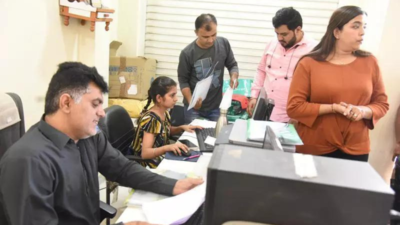
Mandhan, who hails from Ghotki town in Pakistan's Sindh province, and others also got their voting cards and are now eligible to vote in the assembly elections. Last week, they were addressed by community leaders, encouraging them to exercise their franchise.
Like Mandhan, Ravikumar Kukreja from Mirpur Mathelo and Ravi Nagdev from Usta Mohammed in Balochistan province too are among the latest additions to the voters' list. They all got Indian nationality through the normal process of naturalisation. The CAA has not been effective due to technical problem, including their names on the documents, they say.
Naturalisation calls for 12 years of stay in India, while CAA has a shorter process. Most of the citizenship applicants are Hindus from Sindh. If the Sindhi people are known for their distinct surnames in India, back in their homeland Pakistan, they face a kind of identity crisis, say community members. In their documents, including Pakistani passports, their names are simply suffixed with a Kumar for men or Bai or Devi for women. The authorities simply ignore their surnames and issue passports or identity cards with the first name and Kumar or Bai, claim the immigrants.
Starting lives afresh in India as they apply under CAA, a number of applicants have also added their surnames in the forms, only for the file to be rejected. The forms have to be uploaded in the citizenship portal and then verified with the original documents. Since the passports have no surnames, but the form mentions one, there is a mismatch, and the case is rejected. Over 150 to 160 applications have been rejected in Nagpur, with some pending even now. There is none in Nagpur possibly who got Indian nationality under CAA, said a source involved in the official process.
Rajesh Jhambia, secretary of Sindh Hindu Panchayat, the NGO which helps the immigrants, says in Pakistan there is no practice of adding surnames in the documents. In India, it is a part of the social practice. As the immigrants assimilate into Indian culture, even they are preferring to have surnames fixed to their names. "It's also a matter of asserting their identity. Having just the first name can lead to complications in procedures related to school admissions or other work. In India, just a Kumar or a Bai is not enough after the name. In some cases, even the middle name is missing in the Pakistani papers," says Jhambia.
Moreover, adding surnames is not new. Earlier, when citizenship was obtained through the home ministry, a surname could be added even if it was not there in the original papers issued in Pakistan, he said.
Even as some get citizenship under the regular process, there are families where some members are still waiting for their turn to get Indian nationality, said community sources.
Stay updated with the latest news on Times of India. Don't miss daily games like Crossword, Sudoku, and Mini Crossword.
End of Article
FOLLOW US ON SOCIAL MEDIA





Photostories

Hot Picks
TOP TRENDING
Explore Every Corner
Across The Globe
Popular Categories
Hot on the Web
Top Trends
Syrian Civil WarSunil GavaskarWho is Sanjay MalhotraShaheen AfridiMilwaukee Bucks vs Brooklyn NetsWho is Luigi MangioneMohammed SirajIPL 2025 Full Teams SquadRCB Team SquadDiljit Dosanjh Indore ConcertMike TysonHow to Apply Pan 2.0Rashid LatifMumbai Bus AccidentMohammed ShamiHardik PandyaUPSC Mains ResultLive Cricket Score
Trending Topics
Pushpa 2 America Box Office CollectionPushpa 2 ReviewUnitedhealthcare CEOWeight LossBhool Bhulaiyaa 3 OTTViral NewsAmitabh Bachchan HouseOptical illusionBhagavad GitaMukesh Ambani's Favorite FoodSnowfall in KashmirZodiac SignsHair RegrowSkincare Tips for WinterWeight Loss TipsHair FallMicrosoft 365 OutageNarayana MurthyElon Musk
Living and entertainment
Latest News
To-do list for RBI's new bossHow to make amla shot for instant hair growthMahira Khan's green saree is perfect for your friend's NikahRam Charan starrer 'RC16' to include THIS Bollywood superstar in a cameo role? Find outNEET PG 2024 counselling schedule revised: Check revised dates and important details hereEx-South Korea defence minister Kim Yong-Hyun accused of role in martial law tries to commit suicideaespa's Winter and ENHYPEN's Jungwon REACT to dating rumours following VIRAL postThe Luigi ‘solution’Pamela Anderson flaunts new look at Academy Luncheon, check out the PICS hereIndia makes breakthrough discovery in solar system with three sunsSports Ministry to organise national leaguesKaun Banega Crorepati 16: Can you guess the answer for Rs 25,00,000 question which contestant Ashutosh Singh could not answer?From Beyonce to Oprah: How much Kamala Harris' campaign spent on celebrity endorsementAmla Oil vs Rosemary Oil: Which is the best hair oil for winter hair growth?Who is Tony Buzbee? The lawyer who is taking on Jay-Z in Sean 'Diddy' Combs' civil casesWhat are India's choices for bowling line-up in Gabba showdownGerman Shepherding: An MLA who turned out to be a foreign citizenThe week that was in international affairs: Syrian spring? And South Korea’s abortive martial law
Copyright © 2024 Bennett, Coleman & Co. Ltd. All rights reserved. For reprint rights: Times Syndication Service