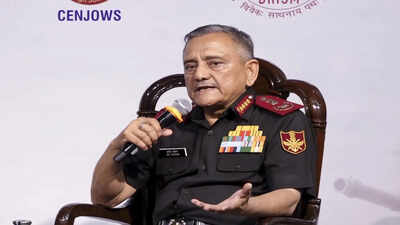
Chief of defence staff general Anil Chauhan, who is slated to retire this month, credited India’s dominance in the escalation matrix during
Operation Sindoor to integrated systems and superior situational awareness.
India's top general stated that over four days, Indian forces maintained the initiative through clearly defined objectives, timely intelligence, and coordinated responses that limited the need for large-scale kinetic action. General Chauhan described the operation as largely non-contact and non-kinetic, highlighting how information advantage translated into operational control.
CDS General Chauhan warned that future conflicts will increasingly be multi-domain, blending cyber, space, electronic, and conventional elements. Given India’s contested land borders, he argued, traditional single-domain approaches are inadequate. Clear objectives and exit strategies are essential to avoid protracted engagements; situational clarity, he said, prevents escalation from becoming open-ended and costly.
On institutional reform, the CDS stated that the primary barrier to theatre commands is cultural, not structural. “Once the mindset changes, structures follow,” he observed, noting extensive outreach to mid-level officers to build acceptance for joint warfighting.
He acknowledged that there is natural protectionism within the armed services but stressed that jointness enhances, rather than diminishes, each service’s contribution—especially when high-value assets are centrally managed to maximise their effect.
Acknowledging a capability gap, Chauhan conceded that India trails some peers by a decade or more in theatre command implementation. To close that gap, he advocated simultaneous, accelerated reforms across doctrine, organisation, and training. He pointed to rapid doctrinal output, noting that sixteen joint or domain-specific doctrines have been published in a compressed timeframe.
This, he said, demonstrates that institutional learning can be accelerated when priorities are aligned.
Practical challenges remain: standing up a tri-service Joint Operations Centre will require significant personnel and internal optimisation. Chauhan emphasised that manpower shortfalls must be addressed through restructuring rather than external recruitment, and that the proposed Data Command represents the next frontier for integration.
Chauhan framed reform as a continuous and irreversible effort. He expressed confidence that officers raised in a tri-service environment will carry the transformation forward more rapidly.
Chief of defence staff general Anil Chauhan, who is slated to retire this month, credited India’s dominance in the escalation matrix during Operation Sindoor to integrated systems and superior situational awareness.
India's top general stated that over four days, Indian forces maintained the initiative through clearly defined objectives, timely intelligence, and coordinated responses that limited the need for large-scale kinetic action. General Chauhan described the operation as largely non-contact and non-kinetic, highlighting how information advantage translated into operational control.
CDS General Chauhan warned that future conflicts will increasingly be multi-domain, blending cyber, space, electronic, and conventional elements. Given India’s contested land borders, he argued, traditional single-domain approaches are inadequate. Clear objectives and exit strategies are essential to avoid protracted engagements; situational clarity, he said, prevents escalation from becoming open-ended and costly.
On institutional reform, the CDS stated that the primary barrier to theatre commands is cultural, not structural. “Once the mindset changes, structures follow,” he observed, noting extensive outreach to mid-level officers to build acceptance for joint warfighting. He acknowledged that there is natural protectionism within the armed services but stressed that jointness enhances, rather than diminishes, each service’s contribution—especially when high-value assets are centrally managed to maximise their effect.
Acknowledging a capability gap, Chauhan conceded that India trails some peers by a decade or more in theatre command implementation. To close that gap, he advocated simultaneous, accelerated reforms across doctrine, organisation, and training. He pointed to rapid doctrinal output, noting that sixteen joint or domain-specific doctrines have been published in a compressed timeframe.
This, he said, demonstrates that institutional learning can be accelerated when priorities are aligned.
Practical challenges remain: standing up a tri-service Joint Operations Centre will require significant personnel and internal optimisation. Chauhan emphasised that manpower shortfalls must be addressed through restructuring rather than external recruitment, and that the proposed Data Command represents the next frontier for integration.
Chauhan framed reform as a continuous and irreversible effort. He expressed confidence that officers raised in a tri-service environment will carry the transformation forward more rapidly.