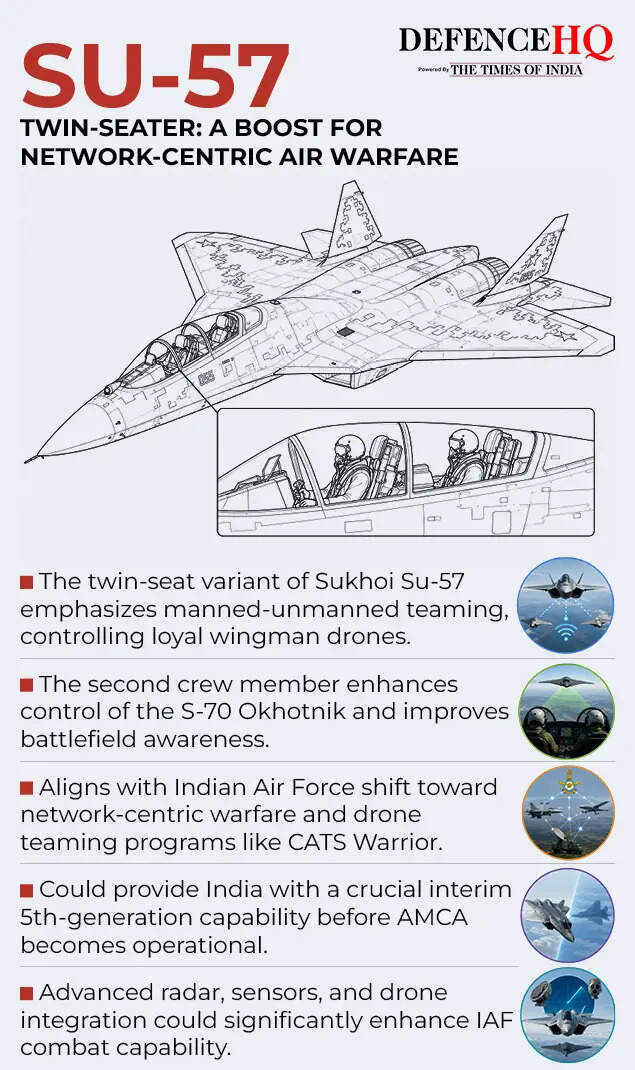
A new rendering of a two seater variant of the fifth-generation Su-57 aircraft has been released. This variant of the aircraft is said to be designated the Su-57D, according to Russian military blogger Ilya Tumanov (Fighter bomber), who has released the image. The image shows an enlarged cockpit section and a longer canopy, which will accommodate the second crew member. The stealthy Sukhoi-57 aircraft is an offshoot of the Indo-Russian joint effort called the Fifth-Generation Fighter Aircraft (FGFA). India was forced to walk away from the FGFA program and initiated its very own fifth-generation fighter programme titled the Advanced Medium Combat Aircraft (AMCA). The key point of contention between Moscow and New Delhi was over India's requirement of a two seat aircraft and Russia's insistence on a single seat variant only.

SU-57 Specifications
India is considering a fifth generation aircraft as the AMCA programme is not expected to deliver an operational variant before 2034-35 time frame. Although, prototype variants for testing and validation will take to the air much earlier. This leaves India at a disadvantage as the Chinese have been flying a stealthy J-20 fighter aircraft, even deploying them in the Tibetan plateau close to the border with India. Pakistan too is slated to procure a stealthy fifth generation fighter called the J-35, this aircraft too is of Chinese origin.
At the same time China is testing two sixth generation aircraft.
Russian Su-35 'Likely' Downed Ukrainian F-16 Over Sumy: Reports
With India’s own fifth Generation programme Advance Medium Combat Aircraft (AMCA) almost a decade away from induction, the immediate need for a stealth platform has brought Russia’s SU-57 back into focus. Su-57 is the being viewed as the most viable option for the Indian Air force as Moscow is offering Transfer of Technology (ToT) and local production to India. The unveiling of the two-seater variant of Su-57 will further boost India’s interest in the aircraft.
The induction of su-57 will significantly enhance IAF capabilities and its edge over its regional adversaries.
The Russian fighters’ capabilities includes: -· Equipped with advance Byelka AESA Radar, with multiple other radars providing a near 360-degree coverage.
· Integrated electronic warfare suites and sensor fusion technology.
· Its 101KS-V electro-optical targeting system allow it to track enemy aircraft without relying entirely on radar.
· With its Next-Generation Al-51 engines, will provide Higher thrust and better supercruise capabilities.
· Its stealth design makes it harder for enemy radars and air defence systems to track it.
· With a combat range of more than 1200 Kilometres, it can conduct long range air-superiority and strike missions without frequent refuelling.
SU-57 is being equipped with wide range of Advanced weapons(a) R-37M Ultra long-range air to air missile.
(b) R-77M Dual pulse BVR missile.
(c) KH-69 stealth cruise missile
(d) R-74M2 short range missile for dogfights.
Twin-Seater SU-57
The Twin seaters variant of Su-57 highlights Russia’s growing focus on manned-unmanned teaming concepts, where fighter jets operate and control the loyal wingman drones. The extra crew member will play a crucial role in controlling Russia’s S-70 Okhotnik stealth drone and overall situational awareness of the battlefield. For India it could be a highly significant as IAF is also moving towards future network-centric warfare and loyal wingman programmes like the CATS Warrior.
Amid the growing capabilities of India’s adversaries in the region, Su-57 could offer a crucial interim fifth generation capability before its own AMCA enters service. SU-57 combines with its powerful radars, sensor suits and loyal wingman operations could significantly strengthen the Indian Air Force combat capabilities.