
- News
- Education News
- News
- Rover Challenge
Trending
This story is from May 25, 2015
Rover Challenge
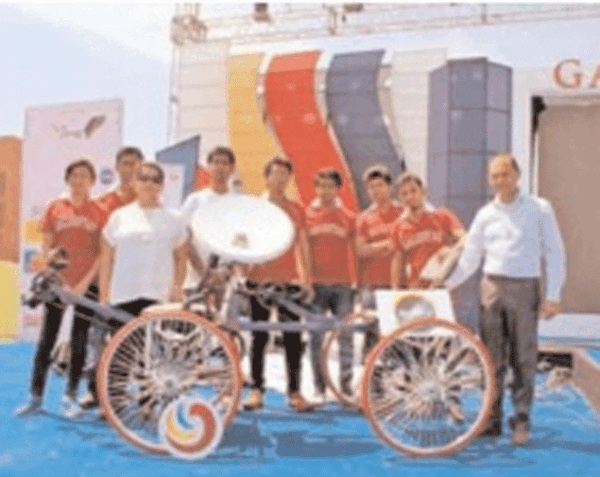
An eight-member team consisting of seven engineering students and faculty advisor and dean, (student affairs) Vinnie Mathur from Galgotias University recently visited NASA at Huntsville, Alabama, US, to participate in the NASA Human Exploration Rover Challenge. The team participated in the competition after being awarded the first prize at the national finale of the competition.

An eight-member team consisting of seven engineering students and faculty advisor and dean, (student affairs) Vinnie Mathur from Galgotias University recently visited NASA at Huntsville, Alabama, US, to participate in the NASA Human Exploration Rover Challenge. The team participated in the competition after being awarded the first prize at the national finale of the competition.
The Rover Challenge requires students to design, construct, test and race human-powered rovers through an obstacle course simulating the terrain potentially found on distant planets, asteroids or moons. Teams compete to finish an obstacle race in the fastest time, vying for prizes in various categories.
As part of the competition, students from Galgotias presented a moon buggy, a lunar roving vehicle created by them at the university workshop under the guidance of faculty members. Over 94 teams from across the globe participated in the contest. Team Galgotia finished the race in 24 minutes and 45 seconds to bag the 30th spot at the international finale.
The Rover Challenge required students to design, construct, test and race human-powered rovers through an obstacle course simulating a terrain, similar to what is found on distant planets, asteroids or moons. The teams then competed to finish the three quarter mile obstacle race.
Team Galgotias was the only group who used solid tyres rather than plastics or dunlop foam tyres as per NASA guidelines of not using pneumatic tyres.In line with NASA guidelines, the team manufactured solid tyres in a private rubber factory, based on a unique formula to make the rubber robust yet elastic, rather than using plastics or dunlop foam. This was done to avoid explosion due to the pressure difference on another planet surface.

The Rover Challenge requires students to design, construct, test and race human-powered rovers through an obstacle course simulating the terrain potentially found on distant planets, asteroids or moons. Teams compete to finish an obstacle race in the fastest time, vying for prizes in various categories.
As part of the competition, students from Galgotias presented a moon buggy, a lunar roving vehicle created by them at the university workshop under the guidance of faculty members. Over 94 teams from across the globe participated in the contest. Team Galgotia finished the race in 24 minutes and 45 seconds to bag the 30th spot at the international finale.
The Rover Challenge required students to design, construct, test and race human-powered rovers through an obstacle course simulating a terrain, similar to what is found on distant planets, asteroids or moons. The teams then competed to finish the three quarter mile obstacle race.
The moon buggy created by the students from Galgotia was made from the alloy of steel known as chrome moly (i.e.chromium and molybdenum) which is rarely available in India and had to be imported from Dubai. Apart from that, the frame had rear and front shock absorbers with springs below the driver's seat to prevent possible damage to the frame. The team (moonbuggy) had 18 gear speed ratios that allowed the team to obtain a wide range of speed-torque combinations depending on the terrain on which they drove.
Team Galgotias was the only group who used solid tyres rather than plastics or dunlop foam tyres as per NASA guidelines of not using pneumatic tyres.In line with NASA guidelines, the team manufactured solid tyres in a private rubber factory, based on a unique formula to make the rubber robust yet elastic, rather than using plastics or dunlop foam. This was done to avoid explosion due to the pressure difference on another planet surface.
End of Article
FOLLOW US ON SOCIAL MEDIA
Visual Stories








Hot Picks
TOP TRENDING
Trending Stories
In Education
Entire Website
- CBSE issues important notice for parents on the correct submission of students' registration data; check details here
- Supreme Court questions change in NEET-PG pattern, seeks response of NBE and Centre
- UGC NET Result 2024 Live Updates: NTA to release UGC NET Result 2024, final answer key soon at ugcnet.nta.ac.in
- TS PGECET 2024 counselling phase 2 schedule released: Check important dates, registration fees, and other details here
- KEA KCET, NEET UG 2024 Round 2 Provisional Seat Allotment Results Released at kea.kar.nic.in
- RPSC RAS 2024 Registration Open: Apply at rpsc.rajasthan.gov.in Before October 18, Check Direct Link Here
- Tripura NEET UG 2024 counselling round 2 provisional merit list released: Check direct link here
- OTET Answer Key 2024 released at bseodisha.ac.in, raise objections till Sept 28: Subject-wise direct links here
- WB NEET UG 2024 counselling schedule revised: Check important dates here
- NEET MDS Revised Cut-off 2024: Ministry of Health reduces qualifying cut-off by 21.692 percentile, NBEMS to release revised results
- 'Detonators' put on way of Army train set off alarm
- Sri Lanka gets Leftist prez, India challenge in man not acquainted with
- No added sugar or sweet lies? How health-washing is misleading us
- PM Modi expresses 'deep concern' on humanitarian situation in Gaza
- Arvind Kejriwal slams PM Modi, poses five queries to RSS chief
- Watch: Team India's 'Rohit Sharma walk' to celebrate Chess Olympiad golds
- Why the biggest successes of India’s Project Cheetah are also its biggest worries
- Dating scam: How a woman lost Rs 3.37 lakh in 'friendship fraud' on Tinder
- Will Trump make another run for President if he loses in 2024?
- Modi & Indian diaspora: A night of culture, music and celebration in NY

Popular Categories
Hot on the Web
Top Trends
Trending Topics
Daughter's Day WishesDaughter's Day 2024 WishesAbdu RozikMukesh KhannaJayamSana Khan HusbandTirupati Laddoo ControversyGOAT CollectionVaazha OTT ReviewKozhipannai Chelladurai ReviewCheetahsKangana RanautAditi Rao HydariDalljiet KaurHoliday DestinationVikas SethiBest Selling Earbuds Under 1000Apple iPhone 16 ProVirat KohliWordle Answer
Living and entertainment
Latest News
What is the 30-30-30 weight loss method? How to do it for maximum benefits?Why Rahul Gandhi is off the mark when it comes to SikhsArvind Kejriwal slams PM Modi, poses five queries to RSS chief6 telltale signs your partner is still not over their exTulsi Gabbard recalls when she was told 'how dare you meet Donald Trump' in 2016Gemini, Daily Horoscope Today, September 23, 2024: Face financial strain today with expenses outpacing incomeBloated tummy woes? Common remedies to get rid of gas and bloatingAmerica-India is the AI power of the new world: PM ModiAishwarya Rai set to take the Paris Fashion Week by storm; reaches the venue with daughter Aaradhya Bachchan - WATCH videosPisces, Daily Horoscope Today, September 23, 2024: Day marked by restlessness and a need for changeJey Uso Takes a Shot at Goldberg and Bron Breakker Over Their Recent PictureImran Khan should get to next level: Khalid JamilMom seeks votes for son in Uchana, resumed Hari Chunri Chaupal eventWhen Deepika Padukone and Ranveer Singh took on the viral 'silhouette challenge'; shared a fun video - WATCHDating scam: How a woman lost Rs 3.37 lakh in 'friendship fraud' on Tinder and was saved from further lossFinal debate showdown: Will Trump let Vance take the spotlight?PM Modi expresses 'deep concern' on humanitarian situation GazaRahul urges people to visit Wayanad, revive tourism there
Copyright © 2024 Bennett, Coleman & Co. Ltd. All rights reserved. For reprint rights: Times Syndication Service