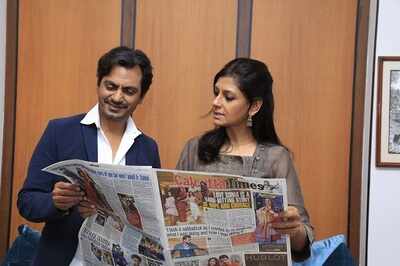
She didn’t think of another film till she rediscovered Manto through his writings and of those who wrote about him during his centenary celebrations. And what
Nandita Das developed as a film in Manto eventually became a whirlpool that sucked the actors in. No wonder,
Nawazuddin Siddiqui, who played Manto, found it hard to come out of the zone days after the film’s shoot got over. In town on Thursday, they opened up on the impact of Manto on their lives. Excerpts:
At what age did you discover Manto’s writings?
Nandita: When I was in college. I saw a play done on his story. That’s when I was introduced to Manto. I was like who is this Manto? Kinka natak hai? When I came out of the play, all of his works were being sold outside in a small bookstore. I bought that; this was many, many years back. Again in 2012, I rediscovered him. His centenary celebrations were going on. A lot of people had written about him at that time — what was he like as a person, what were his struggles… Also, his essays started getting translated. That’s when I started reading about him and I was like, ‘Wow, this man is just as fascinating as his stories’.
Nawazuddin: Maine unki story ki thi 1992 mein (on stage) ek amateur group ke saath. Phir jab main NSD karta tha, maine performance dekhi thi unke stories ki. Manto ke baare mein zyada idea nahin tha. Jab hum mile toh ek zikr hua tha. Nandita ne kaha, ‘Manto ke upar main kuchh karna chahti hoon’. Inhone research ki aur uss ke baad mujhe pehli baar pata chala Manto ke baare mein, unka world, unka thoughts, habits, behaviour, characteristics.
As an actor, mujhe kaam karne mein asaani hui, kyun ki bahut difficult character tha. Unn ke andar emotions jo hai — angst, arrogance, humour — sab picture mein hai.
Manto died at a young age. Was it tough discovering him as a person as not many people can recall real-life incidents?
Nandita: As an author, he was very prolific. He had written both fiction and non-fiction. To know him as a person, I went to Lahore to meet his family. I have been in touch with them. His wife’s sister is one of those who have strong memories of him. She is 75, or maybe a little more. A film is not just about one person, but everyone who shared some kind of a relationship with him. Thanks to the family, I learnt a great deal about his wife, Safiyah.
In 2015, there was a film called Manto in Pakistan. Did you get to watch it?
Nandita: I am aware of it. It was made by Sarmad Khoosat. But I didn’t want to watch it. In 2012, I started researching, the structure was already conceived. I met Sarmad and we did some sessions together on Manto. One was in Lahore, another in Delhi. The periods in our films are different. Sarmad’s film begins where my film ends. He took the last three years, whereas my period is 1945-1950 and he died in 1955. Also, the take and treatments are completely different. I feel the more the merrier. Manto had a very interesting and multi-faceted life; everything is an interpretation. There’s no audio-visual recording of his and we are all interpreting him with all that we have.
Five of his stories have been woven into the film. Which is the one that you find the most interesting?
Nandita: There have been several screenings and different people responded to different stories. That’s what cinema is about, right? You watch out for your life experiences and react to those that move you. Some people were like, ‘Oh, I love this story’, others were like, ‘Oh, that is so much more powerful’. When I did Firaaq, it was the same. It was an ensemble film with five different stories. Everybody liked a different story. Manto wrote close to 300 stories, among them 20-25 are my absolute favourites. Of which I have taken five. Every story of his is unique and it’s difficult to zero in on one. It shows things you in a way know but there’s something new in the way they are presented. All the stories are very unsettling.
What was the reason for such a long break
after Firaaq?
Nandita: In 2008, Firaaq came out. I travelled to a few festivals with the film and then I hadn’t planned another film. I was not sure if I wanted to do another film. In 2009, I was appointed the chairperson of the Children’s Film Society. I was very busy with that. Even if it was an honorary job and you could do as little as you wanted, I took it up very seriously. I was busy with that till 2012. Then during Manto’s centenary celebrations, so much was written about him and I started reading up. I thought these were very interesting. I read some more and re-read the old stories and I looked for the essays. I was finding some words tough, I was generally exploring. Then through that research and exploration, I thought why not take it forward.
Manto was shown in the Un Certain Regard section at Festival de Cannes. What was the reaction?
Nandita: Cannes is unique; it’s not only an audience festival. It’s a festival of film professionals, so there’s always a discerning audience. We were a little nervous as it was our first screening and Nawaz, of course, was there with other people. It was absolutely wonderful.
Nawazuddin: Bahut bahut achha tha. I saw the film for the first time at the Cannes film festival. Mujhe pata nahin tha ki response aise ayega.
Nandita: Haan he had not seen the film before. There was a standing ovation for five minutes.
Nawazuddin: Feedback bahut hi overwhelming tha.
Nawazuddin, you were even being compared with Italian actor Marcello Mastroianni in terms of looks. You had told us in an earlier interview that when you were entering this industry, both TV and films were ruled by conventional good-lookers…
Nandita: Chocolate boys… Good-looking is a relative term. I think Nawaz is very good-looking. He has chiselled features and powerful eyes.
Nawazuddin: Haan, padha tha maine…
Nandita: Tabhi toh lag raha hai shakal se ki padha tha (laughs)… He has got praise across board and people have loved him.
Having done so many roles across mediums, what struck you the most when you did Manto?
Nawazuddin: Manto mein bahut sari khaasiyat hai. Ek toh meri sensibility ka role hai, no doubt. Main chahta tha ki kabhi mujhe aisa role mile jo meri sensibility ke saath match karta ho. Main bol nahin pata hoon utna real life mein, jo thoughts hai mere woh express nahin kar pata, but yehi faida hai films ka, aap character ke through apni sari baat bol sakte ho jo aap real-life mein bol nahin pate. Sach ko digest karna bahut mushkil hai aaj ke time pe.
Nandita, did you write the role keeping him in mind?
Nandita: When I started researching, I just wanted to do the film. But as I started working on the story, I started seeing him in the role.
Firaaq was set in the backdrop of Gujarat riots. That was something we have seen. But to create the Hindu-Muslim riots during Partition must have been immensely more difficult as that’s an era you have not seen…
Nandita: Manto’s Partition stories are not about the masses; they are intimate stories about individuals. The film also looks at Partition through his sharp gaze. It’s the same perspective on that era. I have kept the lens very intimate. In that sense, Firaaq was much easier as it was a work of fiction. It was based on true events, but I could still create composite characters, give them the lines I wanted to. This too is a work of fiction, but it’s completely based on reality. Ninety per cent of the dialogues are things that Manto had written. Apart from two-three, all other characters are real. So, I had to research each one of them so that their equations with Manto came out authentically.
Manto was tried six times for obscenity in his writings, but was not convicted even once. The film also raises the issue of censorship. Do you feel it’s the same even in today’s time?
Nandita:Yes, there’s censorship even now; though it’s of a different kind. We have a censor board and only a few people decide what the country is going to watch — if they will get a U or a U/A certificate etc. Then we have self-proclaimed custodians of culture, who decide what we should wear, read… then a lot of artistes are censoring themselves. So, there’s censorship in many ways and freedom of expression is being threatened.
Is the digital medium challenging Indian
censorship?
Nandita: Mujhe nahin lagta ki challenge karne ke liye kar rahein hain. But yes, there’s no censorship of digital content. But yeh toh ek tarah ka hypocrisy hua na? A lot of committees have now been formed to look into the way our films are censored, Shyam Benegal is heading a committee to see how things can change for the better. So, work is on. Prasoon Joshi is helming the censor board and it’s good as he is a writer himself. He will bring more openness to the board.
Nawazuddin: Uss mein koi doubt nahin hai.
What was the shooting experience like?
Nawazuddin: Uss waqt mein toh main bilkul Manto ke zone mein hi tha. Kai saalon ke baad ek waqt mila tha jab aap puri tarah se honest ho sakte thay apne thoughts ko leke. Kyun ki Manto ke thoughts mere thoughts thay. Aise har aadmi ko lagta hai, mujhe bhi lagta hai. Jo dekha wohi likha unhone, apne life mein hamesha sach bola. Mujhe lagta tha ki main aise insaan ka character kar raha hoon jiske jaisa main hona chahta tha. You know, but nahin ho paate hum log. Hum sach toh bolna chahte hain but samne wala uss ko digest nahin kar pata. Society ki foundation hi uss pe garha gaya hai. I was like thank god meri life mein yeh opportunity ayi hai ki jitna mera sach hai main apne character ke through bol doon. Woh time jo tha mere liye bahut bhari bhi para. Kya hota hai, real aur reel life blur ho jata hai. Main itna hi Manto ke zone mein tha ki main jo bhi bolta tha, sach bolta tha… bahut saare logon ko bura bhi laga. Mujhe bhi baad mein laga, ki yaar maine yeh kya bol diya. Mujhe laga Manto bahut bhari par jayega.
Though directors don’t have gender identity, a woman director in India is always called a ‘woman director’ but directors who are men are just directors. What would you say on such labelling?
Nawazuddin: (Breaks into laugh) Sahi hai.
Nandita: That’s the reality. It’s a male-dominated industry and there’s no doubt about it. The percentage of woman directors everywhere in the world is very small. Yahan pe to aur bhi… I have kind of resisted these labels for a long time. But now that we are talking so much about it, we do need more women directors. Till I don’t own the fact that I am a woman director, how can we say we want more women directors? But when I am working, I am not thinking like a ‘woman director’. Nawaz also said, ‘To me, she is just a director’. But my being a woman also has an impact — my sensibilities, the way I look at things. There’s no violence in the film. Someone came and told me that from the film, you can make out that it’s been made by a woman. I was like, ‘Why did you say that?’ That person said had it been made by a man there would have been a lot more violence.
Nawazuddin, you are working with three woman directors simultaneously — Nandita Das,
Tannishtha Chatterjee and Debamitra Hassan. Do you see any difference in the way they go about films?
Nawazuddin: As an actor aap ka point of view aur enhanced hota hai. Hum log hamesha male point of view se dekhte hai. Main bhi ussi point of view se dekhta hoon. Iss mein mujhe world ko doosre nazariyan se dekhne ko mila, usse actor jo hai mujh mein wohi enriched hua hai. Main khud hua hoon. Yeh jo nazariya hai, humne laakhon, hazaaron saalo se avoid kiya hai. Hum uss nazariyan se dekhna hi nahin chahte thay world ko. Par main fortunate hoon ki mujhe woh dekhne ka mauka mila. Scene ko treat karne ka nazariya alag tha. Uss mein logic tha, par woh male ke nazariyan se thoda alag tha. Creativity thi uss mein. Par jo hum dekhna nahin chahte thay, mujhe dekhne ko mila, mera actor hi bada hua usse.
Nandita started out as an actress and got into direction, would you like to follow suit?
Nawazuddin: Main? Mere bas ka nahin hai. Maine inki halat dekhi hai.
Nandita: He had seen me suffer!
Nawazuddin: Itni sari departments sambhalni padti hai! Mai toh ghore ki naal ki tarah acting ko hi bas dekhta hoon. Direction bahut difficult hai.