- News
- entertainment
- events
- bhopal
- The museum is capable of creating a new future image for communities - Prof. Kishor K. Basa
Trending
This story is from June 22, 2020
The museum is capable of creating a new future image for communities - Prof. Kishor K. Basa
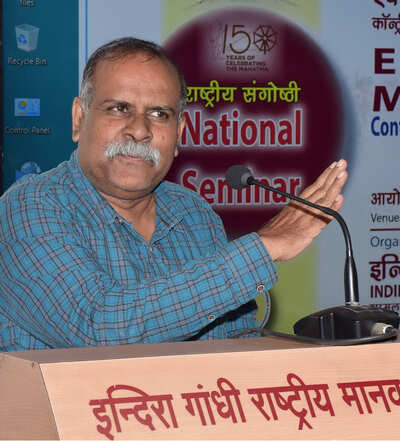
Under the Annual Lecture series of Indira Gandhi Rashtriya Manav Sangrahalaya (IGRMS), Bhopal Prof. Kishor K. Basa, Tagore National Fellow and Ex-Director of IGRMS Bhopal delivered a lecture on Anthropology and Museums in India: Trends and Trajectories (in the form of a webinar) via facebook. At the beginning of the program, Shri Dilip Singh, Joint Director, IGRMS Introduced the Prof. Basa.
Basa.
Professor Basa's told that his lecture comprised three sections. In the first section he discussed anthropology and museums during the colonial period from 1784 to 1947, the period which witnessed the emergence of anthropology and museums in India as distinct disciplines. While anthropology (it was also known as ethnology) was initiated to understand the 'native' cultures in order to enable the British for an effective administration, museums developed to act as a repository of the material cultures collected from various 'native' communities. The establishment of the Asiatic Society of Bengal in Kolkata in 1784 laid the foundation for such studies in India. Basa gave examples of two leading colonial museums. While Indian Museum, set up in 1814 was one of the oldest museums in the world, Madras Museum was set up in 1851. By demonstrating the native communities and their material culture as culturally inferior to the 'civilised' Europeans, both anthropology and museum during the colonial period provided legitimacy to the British rule in India. Basa argued that museum visit as a part of pilgrimage to Kolkata by rural folks of India during colonial period is a typical Indian response to a concept (i. e. Museum) brought from the West. He also showed how Viceroy Lord Curzon (1899-1905) also added to the collection in Indian Museum.
Professor Basa's told that his lecture comprised three sections. In the first section he discussed anthropology and museums during the colonial period from 1784 to 1947, the period which witnessed the emergence of anthropology and museums in India as distinct disciplines. While anthropology (it was also known as ethnology) was initiated to understand the 'native' cultures in order to enable the British for an effective administration, museums developed to act as a repository of the material cultures collected from various 'native' communities. The establishment of the Asiatic Society of Bengal in Kolkata in 1784 laid the foundation for such studies in India. Basa gave examples of two leading colonial museums. While Indian Museum, set up in 1814 was one of the oldest museums in the world, Madras Museum was set up in 1851. By demonstrating the native communities and their material culture as culturally inferior to the 'civilised' Europeans, both anthropology and museum during the colonial period provided legitimacy to the British rule in India. Basa argued that museum visit as a part of pilgrimage to Kolkata by rural folks of India during colonial period is a typical Indian response to a concept (i. e. Museum) brought from the West. He also showed how Viceroy Lord Curzon (1899-1905) also added to the collection in Indian Museum.
End of Article
FOLLOW US ON SOCIAL MEDIA







entertainment videos
Featured In Movies

Popular Categories
Entertainment NewsBollywood NewsTollywood NewsKollywood NewsMollywood NewsMovie ReviewsLatest Hindi MoviesLatest Tamil MoviesMX PlayerParenting TipsHome RemediesWeight LossBeauty TipsParenting TipsHindi VideosHindi Video SongsBhojpuri Music VideosLatest Telugu MoviesBhojpuri Music VideoHindi TV News
Trending in Entertainment
Latest MoviesBollywood MoviesHollywood MoviesTamil Movies 2024Telugu Movies 2024Malayalam Movies 2024Kannada Movies 2024Marathi Movies 2024Bengali Movies 2024Top Rated Movies 2024Best Hindi MoviesBest English MoviesBest Telugu MoviesBest Tamil MoviesBest Malayalam MoviesBest Kannada MoviesBest Bengali MoviesUpcoming Hindi MoviesBest Movies Of All TimeBest Hindi Movies of All Time
Trending in Etimes
Horoscope TodayNumerology Predictions TodayKamala HarrisRobert F Kennedy JrBarron TrumpElon MuskAnna Paulina LunaJustin TrudeauTrump Town Hall Key TakeawaysInternational Day of PeaceDonald TrumpSNL 50 SeasonKamala HarrisSituationship TipsUsha UthupRelationship TipsSean Diddy CombsAlzheimers DiseaseJennifer Lopez
Trending in TV
Trending in Lifestyle
Trending in Regional
Movie Reviews
Yudhra ReviewJo Tera Hai Woh Mera Hai ReviewKahan Shuru Kahan Khatam ReviewHis Three Daughters ReviewNever Let Go ReviewDancing Village: The Curse Begins ReviewTransformers One ReviewFirst Love ReviewBerlin ReviewThe Buckingham Murders ReviewSpeak No Evil ReviewVisfot ReviewThalapathy Is The G.O.A.T ReviewRebel Ridge Review
Upcoming Hindi Movies
Upcoming Regional Movies
Latest News
Olivia Munn and John Mulaney welcome second daughter via surrogateNaseeruddin Shah, Ratna Pathak Shah bring old world charm to DelhiBigg Boss Tamil 8: VJ Jacquline to participate in the upcoming season?Kim Jung-nan chooses Song Joong-ki as most appealing actor, praising his care and leadershipYour Birth Chart Explained: Unlocking the Secrets of Your Cosmic BlueprintGoogle CEO Sundar Pichai after meeting PM Narendra Modi in US: “He pushed us to continue..”Alia Bhatt reveals Ranbir Kapoor sings Malayalam lullaby 'Unni Vavavo' to daughter Raha Kapoor: 'She cues, ‘Mumma vavo, papa vavo’'How Sachin Tendulkar became 'The Little Master'Amid Odisha custody abuse row, Puja held at police station; CCTVs installedBest Time To Upgrade To 4G & 5G Tablets: Lightning-Fast Performance At Unbeatable PricesEssential tips for building and maintaining a happy marriageTirupati Laddoo Controversy: What is Beef Tallow and why was it added'Show proof or face ... ': Himachal Congress warns Kangana Ranaut over her 'foolish' statement on state funds being diverted to Sonia GandhiTrump attempted assassination suspect Ryan Routh to appear in courtSwara Bhasker reveals pre-wedding fear about marrying Fahad Ahmad; Says, 'I will not be called for Bollywood Diwali parties'Nitanshi Goel on 'Laapataa Ladies' Oscar entry: I am full of goosebumps- Exclusive!Exclusive - Monika Singh: Main focus will be on weight loss and taking care of my health, this is what I plan to gift myself on my birthdayBengaluru women's dismemberment case: Police identify ‘outsider’ as prime suspect in gruesome murder
Other Group Sites -
ETimes is an Entertainment, TV & Lifestyle industrys promotional website and carries advertorials and native advertising.