
- ETimes
- Movies
- Movie Reviews
- Hindi
- Maa Behen

Maa Behen
2 hrs 2 minsReleased: 4 Jun, 2026
Hindi
Comedy
, Crime
& Drama
3.5
Critic's Rating
3.5
Users' Rating
About the Movie
An entertaining crime-comedy that never turns into a pity party, Maa Behen has no interest in reforming society's self-appointed moral guardians. Instead, it offers women a far simpler solution: why care?
Cast





Maa Behen Movie Review: A sharp satire on society’s discomfort with female autonomy

3.5
Direction
4.0
Dialogues
3.5
Story
3.0
Music
3.0
Visual Appeal
*The overall critic’s rating is not an average of the sub scores above
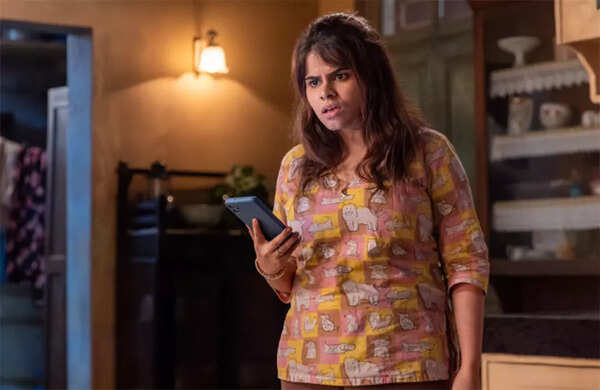
Story: Set in the conservative north Indian Adarsh Colony, single and glamorous mother Rekha (Madhuri Dixit) makes a hysterical late-night phone call to her daughters, Jaya (Triptii Dimri) and Sushma (Dharna Durga), summoning them home after discovering the dead body of her nosy neighbour, Guptaji (Ravi Kishan), inside her house.Review: As the estranged and constantly bickering sisters reluctantly reunite with their seemingly reckless mother, the chaotic trio scrambles to figure out how to manage the crime scene. But there's a twist lurking around the corner that none of them see coming.Director Suresh Triveni (Jalsa, Tumhari Sulu) uses humour layered with tragedy to hold up a mirror to a society that views women simply existing on their own with suspicion. The resemblance to actress Rekha and the long-standing gossip surrounding her personal life and marital status inevitably come to mind. How can women thrive without being subject to the watchful gaze of men? Society's inability to process that question forms the heart of this sharply written story by Triveni and Pooja Tolani.What makes this crime-comedy particularly refreshing is that it never turns into a pity party. These women choose joy, beauty and humour even in the face of adversity. They refuse to be miserable. The characters are wonderfully written and couldn't care less about "log kya kahenge" because they have far more pressing concerns—like survival. The film delivers a stinging rebuke to the notion that if a woman isn't a bechari or abla naari, she must automatically be labelled a daayan.Lewd graffiti and taunts such as "Rekha ka Dekha?" are scrawled across the walls outside their bungalow by neighbourhood gossips and rumour-mongers. The casual normalisation of this harassment and Rekha's need to smile through it if she wishes to survive in the locality is one of the film's most heartbreaking observations. It brings to mind the much-debated viral reel of a Rajasthani woman who asks, "Kapde ho gaye chhote, toh sharm kahan se aaye?", taking aim at so-called modern women. Maa Behen takes on this internalised patriarchy that compels women to police and shame one another. At its core, it is a reflection on society's deep discomfort with women living without men. Similar themes were explored with remarkable sensitivity in Tribeny Rai's Nepali-language drama Shape of Momo, which examined how independent women are often treated as public spectacles open to scrutiny and judgement.Set largely within the confines of a spacious but ageing house, this is far from a one-woman show. The banter between the three women keeps the narrative crackling. Madhuri Dixit, Triptii Dimri and Dharna Durga are an absolute riot together. Their chemistry is delightfully unhinged and electric. The last time a female ensemble generated this kind of effortless camaraderie was in Crew. The madness is infectious, but so are the quieter moments when the film pauses to acknowledge the pain, resentment and grief buried beneath the laughter. Every character gets their due, including Mrs Gupta, played with remarkable depth by Geetanjali Kulkarni.Madhuri is perfectly cast as the sweet seductress with a heart. Gorgeous in every frame, she nails both the comic timing and the north Indian dialect. Triptii shines as the fiercely protective daughter who is forced to hold her family together while constantly defending her mother's unconventional choices. She establishes herself as one of the most formidable acting talents of today. Dharna makes a confident acting debut and more than holds her own despite sharing screen space with two established performers. Ravi Kishan lends strong support with his commanding presence.The film begins on a high, remains engaging for the most part, but does lose momentum in the middle as certain portions feel repetitive. Fortunately, it regains its footing and builds towards a powerful climax. The final scene, in particular, leaves a lasting impression and lingers long after the credits roll.An entertaining crime-comedy, Maa Behen has no interest in reforming society's self-appointed moral guardians. Instead, it offers women a far simpler solution: why care? If they insist on calling you chaalu, chhichori or worse, wear that lipstick, drape that sari and carry on anyway.
User Reviews
0/1500
Post ReviewTrailer

'Maa Behen' Teaser: Madhuri Dixit and Triptii Dimri starrer 'Maa Behen' Official Teaser
Videos


Photos




1 More Photos
Latest Movie Reviews


How would you rate the movie?


Hot on the Web
Aamir KhanPahlaj Nihalani Death NewsShah Rukh KhanPeddi ReviewKJR RajeshKangana RanautHeart HealthGaurav GeraAhaan PandayBigg Boss Kannada 13Shilpa ShindeArchana Puran SinghKedarnath DhamKushboo SundarKheera VS KakdiDalchini Water BenefitsPeddi ReviewProtein Powder RiskBarack Obama QuoteSouth Delhi Restaurant TragedyPeabo Bryson Death NewsDeepika PadukoneUpasana KamineniDrishyam 3 Box Office CollectionKaruppu Box Office CollectionDhurandhar 2 Box Office CollectionChand Mera Dil Box Office CollectionYashAjay DevgnHoroscope TodayDelhi Malviya Nagar Fire4th Squadron S-400India Sudarshan ChakraFirstcry CompensationIAF France Jet DealHuman Evolving On Tibetan PlateauLargest Islands In The WorldJellyfish That Never DiesGoogle Release MosquitoesDelivery Firm Refund DeniedNyt ConnectionsCaptions For Instagram Posts
Trending Topics
Latest MoviesBollywood MoviesHollywood MoviesTamil Movies 2026Telugu Movies 2026Malayalam Movies 2026Kannada MoviesMarathi MoviesBengali Movies 2026Top Rated Movies 2026Best Hindi MoviesBest English MoviesBest Telugu MoviesBest Tamil MoviesBest Malayalam MoviesBest Kannada MoviesBest Bengali MoviesUpcoming Hindi MoviesBest Movies Of All TimeBest Hindi Movies of All TimeLatest English MoviesLatest Malayalam MoviesEnglish TV NewsTamil TV NewsTelugu TV NewsMalayalam TV NewsKannada TV NewsMovie ReviewsBhojpuri Cinema NewsGujarati Cinema News
Popular Categories
Viral NewsK Pop NewsWeb Series NewsAnime NewsUpcoming English MoviesUpcoming Tamil MoviesUpcoming Telugu MoviesUpcoming Malayalam MoviesUpcoming Kannada MoviesFashion TipsTravel NewsEntertainment NewsBollywood NewsTollywood NewsKollywood NewsMollywood NewsFood NewsLatest Hindi MoviesLatest Tamil MoviesParenting TipsHome RemediesWeight LossBeauty TipsParenting TipsHindi VideosHindi Video SongsBhojpuri Music VideosLatest Telugu MoviesBhojpuri Music VideoHindi TV News
Latest News
Hazaribag man drowns while fishing in lake"Behen Darr Gayi!": Fans relive ‘Bhagam Bhag’ era after watching Akshay Kumar's 'Bhooth Bangla' trailerMBOSE HSLC result 2026 to release tomorrow: Check details hereIran war risk: JPMorgan CEO Jamie Dimon warns of oil shocks, sticky inflation and higher interest ratesMake your clutch last longer with these easy driving tips“Three-against-one situation”: El Rubius opens up on being “targeted” in MrBeast’s viral $1M challengeBihar BTSC lab assistant notification released for 1091 posts at btsc.bihar.gov.in; apply hereIPL craze costs techie Rs 1.46 lakh in fake RCB vs CSK ticket scamRaising “robot-proof” kids: Why creativity and curiosity matter more than everInside ‘Satguru Sharan’: Exploring Saif Ali Khan and Kareena Kapoor Khan’s Rs 100 crore Bandra homeHow selling Alaska in 1867 was a costly mistake for Russia'Hera Pheri 3 is coming': Paresh Rawal dismisses delay reports and reveals he will 'start shooting soon'US-Iran War: A daring rescue Hollywood blockbuster is on its way. Till then, pick your favourite from these 10 films on bringing someone home against all oddsKolkata team unveils fan mural at Rash Behari Avenue, celebrating city’s first loveHow US spread a lie to rescue a pilot of a jet shot down in IranNetflix unveils ‘VOID’, an AI model that can change a movie plotAI data centers are causing 'stress' not just to tech companies, but also private insurers"Trans women are.....": Clavicular’s viral moment with trans women sparks fresh conversation on internet culture