Trending
Mohamed Rafiq Khan, a carpenter from Bhopal, secured India’s first Chess Olympiad medal in 1980; know more about him
India secured a historic achievement by winning two gold medals at the 45th Chess Olympiad, claiming victories in both the Open and Women’s sections for the first time. The Indian men’s team triumphed over Slovenia, while the women’s team defeated Azerbaijan in the decisive final round to earn top honours.
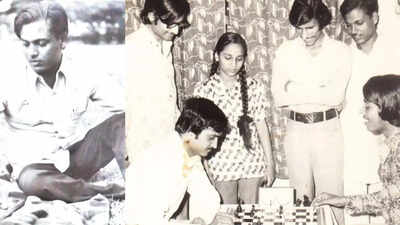
Image source: ChessBase India
Previously, the Indian men’s team had won two bronze medals in 2014 and 2022, and the women’s team earned bronze at the 2022 Olympiad in Chennai.
Interestingly, India’s first Chess Olympiad medal was won back in 1980, long before the legendary Viswanathan Anand became the nation’s first Grandmaster in 1988. That inaugural medal came from Mohamed Rafiq Khan, who took home the silver playing for the third board at the Malta Olympiad.
Who is Rafiq Khan?
Rafiq Khan's story is remarkable, showcasing how he overcame significant challenges, including poverty, to achieve success in a sport that wasn't widely celebrated in India. Born on July 12, 1946, in Bhopal, Madhya Pradesh, Rafiq grew up in a modest household; his father was a carpenter, and Rafiq himself worked in the same trade without any formal education.
His fascination with chess began as he observed local players engaged in matches at a tea stall in Bhopal. “He never had formal education. Instead, he helped his father. After work, he would visit a nearby tea stall where chess enthusiasts gathered. That’s how he developed his interest in the game,” recalled his former teammate, Rajesh Bahadur. Rafiq’s chess journey took off when he entered the Madhya Pradesh chess championship in April 1975, where he surprised everyone by winning against several well-known National ‘A’ players, including Syed Nawab Ali, who had represented India at the Varna Olympiad.
Rafiq Khan’s national achievements and historic victories
Following that victory, Rafiq finished second at the 13th National ‘B’ tournament in Patna in June 1975, earning a spot in the National ‘A’ circuit. His standout moment came in June 1976 at the 14th National ‘B’ in Calcutta, where he achieved an extraordinary 11 wins, including nine consecutive victories, ultimately finishing with a remarkable 13 points.
In 1978, Rafiq became the National Champion by winning the 17th National ‘A’ held in Cochin. “In 1976, he set a record in Kolkata that still stands. Competing in National ‘B’, he secured 11 straight wins before drawing his next four games to win the championship. He was crowned national champion in 1978,” Bahadur added. Despite lacking formal training, Rafiq’s swift ascent in chess led to multiple job offers. He initially worked for the Bhopal Municipal Corporation but had to leave due to tournament restrictions. He later found employment with Bharat Heavy Electricals Limited (BHEL) in 1977, which provided him the financial stability and freedom to pursue chess.
This opportunity paved the way for Rafiq to win India’s first medal at the Chess Olympiad in 1980. In Malta, he achieved a score of 10 out of 13, earning the silver medal for the second-best performance on board three. He also won the prestigious Piloo Modi tournament in 1984, 1986, and 1992.
Also Read | Notable women directors whose films represented India at the Oscars

About the Author
TOI Lifestyle DeskEnd of Article
FOLLOW US ON SOCIAL MEDIA
Visual Stories



Featured In Lifestyle

Popular Categories
Entertainment NewsBollywood NewsTollywood NewsKollywood NewsMollywood NewsMovie ReviewsLatest Hindi MoviesLatest Tamil MoviesMX PlayerParenting TipsHome RemediesWeight LossBeauty TipsParenting TipsHindi VideosHindi Video SongsBhojpuri Music VideosLatest Telugu MoviesBhojpuri Music VideoHindi TV News
Trending in Entertainment
Latest MoviesBollywood MoviesHollywood MoviesTamil Movies 2024Telugu Movies 2024Malayalam Movies 2024Kannada Movies 2024Marathi Movies 2024Bengali Movies 2024Top Rated Movies 2024Best Hindi MoviesBest English MoviesBest Telugu MoviesBest Tamil MoviesBest Malayalam MoviesBest Kannada MoviesBest Bengali MoviesUpcoming Hindi MoviesBest Movies Of All TimeBest Hindi Movies of All Time
Trending in Etimes
Horoscope TodayNumerology Predictions TodayKamala HarrisMarcellus WilliamsVivek RamaswamyElon MuskAnna Paulina LunaChappell RoanGhost Shark SpeciesRyan RouthDonald TrumpLaurene Powell JobsKamala HarrisSituationship TipsMagnesium DeficiencyRelationship TipsSean Diddy CombsAlzheimers DiseaseJennifer Lopez
Trending in TV
Trending in Lifestyle
Trending in Regional
Movie Reviews
Yudhra ReviewJo Tera Hai Woh Mera Hai ReviewKahan Shuru Kahan Khatam ReviewHis Three Daughters ReviewNever Let Go ReviewDancing Village: The Curse Begins ReviewTransformers One ReviewFirst Love ReviewBerlin ReviewThe Buckingham Murders ReviewSpeak No Evil ReviewVisfot ReviewThalapathy Is The G.O.A.T ReviewRebel Ridge Review
Upcoming Hindi Movies
Upcoming Regional Movies
Latest News
Strike by more than 1,000 Samsung workers enters a third week8 Spices that can help reduce high blood sugarWho is Laurene Powell Jobs? Invisible hand behind Kamala Harris's rise"I got the utmost respect for him": Cowboys' CeeDee Lamb Makes An Emotional Apology Following His Argument With Dak PrescottGovernment urges these Microsoft users to immediately update their devicesWatch: Pit Bull saves children from snake attack in Jhansi4 injured after elephant overturns autorickshaw in Kerala's Idukki4 Telangana cops injured during protest over sexual assault on 6-year-old girl by teacherHere’s why free airport lounge access was denied for many flyersChina holds rare test of ICBM into Pacific to show its mightWWE RAW Suffers Lowest Viewership of 2024 Amidst Competition from Two Monday Night Football Games on September 23'Shouldn't BJP's retirement rule apply to PM Modi?': In letter to RSS chief Mohan Bhagwat, Kejriwal poses five questionsWhy you should avoid falling for your best friendJasmine Bhasin pens a heartfelt note for beau Aly Goni on staying away from 11 days, writes 'For the first time in around 6.5 years'Alia Bhatt reveals she and Ranbir Kapoor chose Raha's name at Jr NTR's house: 'He wished to pick the same name for his daughter'Single bullet mark found on left side of Badlapur Pocso accused's head: Autopsy reportBigg Boss 18 Promo: Salman Khan reveals the theme of the season by predicting the contestants' future in the houseHere’s what ChatGPT maker Open AI CEO has to say on taking psychedelic drugs that made 8 tech CEOs quit
Other Group Sites -
ETimes is an Entertainment, TV & Lifestyle industrys promotional website and carries advertorials and native advertising.