
- News
- India News
- Viral aerosols can travel up to 10 metres : Government
Trending
This story is from May 21, 2021
Viral aerosols can travel up to 10 metres : Government
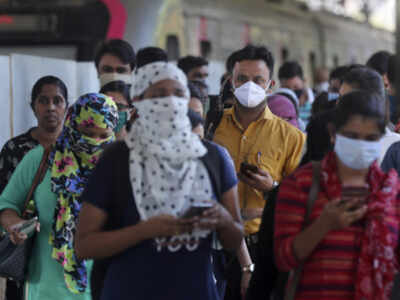
Representative image
Pitching for increased ventilation, the advisory, issued by the office of principal scientific advisor (PSA) to the government on Thursday, said droplets and aerosols become quickly concentrated and greatly increase the risk of transmission in “closed unventilated indoor” spaces.

“In closed indoor spaces, droplets, and aerosols become quickly concentrated, greatly increasing the risk of transmission to people in the area. Just as smells can be diluted by ventilation, high concentrations of the virus can be reduced by ensuring that outdoor air flows in,” said PSA, K VijayRaghavan, on the guidelines which enlisted steps on how to stop the transmission of Covid virus.
“One infected asymptomatic person can release enough aerosols to infect many. Symptoms can take up to two weeks to appear in an infected person, during which time they may continue to shed the virus to infect others. Some people may never show symptoms and yet be spreaders,” tweeted VijayRaghavan, a developmental biologist, on Thursday.
Besides underlining the importance of masks, distance and sanitation, the advisory also lays equal emphasis on ventilation, noting how infection transmission risk is much lower in outdoor areas, as virus particles get quickly dispersed. It said, “Better the ventilation, lower the potential for transmission.”
“Ventilation is a community defence that protects all of us at home or at work. Introducing outdoor air in offices, homes and larger public spaces is advised,” said the guidelines while suggesting ways to improve ventilation in these spaces on priority, both in urban and rural areas.
Fresh evidence and advice on airborne Covid-19 spread had come a few months ago when scientists at two laboratories of the Centre of Scientific & Industrial Research (CSIR) -- Centre for Cellular and Molecular Biology (CCMB) in Hyderabad, and Institute of Microbial Technology in Chandigarh -- had studied the extent of transmission through air.
The studies clearly noted the transmission among people who were suitably distanced but had shared enclosed spaces, like a closed room or vehicle. It suggested that the virus possibly travels in air to far greater distances than the two to three feet that was originally considered the zone of risk.

About the Author
Vishwa MohanEnd of Article
FOLLOW US ON SOCIAL MEDIA










Photostories
Hot Picks
TOP TRENDING
Popular Categories
Hot on the Web
Top Trends
Top Largest Economies in the worldMohamed Muizzu India VisitIsrael Hezbollah WarTravis KelceAssembly Election Result 2024 DateENG vs SA Live ScoreSunil GavaskarKayla NicoleDipa KarmakarHaryana Assembly Constituencies 2024Top Pharmacy Colleges of IndiaDiddyWomen's T20 World CupTop MBA Colleges of IndiaT20 WC ScheduleWomen T20 World Cup Points TableLive Cricket Score
Trending Topics
Bigg Boss 18 Launch LIVE UpdatesBigg Boss Tamil 8 Contestants ListBigg Boss Tamil 8 Launch LIVE UpdatesNavratri Colours 2024Navratri Day 2 ColourDurga Puja 2024Bigg Boss 18 House PhotoDevara CollectionNita AmbaniDeepika PadukoneGovindaDevaraGovinda NewsDevara Movie ReviewSwatantrya Veer SavarkarColdplay India tour 2025Watch NFL Live StreamDress To ImpressCall Of Duty Black Ops 6Wordle Answer
Living and entertainment
Latest News
Ranveer Singh: I have a man crush on Tiger ShroffGhum Hai Kisikey Pyaar Meiin: Savi accuses Jigar of misbehaviour5 must follow rules of Ayurveda to lose 5kg in 30 daysONGC Apprenticeship Recruitment 2024 registration begins: Check direct link hereWWE Hall of Famer Diamond Dallas Page signs new WWE Legends deal'Like a ghost': Manish Sisodia says Arvind Kejriwal has become PM Narendra Modi's 'sole obsession''Singham Again' Trailer: Ranveer Singh kisses wife Deepika Padukone's poster as she skips grand launch eventMy effort in internationalising Shatatantri Veena among the next generation seemingly paying dividends says Tarun Bhattacharya on his return from US TourOptical Illusion: Can you find who's the boss in this picture?'All teams will come to Pakistan for Champions Trophy': PCB chairman on India's participation‘Ke Prothom Kachhe Eshechi’s Mihi aka Radhika Karmakar makes an appearance in ‘Rannaghar’ with her motherVaibhav & Athulya Ravi's 'Chennai City Gangsters' trailerBest Gaming Laptops Under 60000 That Deliver High Performance'Toolkit used to open trunk, paper scanned': CBI gives full details of how UG-NEET paper was leaked'Nervous Nineties': Sachin Tendulkar’s 'unwanted' record in international cricketCleveland Browns coach Kevin Stefanski said the team is “not changing quarterbacks” after Deshaun Watson's poor performanceBigg Boss 18: Chum Darang and Shehzada Dhami lock horns as the latter passes comments on her ethnicity; here’s how she reactedUS elections, and Kamala Harris, in eye of another storm: Hurricane Helene, make way for Milton
Copyright © 2024 Bennett, Coleman & Co. Ltd. All rights reserved. For reprint rights: Times Syndication Service