Trending
This story is from August 12, 2011
'I’m fusing my poetry with Tagore’s'
Acharya Jayanta Bose says ideal artistes are Ray’s Goopy and Bagha...
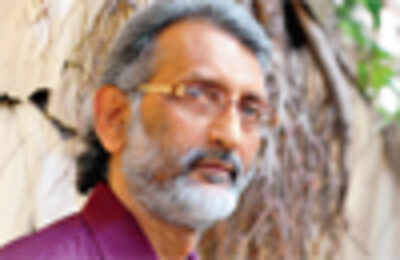
Acharya Jayanta Bose says ideal artistes are Ray’s Goopy and Bagha
Opera in Bengali is something new for the audience of Kolkata. How have you structured the
programme titled Bengali Operatic that will be hosted tonight?
I have tried to imbibe the style/mannerism of operatic singing in Bengali. Historically, there are four ways of presenting an opera — comic, grand, light and cantata oratorio. The form that I shall be presenting tonight is the cantata oratorio. The comic opera has a humorous story with dialogues, songs and acting. The grand opera has a serious story with no dialogues but only songs and acting. The light opera has no acting but only songs. Cantata oratorio is a non-acting opera which has a story that is sung without any dialogues. The message that I wish to convey through my opera is on child education. The lyrics are designed to articulate the sentiments of a male and a female voice.
You are also fusing your poetry with Tagore’s...
Yes. I also wish to present an interesting integration of my poetry with that of Tagore’s “Sfulinga” titled Music-O-Phil. While I will be reciting Tagore’s “Sfulinga”, my disciple will recite my poetry. Two of our poetries and a small script will synchronize to give birth to a new form. That apart, eight songs of mine will also be presented in this section. My students will take an active participation in this whole presentation.
How conscious was the choice of taking up teaching as a profession as opposed concentrating on a solo career?
Though I have been teaching, this is not to say that it has affected my solo career. The reason is that for 12 long years, I have extensively toured and performed abroad. There were years when I would travel at least five to seven times abroad in a year to perform. I had my own band and did a lot of experimental work. Even today, people know a lot about my work abroad than in India. My project with the Oxford University titled The Trees That Sail Away is still referred to in the international music circuit. I used to perform on stage in London for Aphra Behn’s “The Rover” for some months. Today, the DVD of this presentation is part of the course of BBC’s open university. I’ve conducted workshops with L Subramaniam in London that was attended only by senior composers of the world. I’ve composed “Poroshe tar ador mekhe” for Mira Nair’s “The Namesake”. My track, “Bengali song” (“Phote phul apon sukhe”), is so popular in Europe that even today, references of it are sent to Indian composers here to create music on its lines.
In 2002, I decided to form my academy. One has to understand that life is a lot about prioritizing. It’s not just about keeping busy that would prompt a musician to take up 30 shows in 30 days. For me, there came a phase in my life when I wanted to decide on whether to pay more interest in the community or solo work. Music has given me so much in life and I realized that it’s important that I give back a part of what I’ve got from music to the society. As a citizen, this is my responsibility. It’s important not just to create and teach music. The idea is to inculcate a taste for healthy culture. That’s why when I teach my students, I also emphasize on holistic growth. Otherwise, the world today has created a format where everyone is negatively focused.
When good teachers turn performers, some of them also assume the role of mentors on stage. They start thinking of the audience as part of their student fraternity without realizing when and where their performance is becoming more of an extended classroom exercise.
Have you ever come across such a situation? Alternatively, how do you guard yourself against this?
I haven’t heard of such a situation. That could be because principally, I don’t attend concerts. I have certain reservations. When I am performing on stage, I might say a couple of lines in addition to presenting my music. I feel that if there is some inadequacy in the presentation, it can be supplemented by another extra vehicle (read my lines) to help my listeners to communicate better. This is only done to make my listeners travel better to my ideas. But it’s also a fact that for me, it’s very easy to be on a switch-on and switch-off mode. When I am a performer, I leave my mentor identity behind. Besides, this confusion can also be avoided if the performer knows one’s limitations and also that of the audience. My intention is always to nudge the audience to understand what I am trying to communicate.
You said you don’t listen to concerts. Is that an impulsive decision or an informed choice?
No. It’s a fact that I am highly conditional and have certain reservations. But talking about why I don’t socialize or attend concerts is a slightly delicate point and a tender issue. When an organizer comes to me, I first ask him if he will accept all my conditions and reservations. If the answer is instantly yes, I see the urge. But if there are doubts, I feel that it’s not worth it. Besides, I am a very expensive performer though I might not be charging in crores. I’d honestly say that I have found a bit of crookedness in people’s motivations and even in that of fellow artistes. Things are not always very transparent for me. If they say something to me, it’s difficult to gauge whether they are actually meaning it or not. When I say something with a very clear and open mind, I don’t know if that will be taken in the right spirit or not. There was a time when I used to meet and deal with people and listen to artistes. Slowly, I realized that it was getting far too difficult to understand and communicate with people. I had to constantly edit what was being said.
Today, I don’t fancy that pressure where I have make too much of an effort to understand or communicate with people who might have different agendas. I am trying my hands at doing creative work. I need time and a fresh mind for that. The mind has a one-way traffic. If it goes ashtray, it will never come back. That’s why I prefer maintaining a distance.
If you don’t attend concerts, how do you keep yourself in tune with the kind of music being presented by your fellow musicians now? Do you listen to their CDs at home?
I don’t need to listen to contemporary musicians. In most cases, I don’t find labour, seriousness, sincerity, training and knowledge. Sometimes, they come across as very superficial. I don’t even want to criticize what others are doing because that’s their calling. If I have to listen, I go back to certain archival work. Besides, I have a slightly unconventional idea about what one should listen and what one shouldn’t. Perhaps, I am the only exception to be saying this. People often claim that everyone should listen to everything. But I feel, that should never be the case. Listening to music is akin to mental feeding. Just as a two-month-old baby can’t be offered chicken roast, a man can’t be given baby food for breakfast. There can’t be a confusion in the artiste’s mind in terms of the mental fodder he is being supplied with. If the artiste is in a position to choose what’s right from him to imbibe, only then can he filter. Otherwise, things can get very confusing. Even when I am reading, I am very selective.
You’ve also been accused of being anti-publicity...
I know but that’s not the case. I am not anti-media. If I see the earnestness in the right people, I definitely air my views. But I don’t want to broadcast things all the time. I might have reservations about the media covering my programmes. I feel, the media today has a lot of power. I can actually equate the media with the power of a woman. If the media thinks, it can make a huge difference. But if the media believes that it will act negatively, it can also create havoc. I personally don’t wish to be a puppet in this scheme of things. I lead an extremely disciplined life. I only sleep for about three/four hours a day.
Beyond that, I am completely dedicated to my work. I don’t wish to take names but there have been instances where even great maestros (who are much elder to me) have publicly acknowledged my contribution. In the late years of his life, Guru Gyan Prakash Ghosh had told me that it’s imperative that my Bengali kheyal compositions should reach out to every good classical musician this world. I was humbled when, as part of the reason for this statement, he had said that it’s a rare quality in me that I can sing and write with equal ease.
This, he had said, is only possible if Ustad Amir Khan wrote like Samaresh Basu (Kalkut) and if Samaresh Basu sang like Ustad Amir Khan. After Manabendra Mukhopadhyay had said that he had found a diamond mine in me. In all these years, I never learnt to flaunt all these compliments. I talk less but that has been a boon for me since people take whatever I say very seriously. I am privileged that I can also do my kind of work even after being aloof. Not everyone can be this lucky. From singing, creating, teaching music to making and editing films, from reading to writing poetry and epic, I am doing it all. I have just invented a new instrument that connects the harmonium with another string instrument. I call it Dhoni Shingar.
What’s your definition of a true artiste?
An artiste is not a rich person in terms of material parameters. He has certain commitments to this society. The richness of an artiste comes from fulfilling social responsibilities and commitments. Of course, an adequate patronage is always required for artistes. For me, the ideal artiste is Ray’s Goopy Gyne and Bagha Byne. They had all the patronage to remain just the way they wanted to. Whatever they needed in life to maintain a good living was always served on a platter. But they never ran after any excess and even after having access to everything, nobody remembers them for their riches. It’s their art that has connected them to posterity. That’s how an artiste should be.
Opera in Bengali is something new for the audience of Kolkata. How have you structured the
programme titled Bengali Operatic that will be hosted tonight?
I have tried to imbibe the style/mannerism of operatic singing in Bengali. Historically, there are four ways of presenting an opera — comic, grand, light and cantata oratorio.
My daughter, Rema Bose, is singing the female lead. She is a lecturer and is very passionate about music. But what’s interesting about her is that despite her dedication to music, she never wants to take it up professionally. Incidentally, I will also be showing a four-minute long untitled film that is dedicated to Tagore and other maestros. Then, there will also be another 12-minute film which will have only music and scenes but no dialogues.
You are also fusing your poetry with Tagore’s...
Yes. I also wish to present an interesting integration of my poetry with that of Tagore’s “Sfulinga” titled Music-O-Phil. While I will be reciting Tagore’s “Sfulinga”, my disciple will recite my poetry. Two of our poetries and a small script will synchronize to give birth to a new form. That apart, eight songs of mine will also be presented in this section. My students will take an active participation in this whole presentation.
How conscious was the choice of taking up teaching as a profession as opposed concentrating on a solo career?
Though I have been teaching, this is not to say that it has affected my solo career. The reason is that for 12 long years, I have extensively toured and performed abroad. There were years when I would travel at least five to seven times abroad in a year to perform. I had my own band and did a lot of experimental work. Even today, people know a lot about my work abroad than in India. My project with the Oxford University titled The Trees That Sail Away is still referred to in the international music circuit. I used to perform on stage in London for Aphra Behn’s “The Rover” for some months. Today, the DVD of this presentation is part of the course of BBC’s open university. I’ve conducted workshops with L Subramaniam in London that was attended only by senior composers of the world. I’ve composed “Poroshe tar ador mekhe” for Mira Nair’s “The Namesake”. My track, “Bengali song” (“Phote phul apon sukhe”), is so popular in Europe that even today, references of it are sent to Indian composers here to create music on its lines.
In 2002, I decided to form my academy. One has to understand that life is a lot about prioritizing. It’s not just about keeping busy that would prompt a musician to take up 30 shows in 30 days. For me, there came a phase in my life when I wanted to decide on whether to pay more interest in the community or solo work. Music has given me so much in life and I realized that it’s important that I give back a part of what I’ve got from music to the society. As a citizen, this is my responsibility. It’s important not just to create and teach music. The idea is to inculcate a taste for healthy culture. That’s why when I teach my students, I also emphasize on holistic growth. Otherwise, the world today has created a format where everyone is negatively focused.
When good teachers turn performers, some of them also assume the role of mentors on stage. They start thinking of the audience as part of their student fraternity without realizing when and where their performance is becoming more of an extended classroom exercise.
Have you ever come across such a situation? Alternatively, how do you guard yourself against this?
I haven’t heard of such a situation. That could be because principally, I don’t attend concerts. I have certain reservations. When I am performing on stage, I might say a couple of lines in addition to presenting my music. I feel that if there is some inadequacy in the presentation, it can be supplemented by another extra vehicle (read my lines) to help my listeners to communicate better. This is only done to make my listeners travel better to my ideas. But it’s also a fact that for me, it’s very easy to be on a switch-on and switch-off mode. When I am a performer, I leave my mentor identity behind. Besides, this confusion can also be avoided if the performer knows one’s limitations and also that of the audience. My intention is always to nudge the audience to understand what I am trying to communicate.
You said you don’t listen to concerts. Is that an impulsive decision or an informed choice?
No. It’s a fact that I am highly conditional and have certain reservations. But talking about why I don’t socialize or attend concerts is a slightly delicate point and a tender issue. When an organizer comes to me, I first ask him if he will accept all my conditions and reservations. If the answer is instantly yes, I see the urge. But if there are doubts, I feel that it’s not worth it. Besides, I am a very expensive performer though I might not be charging in crores. I’d honestly say that I have found a bit of crookedness in people’s motivations and even in that of fellow artistes. Things are not always very transparent for me. If they say something to me, it’s difficult to gauge whether they are actually meaning it or not. When I say something with a very clear and open mind, I don’t know if that will be taken in the right spirit or not. There was a time when I used to meet and deal with people and listen to artistes. Slowly, I realized that it was getting far too difficult to understand and communicate with people. I had to constantly edit what was being said.
Today, I don’t fancy that pressure where I have make too much of an effort to understand or communicate with people who might have different agendas. I am trying my hands at doing creative work. I need time and a fresh mind for that. The mind has a one-way traffic. If it goes ashtray, it will never come back. That’s why I prefer maintaining a distance.
If you don’t attend concerts, how do you keep yourself in tune with the kind of music being presented by your fellow musicians now? Do you listen to their CDs at home?
I don’t need to listen to contemporary musicians. In most cases, I don’t find labour, seriousness, sincerity, training and knowledge. Sometimes, they come across as very superficial. I don’t even want to criticize what others are doing because that’s their calling. If I have to listen, I go back to certain archival work. Besides, I have a slightly unconventional idea about what one should listen and what one shouldn’t. Perhaps, I am the only exception to be saying this. People often claim that everyone should listen to everything. But I feel, that should never be the case. Listening to music is akin to mental feeding. Just as a two-month-old baby can’t be offered chicken roast, a man can’t be given baby food for breakfast. There can’t be a confusion in the artiste’s mind in terms of the mental fodder he is being supplied with. If the artiste is in a position to choose what’s right from him to imbibe, only then can he filter. Otherwise, things can get very confusing. Even when I am reading, I am very selective.
You’ve also been accused of being anti-publicity...
I know but that’s not the case. I am not anti-media. If I see the earnestness in the right people, I definitely air my views. But I don’t want to broadcast things all the time. I might have reservations about the media covering my programmes. I feel, the media today has a lot of power. I can actually equate the media with the power of a woman. If the media thinks, it can make a huge difference. But if the media believes that it will act negatively, it can also create havoc. I personally don’t wish to be a puppet in this scheme of things. I lead an extremely disciplined life. I only sleep for about three/four hours a day.
Beyond that, I am completely dedicated to my work. I don’t wish to take names but there have been instances where even great maestros (who are much elder to me) have publicly acknowledged my contribution. In the late years of his life, Guru Gyan Prakash Ghosh had told me that it’s imperative that my Bengali kheyal compositions should reach out to every good classical musician this world. I was humbled when, as part of the reason for this statement, he had said that it’s a rare quality in me that I can sing and write with equal ease.
This, he had said, is only possible if Ustad Amir Khan wrote like Samaresh Basu (Kalkut) and if Samaresh Basu sang like Ustad Amir Khan. After Manabendra Mukhopadhyay had said that he had found a diamond mine in me. In all these years, I never learnt to flaunt all these compliments. I talk less but that has been a boon for me since people take whatever I say very seriously. I am privileged that I can also do my kind of work even after being aloof. Not everyone can be this lucky. From singing, creating, teaching music to making and editing films, from reading to writing poetry and epic, I am doing it all. I have just invented a new instrument that connects the harmonium with another string instrument. I call it Dhoni Shingar.
What’s your definition of a true artiste?
An artiste is not a rich person in terms of material parameters. He has certain commitments to this society. The richness of an artiste comes from fulfilling social responsibilities and commitments. Of course, an adequate patronage is always required for artistes. For me, the ideal artiste is Ray’s Goopy Gyne and Bagha Byne. They had all the patronage to remain just the way they wanted to. Whatever they needed in life to maintain a good living was always served on a platter. But they never ran after any excess and even after having access to everything, nobody remembers them for their riches. It’s their art that has connected them to posterity. That’s how an artiste should be.

About the Author
Priyanka DasguptaEnd of Article
FOLLOW US ON SOCIAL MEDIA








Photostories
Featured In Lifestyle
MORE FROM ETIMES
life & stylePopular Categories
Entertainment NewsBollywood NewsTollywood NewsKollywood NewsMollywood NewsMovie ReviewsLatest Hindi MoviesLatest Tamil MoviesMX PlayerParenting TipsHome RemediesWeight LossBeauty TipsParenting TipsHindi VideosHindi Video SongsBhojpuri Music VideosLatest Telugu MoviesBhojpuri Music VideoHindi TV News
Trending in Entertainment
Latest MoviesBollywood MoviesHollywood MoviesTamil Movies 2024Telugu Movies 2024Malayalam Movies 2024Kannada Movies 2024Marathi Movies 2024Bengali Movies 2024Top Rated Movies 2024Best Hindi MoviesBest English MoviesBest Telugu MoviesBest Tamil MoviesBest Malayalam MoviesBest Kannada MoviesBest Bengali MoviesUpcoming Hindi MoviesBest Movies Of All TimeBest Hindi Movies of All Time
Trending in Etimes
Trending in TV
Trending in Lifestyle
Trending in Regional
Movie Reviews
Berlin ReviewThe Buckingham Murders ReviewSpeak No Evil ReviewVisfot ReviewThalapathy Is The G.O.A.T ReviewRebel Ridge ReviewDetective Conan vs. Kid the Phantom Thief ReviewBeetlejuice Beetlejuice ReviewPad Gaye Pange ReviewA Wedding Story ReviewThe Diary Of West Bengal ReviewTikdam ReviewKinds Of Kindness ReviewAfraid Review
Upcoming Hindi Movies
Upcoming Regional Movies
Latest News
4 types of tea to improve gut health and ease digestive issuesWho was Illia 'Golem' Yefimchyk, the Belarusian bodybuilder who consumed 2.5 kg of meat and 108 sushi pieces daily before his death at 36?Vempalle Shareef's story is now a lesson for degree students in Andhra PradeshWhen Shah Rukh Khan performed 'Kanyadaan' at Farah Khan's wedding- See PICSBike rally held to raise voter awareness in Jammu and Kashmir's Doda ahead of assembly electionsFather-son duo Eugene and Dan Levy's dazzling entrance at the EmmysLiza Colon becomes 1st Latina to win Best Supporting Emmy Award'Oh no!': Hilarious goof-up leads to missed catch, leaves bowler in smile. WatchJr NTR on shooting under water scene for 35 days in 'Devara Part 1': It is an important sequence!Last Lunar Eclipse of 2024: What it means for your zodiac signTop NFL Superstars Who Are Vegan: Derrick Morgan, David Carter, Theo Riddick and moreAbhishek Kumar shares selfies with Alia Bhatt; recalls the time when he worked as a crowd artist in ‘Humpty Sharma Ki Dulhaniya’Jessica Gunning wins her 1st Primetime Emmy for 'Baby Reindeer'Shocking! Man celebrates birthday by lying among massive Pythons‘Stree 2’ star Shraddha Kapoor to reveal her character name! But there’s a catchSathiyan set to partner Sreeja in mixed doubles'Seven varsities in Odisha have potential to be in top 100'Capricorn, Daily Horoscope Today, September 16, 2024: Harmonious relationships with partners are likely
Other Group Sites -
ETimes is an Entertainment, TV & Lifestyle industrys promotional website and carries advertorials and native advertising.