

- News
- Speaking Tree News
- Daily Ecstasy News
- Baisakhi: A Celebration of Harvest and Faith
This story is from April 13, 2024
Baisakhi: A Celebration of Harvest and Faith
Baisakhi marks the onset of the harvest season, symbolising prosperity and abundance, and it commemorates the formation of the Khalsa Panth, a pivotal event in Sikh history that carries profound spiritual resonance, writes Stuti Malhotra
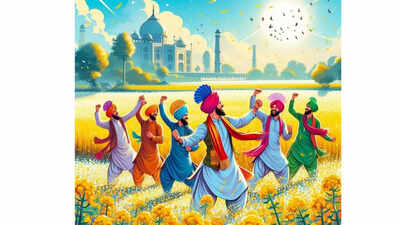
Images: AI generated



The Spring of 1699
On this day, the virile Khalsa Panth was commissioned by Guru Gobind Singh. In the spring of 1699, the Guru sent an invitation to people all over the country to collect at Anandpur Sahib to celebrate the Baisakhi festival. Millions of people from all over the country responded to the Guru's invitation. There was kirtan, worship which continued for days, and the environment was joyous and happy all over. And then was the stage to test the valour of the followers.
One morning, the Guru came out of the big tent erected on a long terrace with a dazzling sword and hailed in a thundering voice, "Is there anybody who can quench the thirst of my sword with his blood?” The atmosphere, which was jubilant, transformed into utter silence. Some thought of fleeing to save their life. On the other hand, some were determined to stand by the Guru. Suddenly, Daya Ram volunteered himself. The Guru took Daya Ram inside the tent, and after a while, with blood dripping from the sword, came out the thundered voice again, 'I want one more head.' This was followed by Dharam Das, Mohkam Chand, Himmat Rai and Bhai Sahib Chand volunteering and entering the tent.
Creation of the Khalsa Panth
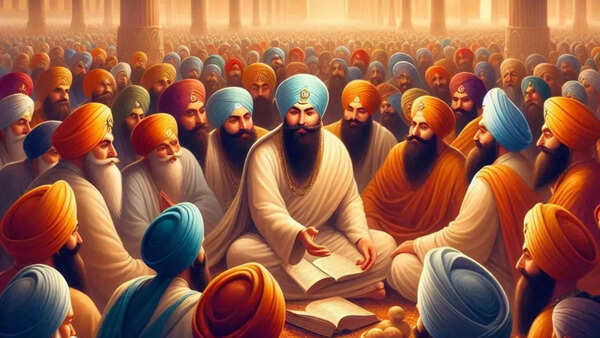
But after some time, the scene changed, and Guru Gobind Singh came out with all those five well-adored, brave men with swords in their hands wearing turbans. They were not dead souls but symbolised valour and sacrifice. Thus, these five people from different castes and from different parts of the country—North, South, East, West, and Centre—were welded into a single fraternity called ‘Khalsa Panth.’
The Guru gave the Five beloveds Amrit (Baptism), instruction for the adoption of a particular code of conduct, serving the society, unity and sacrifice. All five stood before the sangat well adored and were renamed as Singhs: Bhai Daya Singh, Bhai Dharam Singh, Bhai Mohkam Singh, Bhai Himmat Singh and Bhai Sahib Singh. They were renamed as 'Panj Pyare' (Five Beloveds), thus setting an example of equality and mutual trust. As a Khalsa, the Guru had placed himself eternally in his Sikhs. He declared, "If anybody wished to see me, let him go to an assembly of Sikhs and approach them with faith and reverence; he will surely see me amongst them." Prem Sumarg.
Amrit Sanskar
The Amrit Sanskar, or the Sikh baptism ceremony, is central to the formation of the Khalsa. During this solemn ritual, initiated Sikhs partake in Amrit (sacred nectar) prepared with sugar crystals and water, stirred with a double-edged sword (Khanda), symbolising the fusion of spiritual and temporal power. Initiates embrace the five Ks—Kesh (unshorn hair), Kangha (wooden comb), Kara (steel bracelet), Kachera (short undergarment), and Kirpan (ceremonial sword)—which serve as symbols of the Khalsa identity and embody the principles of discipline, dignity, and readiness to defend righteousness. Baisakhi serves as a platform for Sikhs worldwide to commemorate the formation of the Khalsa and reaffirm their commitment to its principles. The legacy of Baisakhi and the formation of the Khalsa continue to resonate deeply worldwide, serving as a source of inspiration and guidance. The principles espoused by Guru Gobind Singh Ji—courage, compassion, and selfless service—remain as relevant today as they were centuries ago.
Khalsa created a new brotherhood with a new spirit, courage and bravery. On Baisakhi, let us strive to embody its noble principles in our lives, fostering a world of harmony, equality, and compassion for all.
Baisakhi is on April 13
Dr Stuti Malhotra is scholar of Sikhism
(Views are personal)
The secret to true happiness: Teachings of Bhagavad Gita, Chapter 2, Verse 55
End of Article
FOLLOW US ON SOCIAL MEDIA

Hot Picks
TOP TRENDING
Popular Categories
Hot on the Web
Top Trends
Trending Topics
Devara CollectionBigg Boss Kannada 11 Launch Live UpdatePawan KalyanJungle SafariStree 2 OTT ReleaseRose GardenDevara CollectionOTT Release MovieMasala OmeletteEmergencyDevaraTaaza Khabar 2 Twitter ReviewDevara Movie ReviewHealthy RaitasSwatantrya Veer SavarkarColdplay India tour 2025Smartphone DealsApple Macbook Air M1Amazon SaleWordle Answer
Living and entertainment
Latest News
West Bengal CM Mamata Banerjee holds meeting to address flood situation in North BengalTumbbad re-release box office: The Sohum Shah starrer mints Rs 95 lakhs on third SaturdaySetting them up to flourish: Why parents and school are a tag teamAir Arabia launches early bird promotion on 500,000 seats from INR 5,727!Diljit Dosanjh presents a gift to his Pakistani fan at his Manchester concert - WatchIndia vs Bangladesh 2nd Test Highlights: Day 3 washed out due to wet outfield in KanpurMayawati urges Dalits not to vote for Congress, BJPFormer Deputy Chief minister Alla Nani faces legal trouble after lift incident in EluruIndian wushu team creates history, bags seven medals at junior worldsCyber Police Kashmir warns against inflammatory posts amid protests over Hezbollah leader Nasrallah's deathWall collapse near Mahakal temple: Two cops, two civic staffers, temple official suspended"Is Taylor Swift Gonna Be in the Stands for the Chiefs vs. Chargers Showdown?"Aishwarya Rai Bachchan touches Nandamuri Balakrishna's feet as a sign of respect, the Telugu star blesses herHost Kiccha Sudeep to Bigg Boss Kannada 11 contestant Aishwarya Shindogi: Come back as a stronger personManipur CM Biren accuses Kuki militants of abducting 2 Manipuri youthsKhatron Ke Khiladi 14 winner: Karan Veer Mehra lifts the trophy and Krishna Shroff becomes the first runner-upAI startup CEO reveals co-founder’s ‘no water…straight to work’ routine; internet says ‘new way of praising toxic culture’What to expect after a facelift procedure
Copyright © 2024 Bennett, Coleman & Co. Ltd. All rights reserved. For reprint rights: Times Syndication Service