
- News
- Sports News
- Two faces of Sushil Kumar: An Olympic legend and a jailed murder accused
Trending
This story is from May 26, 2021
Two faces of Sushil Kumar: An Olympic legend and a jailed murder accused
Those who knew Sushil Kumar personally would often say that the diminutive grappler from a humble family background was an affable person - an obedient son and a caring brother, a loving husband and a doting father, and a faithful friend who would, in some cases, go out of his away to help his loyalists. But a few others who knew about his alleged dubious business dealings would beg to differ. They feared this day for long and Sushil's brush with the law hasn't surprised them.
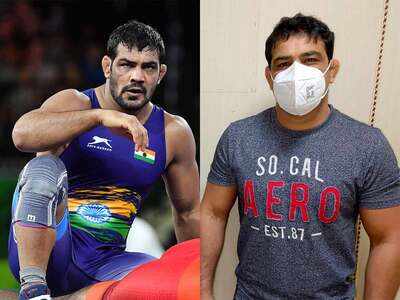
Time will judge how sports fans would like to remember Sushil Kumar - a celebrated sportsperson or a jailed criminal.
NEW DELHI: Sushil Kumar's Wikipedia page, which profiles the celebrated wrestler's awe-inspiring journey from south west Delhi's Baprola village to his incredible podium finishes in the Olympics, Asiad, CWG and World Championships, has a recent update.
An update which no sports lover in the country, even 'pehelwan' Sushil himself, would have thought they would ever see.
Those who knew him personally would often say that the diminutive grappler from a humble family background was an affable person - an obedient son and a caring brother, a loving husband and a doting father, and a faithful friend who would, in some cases, go out of his away to help his loyalists.
But a few others who knew about Sushil's alleged dubious business dealings would beg to differ. They feared this day for long and Sushil's brush with the law hasn't surprised them.

A former national wrestling coach, who has worked closely with Sushil since his Beijing Olympics days and played a key role during his return to competition in December 2017 after a hiatus of three years, said: "For general public and to the parents of budding wrestlers and trainees of other sports disciplines, Chhatrasal stadium has always been considered a sanctum sanctorum of sports activities.
"Aspiring athletes looked at the stadium as a revered sports institution. However, there is an ugly side to Chhatrasal as well, where unwanted guests, none of them sportspersons, would frequent the premises to meet Sushil and his close associates to discuss his off-field business activities. Only people belonging to Sushil's inner circle were part of those discussions," said the coach, requesting anonymity.
It's been alleged that Sushil has business interest in toll plaza collections in outer Delhi and adjacent Haryana and Uttar Pradesh borders, apart from running Ayurveda stores of a leading Indian FMCG brand in the north and north-west Delhi. Then his associates are into real estate, recovery of bad debts and property evacuations. Wrestling dropouts, who failed to make any impact in the sport, would allegedly be employed to man these toll plazas. Delhi Police's crime branch has now been linking Sushil and his associates to jailed dreaded gangster Neeraj Bawana and his enmity with fugitive Kala Jathedi has become the talk of the town.
Golden phase of his sporting career
Sushil's life wasn't this complicated, at least till 2014 Glasgow CWG where he had secured his illustrious career's second CWG gold - the first being at the 2010 Delhi edition and the third at the 2018 Gold Coast Games. Right from finishing at the top of the podium in the World Cadet Games in 1998, Sushil was always meant for big things in wrestling. Sushil was 14 when he enrolled himself at the Chhatrasal stadium. He trained under the guidance of former wrestler and 1982 Delhi Asiad gold medallist, Mahabali Satpal, who later became Sushil's father-in-law.
Sushil steadily climbed up the success ladder, winning medals at the Commonwealth and Asian championships between 2003 and 2008. By the time Doha Asian Games came in 2006, where he secured a bronze in the freestyle 66kg, Sushil had established himself as one of the country's leading wrestlers.
However, his breakthrough moment came in Beijing Games in 2008 when he clinched the historic bronze, becoming the first Indian grappler in 56 years to win an individual medal in wrestling after legendary K D Jadhav's bronze at the 1952 Helsinki Olympics. The incredible gold medal-finish at the 2010 World Championships in Moscow placed him on a pedestal none in the country's wrestling had ever occupied.
Two years later, at the London Games, Sushil did one better than Beijing, winning the silver medal - despite suffering from a stomach bug - to become the only Indian to win two individual Olympic medals. He undoubtedly became the quintessential poster boy of Indian sports. He inspired a generation of wrestlers to take up the sport. Three of India's Tokyo Olympics-bound wrestlers - Ravi Dahiya, Bajrang Punia and Deepak Punia - are all Chhatrasal alumni.
Sushil's international success brought him crores in government's cash awards and big-ticket sponsorship deals. He was appointed as the administrative officer of the Northern Railway Sports Association in 2013 (on Tuesday, his employer Railways suspended him for his alleged involvement in Dhankad's murder case) and was later posted on deputation in the Delhi government's education department as the OSD (Officer on Special Duty) at the Chhatrasal.
Priorities changed, wrestling took backseat
This is when Sushil's priorities began to change. He ventured into businesses not entirely labelled clean and turned the stadium into his little kingdom, where he would train with his sparring partners under Georgian coach Vladimir Mestvirishvili. At the same time, he would carry out his business dealings through his trusted lieutenants.
After the gold at the Glasgow CWG, Sushil became choosy about tournaments which resulted in him giving the Incheon Asiad a miss. Sushil and Narsingh Yadav's ugly face-off for a place in the Indian contingent for the 2016 Rio Olympics, and the following dope controversy, had embarrassingly played out on every national TV channel. It split the country's closely-knit wrestling community for life, even pitting the best of pals in Sushil and Yogeshwar Dutt against each other.
Sushil found himself involved in yet another unsavoury controversy when fellow wrestler Praveen Rana accused Sushil of instigating his supporters to beat him up and his elder brother Naveen during the selection trials for the Gold Coast CWG at the IGI stadium here. Sushil was booked for assault and criminal intimidation and an FIR was registered against him.
Sushil's disenchantment with wrestling continued as he shockingly lost in the first qualification round of the 2018 Jakarta Asian Games. A year later, he competed at the World Championships in Nur Sultan, which was a Tokyo Olympics qualifier, but suffered a first-round defeat. Since then, he has not been to the wrestling arena.
In his first administrative stint (2016-2020) as the president of the School Games Federation of India (SGFI), Sushil didn't show any interest in its working and continued with his carefree attitude. During his tenure, the SGFI copped a lot of criticism for his alleged mishandling of the death of a city-based girl footballer, Nitisha Negi, at the Pacific School Games in Adelaide. The federation was later derecognised for its non-compliance of the national sports code.
Sushil's latest act of alleged indiscretion seems to have put an end to his over two-decade long wrestling career. All his well-wishers see now is the heart-breaking image of Sushil's face hidden behind a towel like a criminal, and the wrestler spending his first night in the lock-up crying in remorse.
Time will judge how sports fans would like to remember their hero - a celebrated sportsperson or a jailed criminal.
An update which no sports lover in the country, even 'pehelwan' Sushil himself, would have thought they would ever see.
It reads: "On 23 May 2021, he (read Sushil) was arrested over alleged involvement in the murder of a 23-year-old fellow wrestler Sagar Dhankar in Delhi."
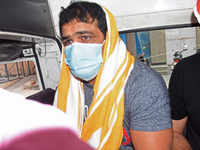
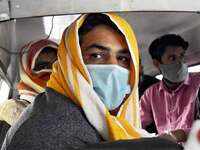
Those who knew him personally would often say that the diminutive grappler from a humble family background was an affable person - an obedient son and a caring brother, a loving husband and a doting father, and a faithful friend who would, in some cases, go out of his away to help his loyalists.
But a few others who knew about Sushil's alleged dubious business dealings would beg to differ. They feared this day for long and Sushil's brush with the law hasn't surprised them.

A former national wrestling coach, who has worked closely with Sushil since his Beijing Olympics days and played a key role during his return to competition in December 2017 after a hiatus of three years, said: "For general public and to the parents of budding wrestlers and trainees of other sports disciplines, Chhatrasal stadium has always been considered a sanctum sanctorum of sports activities.
"Aspiring athletes looked at the stadium as a revered sports institution. However, there is an ugly side to Chhatrasal as well, where unwanted guests, none of them sportspersons, would frequent the premises to meet Sushil and his close associates to discuss his off-field business activities. Only people belonging to Sushil's inner circle were part of those discussions," said the coach, requesting anonymity.
It's been alleged that Sushil has business interest in toll plaza collections in outer Delhi and adjacent Haryana and Uttar Pradesh borders, apart from running Ayurveda stores of a leading Indian FMCG brand in the north and north-west Delhi. Then his associates are into real estate, recovery of bad debts and property evacuations. Wrestling dropouts, who failed to make any impact in the sport, would allegedly be employed to man these toll plazas. Delhi Police's crime branch has now been linking Sushil and his associates to jailed dreaded gangster Neeraj Bawana and his enmity with fugitive Kala Jathedi has become the talk of the town.
Golden phase of his sporting career
Sushil's life wasn't this complicated, at least till 2014 Glasgow CWG where he had secured his illustrious career's second CWG gold - the first being at the 2010 Delhi edition and the third at the 2018 Gold Coast Games. Right from finishing at the top of the podium in the World Cadet Games in 1998, Sushil was always meant for big things in wrestling. Sushil was 14 when he enrolled himself at the Chhatrasal stadium. He trained under the guidance of former wrestler and 1982 Delhi Asiad gold medallist, Mahabali Satpal, who later became Sushil's father-in-law.
Sushil steadily climbed up the success ladder, winning medals at the Commonwealth and Asian championships between 2003 and 2008. By the time Doha Asian Games came in 2006, where he secured a bronze in the freestyle 66kg, Sushil had established himself as one of the country's leading wrestlers.
However, his breakthrough moment came in Beijing Games in 2008 when he clinched the historic bronze, becoming the first Indian grappler in 56 years to win an individual medal in wrestling after legendary K D Jadhav's bronze at the 1952 Helsinki Olympics. The incredible gold medal-finish at the 2010 World Championships in Moscow placed him on a pedestal none in the country's wrestling had ever occupied.
Two years later, at the London Games, Sushil did one better than Beijing, winning the silver medal - despite suffering from a stomach bug - to become the only Indian to win two individual Olympic medals. He undoubtedly became the quintessential poster boy of Indian sports. He inspired a generation of wrestlers to take up the sport. Three of India's Tokyo Olympics-bound wrestlers - Ravi Dahiya, Bajrang Punia and Deepak Punia - are all Chhatrasal alumni.
Sushil's international success brought him crores in government's cash awards and big-ticket sponsorship deals. He was appointed as the administrative officer of the Northern Railway Sports Association in 2013 (on Tuesday, his employer Railways suspended him for his alleged involvement in Dhankad's murder case) and was later posted on deputation in the Delhi government's education department as the OSD (Officer on Special Duty) at the Chhatrasal.
Priorities changed, wrestling took backseat
This is when Sushil's priorities began to change. He ventured into businesses not entirely labelled clean and turned the stadium into his little kingdom, where he would train with his sparring partners under Georgian coach Vladimir Mestvirishvili. At the same time, he would carry out his business dealings through his trusted lieutenants.
After the gold at the Glasgow CWG, Sushil became choosy about tournaments which resulted in him giving the Incheon Asiad a miss. Sushil and Narsingh Yadav's ugly face-off for a place in the Indian contingent for the 2016 Rio Olympics, and the following dope controversy, had embarrassingly played out on every national TV channel. It split the country's closely-knit wrestling community for life, even pitting the best of pals in Sushil and Yogeshwar Dutt against each other.
Sushil found himself involved in yet another unsavoury controversy when fellow wrestler Praveen Rana accused Sushil of instigating his supporters to beat him up and his elder brother Naveen during the selection trials for the Gold Coast CWG at the IGI stadium here. Sushil was booked for assault and criminal intimidation and an FIR was registered against him.
Sushil's disenchantment with wrestling continued as he shockingly lost in the first qualification round of the 2018 Jakarta Asian Games. A year later, he competed at the World Championships in Nur Sultan, which was a Tokyo Olympics qualifier, but suffered a first-round defeat. Since then, he has not been to the wrestling arena.
In his first administrative stint (2016-2020) as the president of the School Games Federation of India (SGFI), Sushil didn't show any interest in its working and continued with his carefree attitude. During his tenure, the SGFI copped a lot of criticism for his alleged mishandling of the death of a city-based girl footballer, Nitisha Negi, at the Pacific School Games in Adelaide. The federation was later derecognised for its non-compliance of the national sports code.
Sushil's latest act of alleged indiscretion seems to have put an end to his over two-decade long wrestling career. All his well-wishers see now is the heart-breaking image of Sushil's face hidden behind a towel like a criminal, and the wrestler spending his first night in the lock-up crying in remorse.
Time will judge how sports fans would like to remember their hero - a celebrated sportsperson or a jailed criminal.
End of Article
FOLLOW US ON SOCIAL MEDIA




Top Sports News
TOP TRENDING
Trending Stories
In Sports
Entire Website
- Batista Reveals Reasons Behind His WWE Exit to Pursue Hollywood Career
- Lionel Messi's Maserati to Lebron James' Lamborghini - Top sports stars and their luxurious fast cars
- Moeen Ali talks about Brendon McCullum’s role in easing pressure on Jos Buttler
- '17-year-old boy became a man...': When Sunil Gavaskar lauded Sachin Tendulkar for his first Test hundred
- 'If it rains like this...': ACB official after third day also washed-out in Afghanistan vs New Zealand one-off Test
- 'If he were to retire tomorrow...' says England coach Brendon McCullum about Jos Buttler
- Rohit Sharma's 'workouts and fun' fitness routine ahead of India vs Bangladesh Test series - Watch
- EXPLAINED: Why Viswanathan Anand is missing from India's Chess Olympiad squad for second time in a row
- Focus on fitness and mentality: Harendra Singh
- HS Prannoy to take a break from game
- Govt suspends licence to make, sell eye drop that claimed no use of glasses
- 50-year-old injured in wolf attack in Bahraich; search on for sixth 'killer'
- Actor dies in his sleep. Why sudden heart attacks are killing Indians
- Nagpur Audi crash probe: Maha BJP chief’s son Sanket called after 14 hours
- Centre seeks review of SC’s mineral royalty judgment; CJI surprised
- 2 Army officers thrashed, their female friend gang-raped in Madhya Pradesh
- Pictures, videos: Why there is no other beach like this in India
- German foreign minister to S Jaishankar: ‘Very impressed by your ....’
- K'taka: Kumaraswamy blames appeasement politics over communal flare up
- EXPLAINED: What India need to qualify for WTC final

Popular Categories
Hot on the Web
Top Trends
Trending Topics
Alia BhattMalaika Arora Father DeathArbaaz KhanNatasa StankovicMr Bachchan OTT ReleaseNational Parks In IndiaSelena GomezGOAT CollectionVikas Sethi DeathMalayalam ProducersIndia's Best Dancer 4Simi GarewalDilli BabuIndian National ParksLaung BenefitsVikas SethiiPhone 16Dubai Princess Sheikha MahraMG Windsor EvWordle Answer
Living and entertainment
Latest News
Kapil Sharma gives fans a peek into his Ganesh Chaturthi festivities with wife GinniNot MS Dhoni and Rohit Sharma, Gautam Gambhir calls this Indian player 'Shahenshah'. WatchBest 20000mAh Power Banks To Power Your Devices Wherever You GoWalking dog in Goa? Mouth guard, leash soon to be mustBhubaneswar man held for stalking, harassing woman doctor on social mediaCommunal violence erupts in Karnataka during Ganpati Visarjan, section 144 imposedTrump's claim about sending Taliban leader Abdul his house photo fuels social media frenzyTS PGECET 2024 first phase seat allotment result out at pgecetadm.tsche.ac.in: Direct link to download hereFinding divinity in a world addicted to noiseMTV VMAs 2024's major highlights: Taylor Swift's tribute melts hearts, Eminem's performance gives a nostalgic dose and BLACKPINK's Lisa shines on the stageOmar fighting for chair, I’m fighting for people of Kashmir, says Engineer Rashid after walking out of TiharTovino Thomas praises Prithviraj Sukumaran as director: "One of the brilliant directors I have ever worked with"Border Gavaskar Trophy: When Sourav Ganguly's Brisbane heroics set the tone for an enlivening seriesLive wire snaps, boy recalls science lesson, saves lives with sisterNTR Jr’s Devara crosses US $1 million mark for its premiere shows in USA with 15 days to releaseHow to make an egg mask for ultimate hair growthIt will take time to get back to the top: Pakistan coach ZamanThe Luckiest Zodiac Signs: Who's Got the Midas Touch?
Copyright © 2024 Bennett, Coleman & Co. Ltd. All rights reserved. For reprint rights: Times Syndication Service