
- News
- Sports News
- Olympics 2024
- India@Paris
- Manu Bhaker: Olympic glory inspired by Gita, training fines and Tokyo lessons
Trending
Manu Bhaker: Olympic glory inspired by Gita, training fines and Tokyo lessons
Manu Bhaker, a 22-year-old elite athlete, has finally achieved her long-awaited dream of winning an Olympic medal after years of dedication and hard work. The teachings of the Bhagwat Gita played a crucial role in her journey to success.
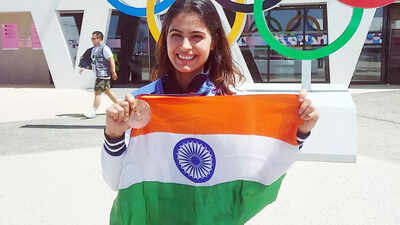
Hailing from Jhajjar, Bhaker made history by becoming the first Indian woman to secure a shooting medal at the Summer Games.

Despite numerous accolades on the international stage, the ultimate prize had remained elusive until now. Bhaker's first Olympic experience in Tokyo ended in heartbreak, with tears streaming down her face.
However, her perseverance and commitment to a rigorous training regimen designed by her demanding coach, Jaspal Rana, finally paid off. On Sunday, Bhaker clinched the bronze medal in the 10m air pistol event, a momentous achievement in a nation where Olympic medals are incredibly rare and cherished.
Reading Gita was guiding force for Bhaker
After her debut Olympics, she learned tough lessons and underwent rigorous training regimens worldwide, which proved to be priceless. To mentally prepare herself following the disappointment in Tokyo, she turned to the Bhagwat Gita and now strongly believes in the concept of karma.
"I have become religious after Tokyo but not in an extreme way (laughs). I believe that there is an energy that guides us and protects us. And there is an aura around us that feeds on that energy. I think there should be some faith in God who has created us," Manu said, as quoted by PTI.
Bhaker was recalling verses from the Gita during an intense final round where competitors were progressively eliminated between the 12th and 22nd shots. The ultimate fate of the silver and gold medals hung in the balance, determined by the last two shots fired.
"The most famous quote in Gita is don't worry about the results, just keep working diligently. So the same was going on in my mind (in the final)," she said.
Bhaker found solace in the presence of her coach, Rana, who was observing from the stands. Throughout the competition, they maintained eye contact, a silent form of communication that provided Bhaker with the resilience to handle the intense pressure of the event.
She shared how reconnecting with Rana during the past year has contributed to her growth and development as an athlete.
"I had figured out where Jaspal sir was sitting in the crowd and I was making sure I was only looking at him and nobody else.
"Looking at him gives me courage and I am grateful that you know all those years of hard work that we have put in together paid off with this and probably even more.
"So we will not let this get the better of us and we will keep trying hard in the future. I owe a lot to him. He made the training so difficult for me that this was not very difficult for me when it came to performing," she said referring to her remaining two events at the Paris Games.
Bhaker displayed remarkable poise and self-assurance throughout the competition, both during the qualification round on Saturday and the final, which took place a day later. Her confident demeanor was evident in her body language, a fact that did not go unnoticed by Abhinav Bindra, a former shooter and one of only two Indian athletes to have won an individual gold medal at the Olympic Games.
"For me the greatest moment was when I saw a picture of her yesterday after qualification. There was no emotion that she displayed which meant she was in business for today," Bindra told PTI.
"Her journey has been wonderful. She is showing what an athlete's life is all about (highs and lows)," he added.
Lessons from Tokyo
She faced a significant setback during the Tokyo Olympics when her pistol malfunctioned during the qualification round. The incident left her deeply disappointed and disheartened.
"In Tokyo, things definitely didn't go to plan. But somewhere, I would be careless. I fell short because of whatever reason.
"I think that if you can't win something, you can learn a lot from it. If I didn't have those lessons in my life in Tokyo, I wouldn't be here today.
"We have a lot of talent here but we lack confidence that whether we can do it or not at this stage or we let the pressure get the better of ourselves.
"I am so grateful that I was able to break this chain and get the medal home."
Intense training, daily fines of 400 Euros and community service
Rana maintained well-defined objectives for her during practice sessions, regardless of the location - be it Luxembourg or Dehradun. Failure to achieve the predetermined scores set by Rana would result in Bhaker paying fines, which were subsequently utilized to assist those in need globally.
"His working method is very different from the rest of the people. Usually he sets a goal and if you score that much, then it's okay.
"And if you don't score that much, then the points that were less in that score, let us say we decided to score 582 and I scored 578. So those four points will amount to 40 Euros and sometimes 400 Euros depending on the situation and country. You have to donate that much," said Bhaker.
More details of their mutual agreement was revealed by Rana who was naturally emotional given the enormity of the occasion.
"I remember once in Dehradun, she bought jaggery worth thousands of rupees to feed to cows. The money would also be used to feed beggars around the world.
"More recently, we were in Luxembourg and she ended up giving 40 Euros to performers in a restaurant. They too were left surprised by that gesture," recalled Rana.
Having finally broken the barrier, Bhaker is in no mood to relax. She senses a medal in women's 25m pistol and 10m air pistol mixed team events.
"She went beyond limits to prepare for this Olympics. There is more to come from her," concluded Rana.

About the Author
TOI Sports DeskEnd of Article
FOLLOW US ON SOCIAL MEDIA
Visual Stories






Top Sports News
TOP TRENDING
Popular Categories
Hot on the Web
Top Trends
Trending Topics
Devara CollectionBigg Boss Kannada 11 Launch Live UpdatePawan KalyanJungle SafariStree 2 OTT ReleaseRose GardenDevara CollectionOTT Release MovieMasala OmeletteEmergencyDevaraTaaza Khabar 2 Twitter ReviewDevara Movie ReviewHealthy RaitasSwatantrya Veer SavarkarColdplay India tour 2025Smartphone DealsApple Macbook Air M1Amazon SaleWordle Answer
Living and entertainment
Latest News
TN: Sri Lankan Navy apprehends 17 fishermen off Rameswaram coast, seizes 2 boatsIndia shooter reports late for final, misses potential medal at Junior World ChampionshipsExclusive - A sneak peek into Zain Imam aka Teerth’s makeup room on the set of Suman IndoriTumbbad re-release box office: The Sohum Shah starrer mints Rs 95 lakhs on third SaturdayAir Arabia launches early bird promotion on 500,000 seats from INR 5,727!Three killed, four injured after bus collides with truck in Bihar's KaimurSivakarthikeyan imitates Kamal Haasan at the 'Amaran' promotional event, gets praises‘Devara’ stars Jr. NTR and Saif Ali Khan try their hand at Punjabi and BhojpuriAir Canada fined for breaching restricted Iraqi airspace"Is Taylor Swift Gonna Be in the Stands for the Chiefs vs. Chargers Showdown?"Stress could be your heart's worst enemyI Say ‘Khamosh’ to Sonakshi: Zaheer Iqbal - ExclusiveBaloch Human Rights slam Pakistan and China, call it 'a failed state'NFL Analyst Sparks Controversy with Deshaun Watson and Joe Flacco Comparison over $230 Million ContractHaryana polls: Explain the 'compelling' circumstances, CEO asks authorities on Dera Sacha Sauda chief Ram Rahim's plea for temporary releaseUnion minister Nitin Gadkari invites Sachin Tendulkar for coffee at newly inaugurated bird park in Maharashtra's JamthaDrake Hogestyn, beloved 'Days of Our Lives' star, passes away at 70Fire Country Season 3: Bode's road to freedom, new characters, and trouble ahead
Copyright © 2024 Bennett, Coleman & Co. Ltd. All rights reserved. For reprint rights: Times Syndication Service