
- News
- Sports News
- Tennis News
- US Open 2024 News
- US Open champion Naomi Osaka makes her point on and off the court
Trending
This story is from September 14, 2020
US Open champion Naomi Osaka makes her point on and off the court
For a sizeable section of the tennis world, Osaka, who stopped an inspired Azarenka 1-6, 6-3, 6-3 to clinch her second US Open crown on Saturday, is the standard. The sky. The limit.

Naomi Osaka posing with her US Open trophy (AP Photo)
“I’ve always wanted to see what they saw,” Osaka said. “It was an incredible moment,” she reflected.
For a sizeable section of the tennis world, Osaka, who stopped an inspired Azarenka 1-6, 6-3, 6-3 to clinch her second US Open crown on Saturday, is the standard.
Top Picks For You

Naomi Osaka's third Grand Slam, anti-racism stand, hailed in Japan
The Japanese powerhouse showed just why during her near two-hour outing on the court. Down 1-6, 0-2, and broken four times in under 40 minutes, Osaka, who had dropped serve just five times en route to the final, appeared to be hurtling to a disappointing loss. Then she dug in, left fist clenched into a ball which she tapped against her heavily taped leg, perhaps reminding herself of what she’s capable of.
An hour later, it was not just a fightback that Osaka had authored, she scripted some daring lines that saw her charge to victory. Hers was the boldest statement, the tallest tennis tale of the Open. But Azarenka, that most inspiring of mothers with a grunt that screams of guts, was the story players and followers wanted to hear.
The Belarusian, who has lived in the United States since she was a teenager, has waged a draining, three-year custody battle with her former boyfriend Billy McKeague. Once topranked on the WTA Tour and winner of two Australian Opens, she battled adversity — including a spate of injuries, depression, failed relationships — as only she can.
In the last few months, with no clear answers in her personal life (read custody case), she came very close to drawing the curtains on her tennis career. Azarenka hadn’t touched her racquet for five months, until she decided to give the game, that is her passion, one last go.
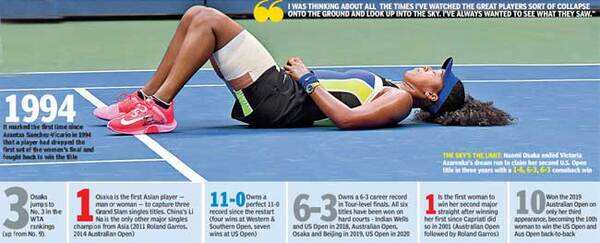
Osaka told the smiling 31-year-old that the final had been a tough outing. The Japanese star confessed to not enjoying it particularly, and even more, wasn’t looking forward to more major finals against the Belarusian, who has climbed to No. 14 in the new rankings.
Azarenka said: “I gave everything that I could. It didn’t come my way. But I’m very proud of the last three weeks that I’ve been here.”
Osaka took hold of the match after wrangling a tough hold in the third game of the second set. She sent Azarenka on a chase thereafter, neutralizing her range from the back of the court, much like the world No. 27 had done to the Japanese’s serve at the start of the match.
“Like two years ago, I maybe would have folded being down a set and a break,” Osaka explained. “The lessons that I learned with life definitely developed me as a person.”
Osaka’s onslaught started earlier. She used the last few months, when the tennis tours had come to a grinding halt, purposefully. “I never had a chance to slow down,” she confessed. “The quarantine gave me a chance to think a lot about what I want to accomplish, what I want people to remember me by. I came into this tournament, or these two tournaments, with that mindset.”
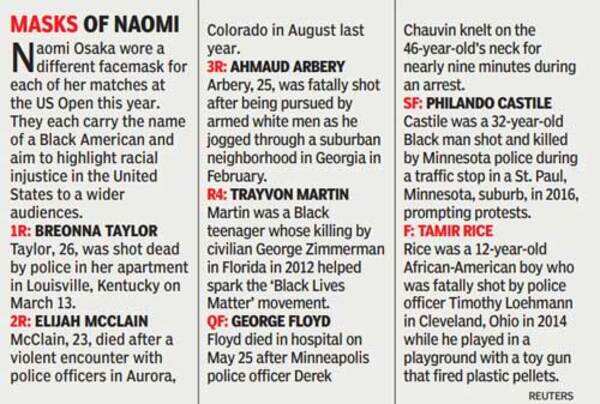
If her tennis has been driven, point-precise and heavy-striking, she has been equally emphatic off the court. The 22-year-old Beverly Hills resident joined the Black Lives Matter protests earlier in the summer. Before sporting masks bearing the names of police victims for her seven outings at Flushing Meadows, she had indicated that she would sit out of her semifinal of the Western and Southern Open. Osaka had stepped up to the line, and she was going to dictate play.
End of Article
FOLLOW US ON SOCIAL MEDIA






Photostories

Top Sports News
TOP TRENDING
Popular Categories
Hot on the Web
Top Trends
Israel Hezbollah WarMost Runs in International CricketVirat KohliIND vs BAN Live ScoreRohit SharmaIndian Team Fastest Test FiftyMohammed SirajUGC NET Result 2024TS DSC Results 2024Women T20 World Cup Points TableWomen T20 World Cup ScheduleShane McMahon Net WorthHezbollah ChiefTourists Not AllowedDiddyTop Management Colleges of IndiaLive Cricket Score
Trending Topics
Devara CollectionMithun ChakrabortyKangana RanautNavratri WishesGandhi Jayanti WishesAnant AmbaniDevara CollectionGandhi Jayanti 2024Masala OmeletteEmergencyDevaraTaaza Khabar 2 Twitter ReviewDevara Movie ReviewHealthy RaitasSwatantrya Veer SavarkarColdplay India tour 2025Smartphone DealsApple Macbook Air M1Amazon SaleWordle Answer
Living and entertainment
Latest News
iVoomi S1 Lite e-scooter launched at Rs 84,999: 180 km range, three-year warranty!Tata Nexon turbo CNG: Variant-wise features with price explainedPMI in India intensifies efforts against Illicit Tobacco Trade to Safeguard Economic Interests and Consumer ProtectionBarbra Streisand pays tribute to late 'A Star Is Born' co-star Kris Kristofferson: 'He was something special'Mumbai vs Rest Of India: Irani Cup tie offers chance for hopefuls and rejects to impress selectorsOlivia Culpo and Christian McCaffrey buy George Clooney's mansion for $14.5 millionKaun Banega Crorepati 16: Amitabh Bachchan believes he is 'Half-Sikh' recalling his maternal roots; reveals his aunts called him 'Amitabh Singh'RG Kar case: Kolkata court extends judicial custody of ex-principal, suspended cop till October 4When Dikembe's shoe size astonished the Mumbai Temple guardHow can Ben Stokes and other overseas players avoid a two-year IPL ban?"Nothing he was doing was believable", Darby Allin picks names wrestler who benefited most from AEW All In 2023 backstage incidentColleagues remember braveheart Delhi Police constable Sandeep: 'Would rush to crime scene alone'5 ways insecurity can ruin a relationshipBengaluru resident exposes fake Flipkart agent attempting to deliver bogus iPhone 15; read online reactionsBihar and Jharkhand among top two states enrolling for contributory pension scheme for farmers"Tyler Huntley’s 'Snoop' Nickname: The Rapper Connection Explained”BTS star V crowned 'Most Handsome Man in the World 2024'Decoding a bowl of Idli Sambhar: From calories to nutrients
Copyright © 2024 Bennett, Coleman & Co. Ltd. All rights reserved. For reprint rights: Times Syndication Service