Kawah Ijen, the Indonesian volcano that breathes blue fire
Kawah Ijen, the Indonesian volcano that breathes blue fire
You're Reading


Synopsis
Ever heard of a volcano that spits blue fire? Well, Indonesia's Kawah Ijen volcano, set close to the eastern tip of Java island, does that! During the day, it is just like any other volcano in the world; but, as night approaches, … Read more
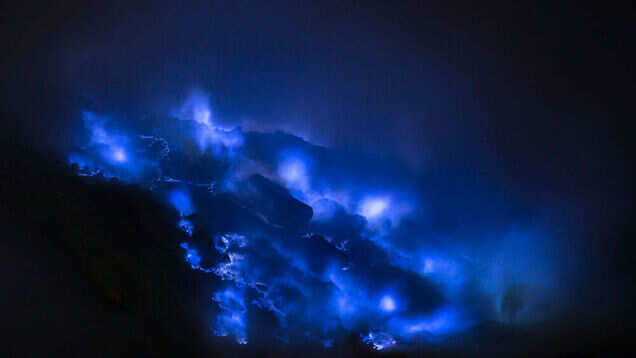
Let’s discover more about this ordinary-yet-extraordinary volcano and the mystery behind the blue fire.


In scientific terms, the Kawah Ijen volcano complex comprises a lot of composite volcanoes sitting on the border between Banyuwangi Regency and Bondowoso Regency of East Java. As far as blue flames are concerned, those are ignited sulfuric gas emerging from the volcanic cracks. When the temperature goes up to 600 °C, the blue flames erupt from the volcano and they can go up to 16 ft high!
This particular phenomenon makes this one of the largest blue flame regions in the world. Besides, the same thing can also be witnessed in Dallol mountain in Ethiopia.
Before the social media era, this volcano was as normal as it could get but after a photographer posted some pictures of the blue flames pouring down the mountain, the place started attracting tourists from all over the world.
How to reach?
To witness this magic, one will have to head to the base of the volcano after midnight. After reaching the base, hike begins into the volcano's crater, which is not everyone’s cup of tea. It’s a treacherous path of more than six km and ascends to heights of around 10000 ft.
Word of precaution
You need to be fully prepared before embarking on your journey to find blue flames. Gas mask is the most important thing you need to carry as when you start your descent into the crater, toxic sulfur fumes will try to stop you by making it difficult to breathe and see.
So, it is suggested that you come here with a local guide and never venture alone or with friends. This might sound a little dangerous, but precautions should be taken.
As the clock strikes three or four in the morning, you’ll see blue flames erupting from the volcano and it might be one of the most beautiful and otherworldly sights ever! The sight of blue fire, slowly flowing down the mountain will wash all your tiredness away.

closecomments

Be the first one to review.
We have sent you a verification email. To verify, just follow the link in the message
end of article

Visual Stories
10 pretty Indian villages to visit this year-end
8 castles in Germany straight out of a fairy-tale
8 tiger reserves every wildlife enthusiast should visit in India

10 animals that are easily spotted in Ranthambore National Park
How to prepare for a night safari in India?

9 rare animals to spot in the Western Ghats and where to find them


Trending Stories
6 incredible animals that are found only in India, and where tourists can see them
Russian traveller, now settled in India, shares 12 things that surprise her the most in this country
This remote village in Russia wakes up to “Hare Krishna”; how Indian travellers can reach here
7 countries where Indians can enjoy island vacations; all under INR 80,000!
48°C and counting: What India’s brutal heatwave is doing to summer travel plans




Comments (0)