

Russia’s Oreshnik: What makes the multi-warhead ballistic missile used against Ukraine so hard to stop
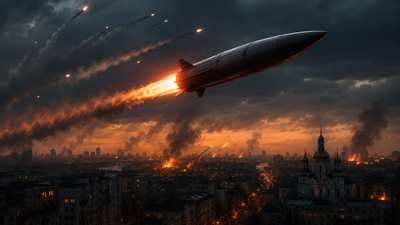
Why is the Oreshnik difficult to intercept?
- Unlike cruise missiles, which fly within the atmosphere at lower altitudes, the Oreshnik follows a ballistic trajectory before descending toward targets at hypersonic speeds during its terminal phase.
- The missile is classified as an intermediate-range ballistic missile (IRBM) with an estimated range of 3,500 to 5,000 kilometres, giving it the ability to strike targets across much of Europe.
- One of the biggest challenges for air defence systems is the missile’s extreme velocity. The Oreshnik is believed to travel at speeds exceeding Mach 10, or nearly 12,000 km/h, drastically reducing the reaction time available to defending forces.
- Analysts say that at such speeds, existing missile defence systems have only minutes, or in some cases seconds, to detect, track and attempt interception.
- Another major factor is the missile’s MIRV capability, or Multiple Independently Targetable Reentry Vehicles. This allows a single
Oreshnik missile to release multiple warheads during its final phase of flight, potentially targeting different locations simultaneously. - The use of MIRVs complicates interception because air defence systems may have to engage several incoming warheads at once instead of a single target.
- The missile is also believed to use a multi-stage solid-fuel rocket motor, enabling rapid launch readiness and mobility. Defence experts say it may additionally deploy decoys and countermeasures designed to confuse radar systems and evade interceptors.
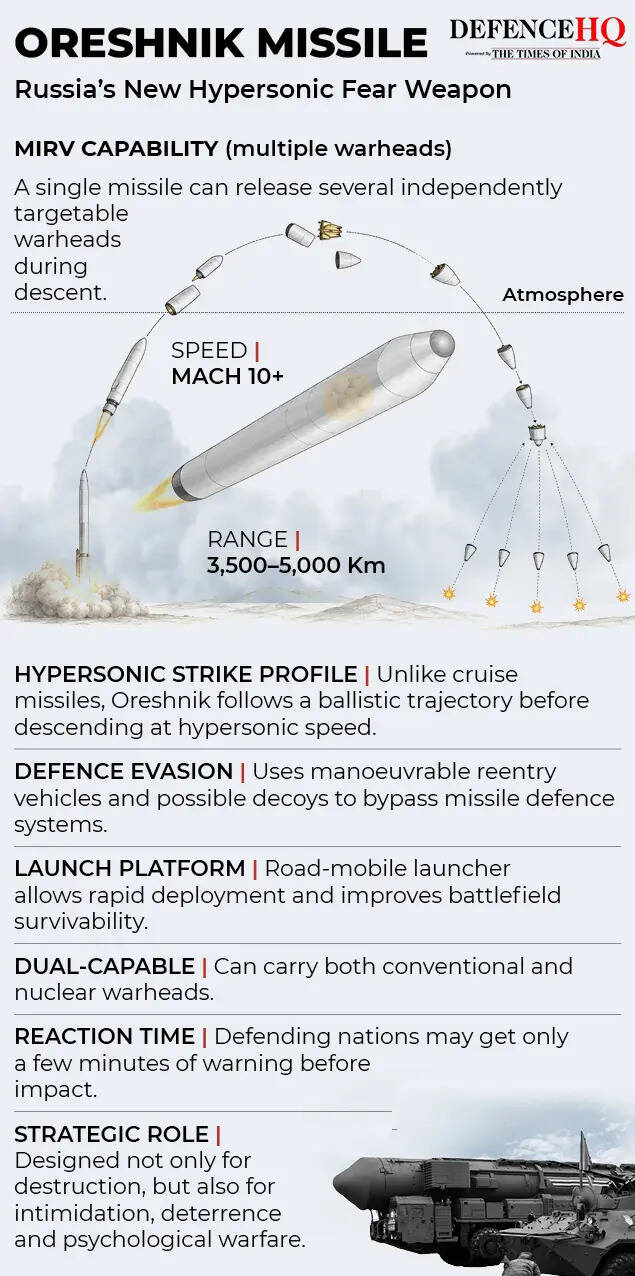
Oreshnik missile
More than just a military weapon
End of Article
Tired of too many ads?go ad free now
Arsenal
- Missiles
- Tanks
- Guns
- Submarines
RS-28 Sarmat Satan II
Missiles
- RS-28 Sarmat Satan II
Russia
- Trident II D5
USA
- LGM-30G Minuteman III
USA
- RS-24 Yars
Russia
- M51.3
France
- Agni-V
India
- Hwasong-17
N. Korea
- RT-2PM2 Topol-M
Russia
- Julang-2
China
- Agni-V
India
- Agni-P
India
- K-4
India
- BrahMos
India
- Pralay
India
- Nirbhay
India
- Akash-NG
India
- Astra Mk2
India
- Rudram-1
India
- MR-SAM
India
- Iron Dome Tamir
Israel
- David's Sling Stunner
Israel
- Arrow 2
Israel
- Arrow 3
Israel
- Jericho III
Israel
- LORA
Israel
- Delilah
Israel
- Popeye Turbo ALCM
Israel
- Spike NLOS
Israel
- Python 5
Israel
- Derby
Israel
- Patriot PAC-3 MSE
USA
- THAAD
USA
- SM-3 Block IIA
USA
- SM-6
USA
- Tomahawk Block V
USA
- JASSM-ER
USA
- AIM-120D AMRAAM
USA
- BGM-109 Tomahawk Block IV
USA
- Shahab-3
Iran
- Emad
Iran
- Sejjil-2
Iran
- Kheibar Shekan
Iran
- Fattah-1
Iran
- Soumar
Iran
- Paveh
Iran
- Noor
Iran
- Khalij Fars
Iran
- Shahed-136
Iran
- Bavar-373
Iran
- Fateh-110
Iran
Russia
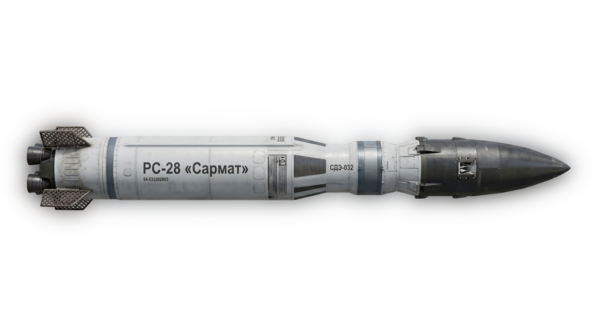
Missile
RS-28 Sarmat Satan II
Service Start
2023
Service End
Present
Range
18000 km


