As tensions in the Middle East continue to focus attention on maritime security and the strategic Strait of Hormuz, one aircraft has repeatedly found itself back in the spotlight: the MH-53E Sea Dragon.
For nearly four decades, the massive helicopter has served as the US Navy's primary airborne mine countermeasures platform, capable of detecting, sweeping and neutralising naval mines that threaten commercial shipping and military vessels.
However, the aircraft is now approaching the end of its operational life, with the Navy planning to retire its remaining fleet as it shifts towards newer technologies.
What is the MH-53E Sea Dragon?
The MH-53E Sea Dragon is a specialised heavy-lift helicopter developed by Sikorsky Aircraft for the US Navy. It is derived from the CH-53 Super Stallion but was extensively modified for maritime operations, particularly mine countermeasure missions.
The aircraft first flew in 1981 and entered service in 1986. It remains one of the largest helicopters ever operated by the US military. Unlike conventional helicopters designed primarily for troop transport or combat support, the Sea Dragon was built to perform the demanding task of clearing naval mines from strategic waterways, according to website Aerocorner.
The helicopter's mission has become particularly relevant amid concerns about maritime security in the Persian Gulf and the Strait of Hormuz. The strategic waterway handles a significant share of global oil shipments, making any threat to shipping lanes a major international concern.
Recent statements by US officials have highlighted fears that Iran could deploy naval mines in the region, potentially disrupting commercial traffic and military operations. In such scenarios, aircraft like the MH-53E are designed to rapidly locate and remove mine threats, helping reopen vital shipping routes, according to The War Zone.
The Sea Dragon's primary mission: Mine warfare
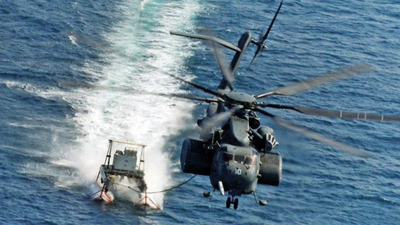
The MH-53E's most important role is Airborne Mine Countermeasures (AMCM). Instead of carrying out traditional combat missions, the helicopter often tows specialised mine-hunting and mine-sweeping equipment behind it while flying at low altitude over the sea.

.
Using advanced sensors and mine countermeasure systems, the aircraft can detect underwater mines, sweep minefields and support mine neutralisation operations. By towing large mine-hunting sleds through the water, the helicopter can search and clear large areas much faster than many surface vessels.
This capability has made the Sea Dragon one of the world's most specialised and effective airborne mine-clearing platforms.
Beyond mine warfare, the MH-53E also performs heavy-lift and Vertical Onboard Delivery (VOD) missions. The helicopter is capable of transporting troops, vehicles, equipment and supplies between ships and shore installations.
Its enormous lifting capacity allows it to carry heavy external loads, making it an important logistics asset during military operations. The aircraft's extended fuselage and enlarged fuel tanks also enable it to undertake long-duration missions.
Advanced systems and capabilities
The Sea Dragon incorporates a Precision Navigation System that combines GPS technology, Doppler radar and specialised approach, hover and tow systems. These allow crews to maintain extremely precise flight paths while towing heavy mine-sweeping equipment across challenging maritime environments.
The helicopter is also equipped with UHF, VHF and HF radios, secure communications systems and Identification Friend or Foe (IFF) technology, enabling it to operate effectively alongside naval and allied forces.
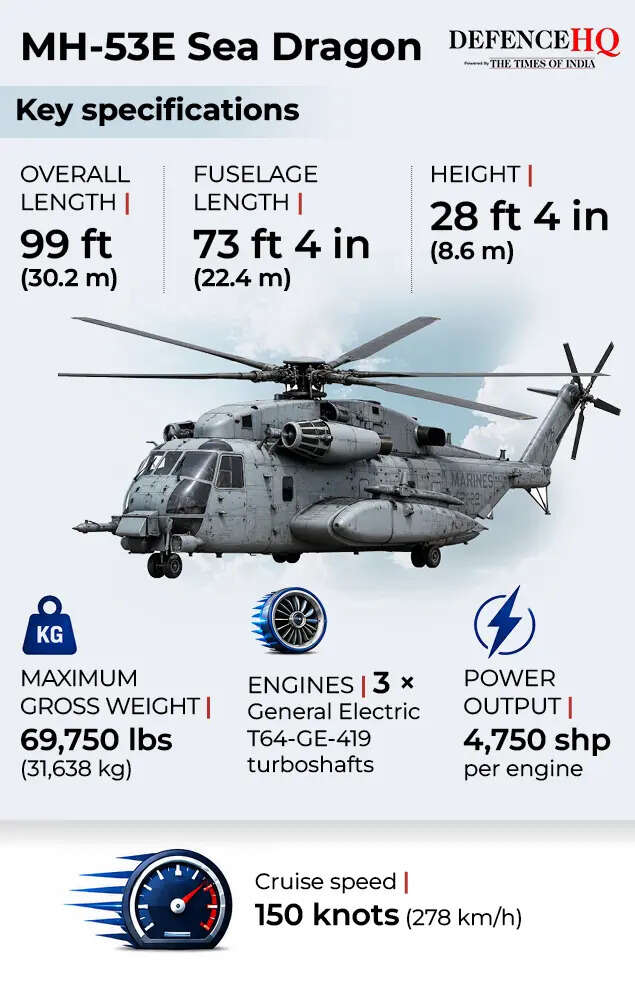
The MH-53E is among the largest helicopters ever fielded by the US military. The aircraft measures 99 feet in overall length, while its fuselage alone stretches more than 73 feet. Standing over 28 feet high, it has a maximum gross weight of nearly 70,000 pounds.
Power comes from three General Electric T64-GE-419 turboshaft engines, each producing roughly 4,750 shaft horsepower. These engines allow the aircraft to cruise at approximately 150 knots, or around 278 kilometres per hour, while carrying heavy payloads or towing specialised mine countermeasure systems.
Depending on the mission, the Sea Dragon is operated by two pilots along with between one and six additional crew members.
The MH-53E has long been regarded as one of the most challenging aircraft in US naval aviation. Mine countermeasure operations require sustained low-altitude flying over open water while towing heavy equipment behind the aircraft. Crews must maintain exceptional precision for extended periods, often in difficult weather and sea conditions.
The helicopter's enormous size, combined with the complexity of its missions, has contributed to a number of serious accidents throughout its service history.
Why is the Navy retiring it?
Despite its unique capabilities, the Sea Dragon is gradually being phased out as part of a broader transformation of the Navy's mine warfare force.
The service plans to replace many of its functions with MH-60S Seahawk helicopters supported by advanced mine countermeasure systems, alongside uncrewed underwater vehicles and uncrewed surface vessels. The shift reflects the Navy's increasing focus on autonomous technologies and distributed operations.
However, the transition remains controversial. Some defence analysts and former operators have questioned whether the newer systems can fully replicate the Sea Dragon's ability to rapidly clear large minefields during a major conflict.
Even as retirement approaches, the MH-53E remains one of the most capable airborne mine countermeasure platforms ever built. Naval mines continue to pose a serious threat to global shipping and military operations, particularly in strategic chokepoints such as the Strait of Hormuz.
In any future crisis involving maritime trade routes, the ability to quickly locate and remove mines could prove crucial. For nearly 40 years, that responsibility has largely fallen to the MH-53E Sea Dragon, a giant helicopter whose unique mission has made it one of the most distinctive aircraft in the US Navy's inventory.