
Dowry harassment to divorce settlement: 5 Indian marital cases that changed marriage rights for women
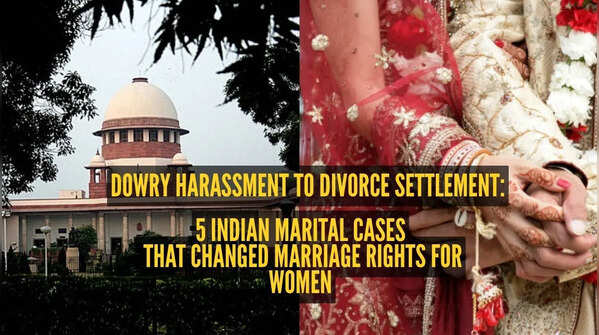
5 Indian marital cases that changed marriage rights for women
The Indian society is currently shaken by a marital case that has left unmarried woman scared of the institution and married ones questioning their own. On May 12, the death of Twisha Sharma in Bhopal made a media frenzy when it was alleged that she was tortured by her husband and mother-in-law over dowry demands and eventually died. While the investigation in the case goes on, with her husband of 5 months missing, the case has highlighted just how difficult the journey for marital life and rights has been for women. Here are five landmark Indian marital cases that changed marriage rights for women:

Shayara Bano vs Union of India
In one of the most important judgments for marital life and Muslim women, the Supreme Court struck down the practice of 'triple talaq' or talaq-e-biddat, where a Muslim man could instantly divorce his wife by saying 'talaq' three times. It was Shayara Bano who challenged the practice after her husband sought a divorce through a letter, and argued that the system violated her constitutional rights to equality and dignity. A five-judge Constitution bench ruled 3:2 that instant triple talaq was unconstitutional since it was arbitrary and discriminatory against women.

Joseph Shine vs Union of India
Section 497 of the Indian Penal Code criminalised adultery, but only punished men who had relations with a married woman "without the husband's consent." Under the law, the woman was exempted from punishment as an abettor and married women could not press charges against their adulterous husbands. Women were treated as possessions of their husbands. In 2018, Joseph Shine contested this in a PIL. The Supreme Court unanimously struck down the adultery law, calling it unconstitutional and patriarchal. The judges ruled that marriage does not destroy a woman's individuality, dignity or sexual autonomy and sexual privacy and autonomy are core components of an individual's right to life and personal liberty.

Lata Singh vs State of Uttar Pradesh
Lata Singh, a 27-year-old graduate who was pursuing her Master's course in Hindi from Lucknow University was living with her brother when she left his house and got married to a man from another caste. They had a child together when her brother filed a missing person report while also threatening to kill her husband since it was an inter-caste marriage. The Supreme Court ruled that every adult woman had the right to marry any person of her choice. It condemned honour-based harassment and directed authorities to protect couples facing threats from relatives or communities. It also added that if the parents of the man or woman don't approve of the inter-caste or inter-religious marriage then the maximum they can do is cut off social relations with them.

Independent Thought vs Union of India
Indian law earlier allowed marital intercourse with a wife aged between 15 and 18 years, even though sex with minors outside marriage was considered rape. Independent Thought, an NGO working for child rights argued that child marriage and marital rape of minors violated bodily integrity and demanded that the law treat all females under 18 as children. In a historic decision delivered on October 11, 2017, the Supreme Court declared Exception 2 to Section 375 unconstitutional, effectively making the universal age of consent for females in India to be 18. It also ruled that marriage does not strip a child of her bodily integrity or her right to be protected from sexual violence.

Shobha Rani vs Madhukar Reddi
Section 13(1) (i-a) of the Hindu Marriage Act provides that a marriage may be dissolved if one spouse has treated the other with cruelty. The act does not define "cruelty" though. In 1982, Shobha Rani sought a divorce from Madhukar Reddi on the grounds of cruelty, adding that her husband and his family persistently demanded dowry, causing her mental distress. Her case was dismissed by both the trial court and the High Court. In the end, the Supreme Court held that persistent dowry demands, particularly when admitted by the husband, constitute mental cruelty and are sufficient grounds for divorce. Moreover, the husband's admission and the wife's credible testimony were found sufficient to establish cruelty. The case marked a significant shift in acknowledging the mental cruelty in the context of dowry demands.
Featured In etimes

