
- News
- India News
- No ground for police custody, rules court
Trending
This story is from August 20, 2015
No ground for police custody, rules court
A magisterial court on Wednesday ordered the release of five students of the Film and Television Institute of India (FTII) on bail against personal release bonds of Rs 3,000 each.

PUNE: A magisterial court on Wednesday ordered the release of five students of the Film and Television Institute of India (FTII) on bail against personal release bonds of Rs 3,000 each.
The students were arrested from the institute’s campus on Tuesday midnight in connection with Monday’s gherao in the FTII director’s office.
READ ALSO: 5 arrested FTII students get bail
The bail pleas were moved soon after the court of Judicial Magistrate First Class Narendra Joshi ruled that police did not furnish sufficient reasons to justify custodial remand of the arrested students. He ordered their remand in magisterial custody till September 1. A person can apply for bail after he is granted custodial remand. The court also directed the students to cooperate with the police as and when summoned for inquiry.
READ ALSO: In late night swoop, cops enter FTII campus, arrest 4 students
The students have been on strike for over two months now against the government’s move to appoint actor Gajendra Chauhan as chairman of the FTII governing council. The institute’s authorities had issued warnings and recently decided to start with the assessment of the 2008 film projects of students which sparked the gherao.

The students were protesting in the director's office on Monday afternoon against the decision on the grounds that their projects were incomplete owing to certain inadequacies for which the institute was responsible and that the heads of departments and the academic council had recommended against such assessment exercise.
During the commotion that prevailed when the police, present on the spot, tried to move the students out of the room, a glass pane in the director's cabin broke.
Late on Tuesday night, FTII director Prashant Pathrabe registered a complaint with the Deccan Gymkhana police naming 17 students as involved in the gherao and related incidents.
Another 30 students were also booked for offences ranging from unlawful assembly, rioting, wrongful restraint, causing hurt, damage to public property (all bailable offences) and obstructing a public servant from performing his duties, which is a non-bailable offence that attracts up to two years prison term.
As it happened: FTII row
Following this, five students were arrested from the campus and the police were searching for the remaining 12 students.
The arrested students were produced around 3.15pm before JMFC Joshi by Deccan Gymkhana police inspector (crime) Sucheta Khokale, who submitted a report seeking their remand on the grounds that the police needed to effect some more arrests, verify the statements and investigate possible involvement of other elements behind the agitation.
Shivade argued that the police action was in violation of the Supreme Court guidelines relating to police’s powers to arrest especially when the offence attracts punishment of less than seven years.
“The police were bound to justify their action by furnishing a separate report specifying the reasons for arrest but they did not do so in their remand report,” he said.
Shivade argued that the police misconstrued the students’ meeting with the FTII director as an unlawful assembly when all they were wanting to know from the director was that how can he proceed with the assessment of the incomplete projects when the department heads and the academic council had said that such an exercise was unwarranted at this point in time. The students’ career was at stake and they were justified in meeting the director in the presence of other institute officials, he contented.
He argued that it was not the police’s case that they wanted to recover some material and valuable information from the arrested students and such requirement is key to custodial remand.
Shivade played a video clip of the agitation on a laptop before the court to show that the students were not at fault for the breaking of the glass pane in the director’s office. He said the film is quite clear for the police to identify all those who were present in the room and hence there was no need for custodial remand of the arrested students.
READ ALSO: FTII director defends action against students, says 'I was mentally tortured'
“This is a perfect case of a genuine dispute between the student and the institute authority and the police has no justifiable reason for seeking their remand,” he added.
Shivade argued that the police could have acted on their own on Monday instead of waiting till the FTII director’s FIR on Tuesday night, if it was their case that the students indulged in rioting and other offences.
Lawyer Asim Sarode, also representing the students, argued that the manner in which the arrests were made was nothing but an attempt to make the students appear like hardened criminals. He argued that the police action was an attempt to break the strike. There was no urgency for the arrest considering that the students have been agitating peacefully for two months and have cooperated with the police whenever summoned for questioning, he said.
The students were arrested from the institute’s campus on Tuesday midnight in connection with Monday’s gherao in the FTII director’s office.
READ ALSO: 5 arrested FTII students get bail
The bail pleas were moved soon after the court of Judicial Magistrate First Class Narendra Joshi ruled that police did not furnish sufficient reasons to justify custodial remand of the arrested students.
In a related development, 12 other FTII students, named in the police FIR relating to the gherao, were granted interim anticipatory bails by the court of additional sessions judge S Kachare, their lawyer Shrikant Shivade told TOI.
READ ALSO: In late night swoop, cops enter FTII campus, arrest 4 students
The students have been on strike for over two months now against the government’s move to appoint actor Gajendra Chauhan as chairman of the FTII governing council. The institute’s authorities had issued warnings and recently decided to start with the assessment of the 2008 film projects of students which sparked the gherao.
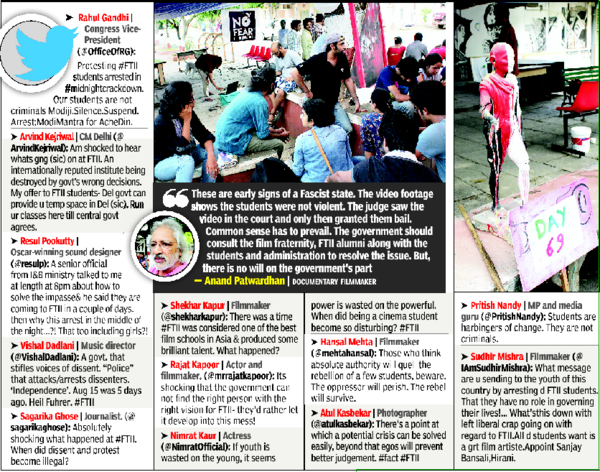
The students were protesting in the director's office on Monday afternoon against the decision on the grounds that their projects were incomplete owing to certain inadequacies for which the institute was responsible and that the heads of departments and the academic council had recommended against such assessment exercise.
During the commotion that prevailed when the police, present on the spot, tried to move the students out of the room, a glass pane in the director's cabin broke.
Late on Tuesday night, FTII director Prashant Pathrabe registered a complaint with the Deccan Gymkhana police naming 17 students as involved in the gherao and related incidents.
Another 30 students were also booked for offences ranging from unlawful assembly, rioting, wrongful restraint, causing hurt, damage to public property (all bailable offences) and obstructing a public servant from performing his duties, which is a non-bailable offence that attracts up to two years prison term.
As it happened: FTII row
Following this, five students were arrested from the campus and the police were searching for the remaining 12 students.
The arrested students were produced around 3.15pm before JMFC Joshi by Deccan Gymkhana police inspector (crime) Sucheta Khokale, who submitted a report seeking their remand on the grounds that the police needed to effect some more arrests, verify the statements and investigate possible involvement of other elements behind the agitation.
Shivade argued that the police action was in violation of the Supreme Court guidelines relating to police’s powers to arrest especially when the offence attracts punishment of less than seven years.
“The police were bound to justify their action by furnishing a separate report specifying the reasons for arrest but they did not do so in their remand report,” he said.
Shivade argued that the police misconstrued the students’ meeting with the FTII director as an unlawful assembly when all they were wanting to know from the director was that how can he proceed with the assessment of the incomplete projects when the department heads and the academic council had said that such an exercise was unwarranted at this point in time. The students’ career was at stake and they were justified in meeting the director in the presence of other institute officials, he contented.
He argued that it was not the police’s case that they wanted to recover some material and valuable information from the arrested students and such requirement is key to custodial remand.
Shivade played a video clip of the agitation on a laptop before the court to show that the students were not at fault for the breaking of the glass pane in the director’s office. He said the film is quite clear for the police to identify all those who were present in the room and hence there was no need for custodial remand of the arrested students.
READ ALSO: FTII director defends action against students, says 'I was mentally tortured'
“This is a perfect case of a genuine dispute between the student and the institute authority and the police has no justifiable reason for seeking their remand,” he added.
Shivade argued that the police could have acted on their own on Monday instead of waiting till the FTII director’s FIR on Tuesday night, if it was their case that the students indulged in rioting and other offences.
Lawyer Asim Sarode, also representing the students, argued that the manner in which the arrests were made was nothing but an attempt to make the students appear like hardened criminals. He argued that the police action was an attempt to break the strike. There was no urgency for the arrest considering that the students have been agitating peacefully for two months and have cooperated with the police whenever summoned for questioning, he said.
About the Author
Vishwas KothariEnd of Article
FOLLOW US ON SOCIAL MEDIA






Hot Picks
TOP TRENDING
Trending Stories
In India
Entire Website
- 'We were treated like slaves, made to work for 15 hours a day': Tricked into Ukraine war, 3 from Karnataka return home
- 'My father was on the flight': Jaishankar opens up about 1984 Air India hijack
- Airtel CEO Gopal Vittal sends letter to Reliance Jio, Vodafone-Idea, Tata Tele and BSNL CEOs; here's what he said
- Prince Harry to celebrate 40th birthday away from Meghan Markle
- Haitian immigrant pet-eating row: Ohio woman accused of eating cat is US citizen, video is not from Springfield
- Kejriwal out of jail; 'CBI arrest only to frustrate ED case bail': SC judge
- Donald Trump reveals what Laura Loomer is to his campaign: 'I don't control her'
- Hamster Kombat Daily Cipher Codes and Combo Cards for September 14, 2024: Unlock up to 1 million coins
- Laura Loomer's photo with Donald Trump viral. People ask where's Melania, where's wedding ring
- Garena Free Fire MAX redeem codes for September 13: Win in-game goodies and rewards
- BJP expels functionary for posting clip of man’s apology to FM Sitharaman on GST
- Opposition offered to back me as prime minister, I refused: Nitin Gadkari
- Why you should not be fooled by ‘20-year SIP crorepati’ dream
- Taj Mahal's dome leak due to cracks in metal set due to rust: ASI
- Recruitment drive for 10,000 Israel jobs to start tomorrow
- 'Tu suicide kar le': Paralympics champion Navdeep
- The new ‘green revolution’ will not feed India
- Melinda Gates reveals the 'best part' of not working with ex-husband Bill Gates
- Encounter breaks out between security forces, terrorists in J&K's Poonch
- Kolkata rape-murder case: 'Police involved,' says Suvendu Adhikari

Popular Categories
Hot on the Web
Top Trends
Trending Topics
World Largest HorseEID WishesOnam WishesPriyanka Chopra TattooKottukkaali OTT ReleaseNarendra ModiGhaziabad Juice SellerHair LossSudha MurtyMalayalam ProducersIndia's Best Dancer 4Simi GarewalDilli BabuIndian National ParksLaung BenefitsVikas SethiApple iPhone 16Donald TrumpAadhar Card UpdateWordle Answer
Living and entertainment
Latest News
Premier League: Erling Haaland hits another two in Man City's come from behind win over BrentfordMeerut building collapse: 3 dead; rescue operations continueDon’t rethink pink. Plane truth is we need women-friendly seatsTCS teams up with Tata Electronics for ‘made-in-India’ chipsWWE NXT Star Reunites With Father At TNA Victory RoadKashmir will soon get a government, but those blinkers are going to stay‘There is no affordable transport currently, the biggest problem in Goa is taxis’IIM Jammu hosts 'Fostering Academia and Industry Partnerships' event at BengalaruMP Bharat, TDP Andhra President Srinivas promise action to safeguard protection of steel plant workersLiverpool slump to shock 1-0 home defeat by Nottingham ForestVinith Venkatesh scores in ISL debut as Bengaluru FC edge past East BengalJitendra Jorwal takes charge as new Ludhiana deputy commissioner, vows seamless delivery of services'Hindi must be made acceptable, not imposed'37 year old beats fatty liver condition with unbelievable weight lossCong holds protests on second anniversary of MLA defectionsCouncillor's bro, 4 others held for hurling stones at Vande BharatCancer, Weekly Horoscope, September 15 to September 21, 2024: Encounter a busy week filled with unexpected challengesDoctor posts morphed clip of med classmate, held in Tamil Nadu
Copyright © 2024 Bennett, Coleman & Co. Ltd. All rights reserved. For reprint rights: Times Syndication Service