
- News
- City News
- bengaluru News
- Bengaluru chokes as Deepavali crackers push air quality to dangerous levels
Trending
Bengaluru chokes as Deepavali crackers push air quality to dangerous levels
Bengaluru experienced a significant dip in air quality this Deepavali due to widespread firecracker use, despite regulations promoting green crackers. PM2.5 levels soared past the 'poor' threshold in most monitored areas, raising health concerns, particularly for respiratory health, marking a concerning post-pandemic peak.
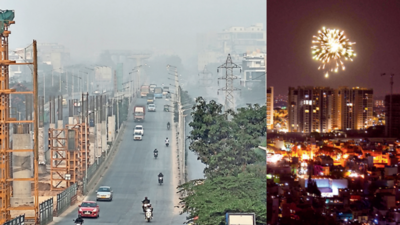
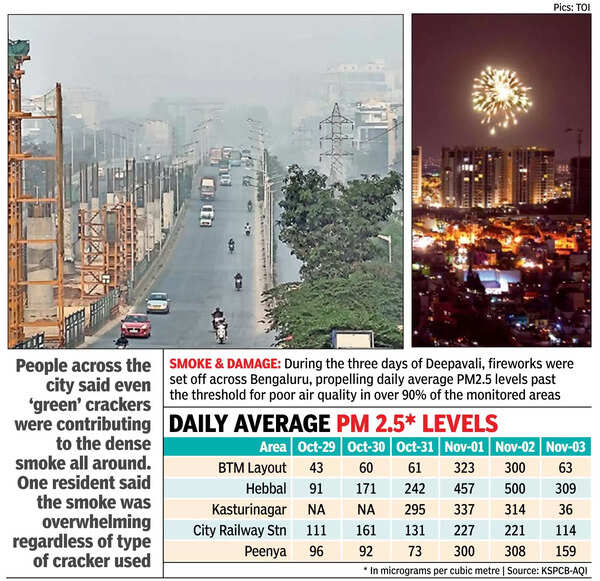
In the past few days, fireworks were set off extensively, propelling daily average PM2.5 levels past 100 microns per cubic metre - the threshold for poor air quality - in over 90% of the monitored areas. PM2.5, an air quality index, is invisible particulate matter of 2.5 microns thickness suspended in the air. PM2.5 is measured as micrograms per cubic metre and averaged over 24 hours. BTM Layout, with a PM2.5 level of 323 microns/cubic metre, Hebbal (457), Kasturinagar (337), Peenya (300), and City Railway Station (227) were among the worst-affected areas on Nov 1.
The areas around Hebbal saw the PM2.5 level touching 500 on Nov 2 - one of the highest in the city - attributed to an overwhelming concentration of fireworks and heavy traffic along KIA Road.
Shanth A Thimmaiah, chairman of KSPCB, said, "Over the past four days, vehicular movement surged, especially on Nov 3 (Sunday). This increase led to a rise in ground-level pollutant concentration. With limited atmospheric buoyancy, these particles are likely to remain at ground level for an extended period."
Residents across the city said even "green" crackers were contributing to the dense smoke. "We were told green crackers were less polluting, but they don't seem to be any different," said Ravi Kumar, a resident of Kasturinagar. "The smoke was overwhelming and my family had to stay indoors with the windows closed," he elaborated.
End of Article
FOLLOW US ON SOCIAL MEDIA



Photostories

Hot Picks
TOP TRENDING
Explore Every Corner
Across The Globe
Popular Categories
Hot on the Web
Top Trends
GRAP Stage 4Janja Lula da SilvaDonald TrumpTaylor SwiftDehradun AccidentManipur CurfewTom BradyModi Today's VisitLive Cricket ScoreDiddyIPL Auction Full ListBorder Gavaskar Trophy 2024BPSC TRE 3.0 Result 2024Robert F. Kennedy JrKerala Lottery ResultsJerry JonesT20 Cricket RecordCBSE Board Exam Syllabus
Trending Topics
Kanguva ReviewSkin Care Tips for WinterKanguva CollectionDhanushThe Sabarmati Report Collectionkanguva Twitter ReviewThe Sabarmati Report Movie ReviewKanguva Movie ReviewSingham Again ReviewKartik Purnima 2024Bigg Boss 18Rupali GangulySushmita SenSupermoon 2024kanguva OTT ReleaseTulsi GabbarBlox Fruit CodesBsnl Recharge PlansNetflix Down
Living and entertainment
Latest News
Tatas to buy stake in Apple partner Pegatron's India businessJohns Hopkins in talks for India campusPrince William and Kate Middleton consider Lady Louise, the Duke of Edinburgh's daughter, a 'royal asset'Air turns ‘severe plus’; schools to go online except for Standard 10, 12In pre-poll blow to AAP, Kailash Gahlot quits party & Delhi Cabinet80-year-old who lives alone in a Uttarakhand ghost village is an unlikely film heroineOklahoma superintendent Ryan Walters faces criticism over religious freedom video mandate in schoolsSeek nod for Friday sermon topics, waqf board tells Chhattisgarh imamsEyeing 'office of profit' tweaks, Centre seeks to replace 1959 lawDigital clutter could affect your mental health, experts sayAhead of Maharashtra, Delhi polls, Centre & city gas companies spar over CNG priceAmid global race, India tests its first hypersonic missile2 more bodies float down river; attacks on homes of Manipur MLAs continue'Biren Singh failed': NPP withdraws support to BJP government in ManipurHezbollah media chief Mohammed Afif al-Naboulsi killed in Israeli strike on BeirutHouse panel on OBCs likely to push for 'equivalence of posts'6 ways to eat sesame seeds for melting belly fatUnder BJP, Manipur neither 'ek' nor 'safe': Mallikarjun Kharge
Copyright © 2024 Bennett, Coleman & Co. Ltd. All rights reserved. For reprint rights: Times Syndication Service