
- News
- City News
- bengaluru News
- Full bench of Karnataka high court set to hear hijab petitions today
Trending
This story is from February 10, 2022
Full bench of Karnataka high court set to hear hijab petitions today
A full bench of the Karnataka high court comprising Chief Justice Ritu Raj Awasthi, Justice Krishna S Dixit and Justice Jaibunissa M Khazi will hear a batch of petitions challenging the ban on hijab in schools and colleges on Thursday. The hearing will begin at 2.30pm.
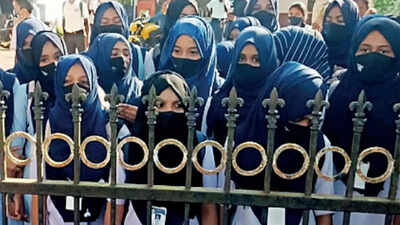
The bench was also of the view that the interim prayers should also be placed before a larger bench. (File photo)
Earlier on Wednesday, a single judge referred the petitions to a larger bench of the HC.

Noting that all these matters have given rise to certain constitutional questions in view of some aspects of personal law, the judge pointed out that judgments of as many as three high courts have been cited and more than half-a-dozen judgements of the apex court have also been referred to.
"This matter was very passionately argued yesterday by both sides for some time, from which the judge has benefited. Regarding the enormity of the importance of the questions that are debated, the court is of the considered opinion that the papers be put at the hands of honourable Chief Justice to consider if a larger bench can be constituted in the subject matter," the judge observed in his order.
The bench was also of the view that the interim prayers should also be placed before a larger bench. "In the above circumstances, the registry is directed to place the papers before the Chief Justice immediately regarding the urgency pleaded in the matter. It is open to the petitioners to seek interim relief after a decision is taken by the Chief Justice," the judge further observed.
‘CDC decides on uniforms'
Earlier, during the brief hearing, Advocate General Prabhuling K Navadgi submitted that all these petitions are misconceived. He told the court that a plain reading of February 5, 2022, circular makes it clear that it is the College Development Committee (CDC) that should decide the uniform of each institution and the state government does not take a decision and prima facie a case does not arise.
He further claimed that in so far as hijab is concerned, religious identity is impermissible and added that this is not an essential religious practice and students must attend classes by adhering to the uniform prescribed by the CDC.
‘No girl child should be deprived of education'
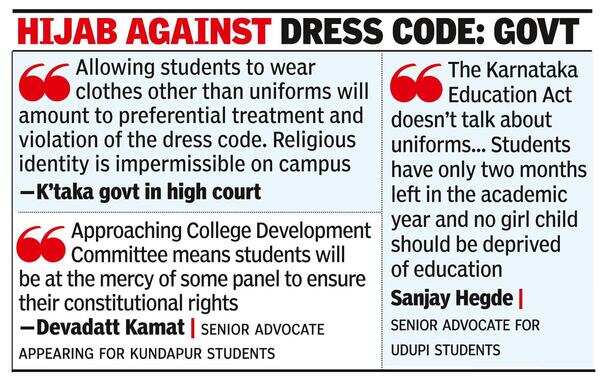
Senior advocate Sanjay Hegde, appearing for petitioner-students from a Udupi college, submitted that the students have only two months left in the academic year.
"The problems arise from Udupi, my hometown. Is there a power to prescribe a uniform? What is important is these students return back to colleges. No heaven will fall in two months. No girl child can be deprived of education," he submitted.
"Whether students go to school or not matters to us; whether the principal of a school allows us to sit in a class with hijab. There is nothing in Karnataka Education Act about uniform. What it has is about curriculum. Even assuming the state government has power, can the same be exercised to exclude certain children totally. I would say ‘no'," he added.
He also recalled that there was no provision for women to study at another college in Udupi, and his mother was a co-petitioner seeking right to education at the college.
As regards to the AG's suggestion for approaching the CDC, senior advocate Devadatt Kamat termed it as worse and added that would mean students are at the mercy of some committee to ensure their constitutional rights.
End of Article
FOLLOW US ON SOCIAL MEDIA









Photostories

Hot Picks
TOP TRENDING
Popular Categories
Hot on the Web
Top Trends
Stock Market TodayBasit AliBrittany MahomesRavichandran AshwinBabar AzamKanpur Test Match RecordsUGC NET Result 2024Tirupati LadduIndia T20 WC SchedulePPF CalculatorBryonna Burrows Net WorthWomen T20 World Cup Points TableWomen T20 World Cup ScheduleIND vs PAK T20 WC MatchDiddyTop Management Colleges of IndiaLive Cricket Score
Trending Topics
GovindaNavratri Colours 2024Solar Eclipse 2024 TimesNavratri WishesGandhi Jayanti WishesDevara CollectionGOAT OTT ReleaseGandhi Jayanti 2024Rajinikanth Health UpdateNavratri HistoryDevaraGovinda NewsDevara Movie ReviewHealthy RaitasSwatantrya Veer SavarkarColdplay India tour 2025Upcoming Smartphones In OctoberAmazon SaleSony Bravia 55 inch 4k Ultra HD TVWordle Answer
Living and entertainment
Latest News
Aishwarya Majmudar and Hitu Kanodia light up Ahmedabad with electrifying Garba nightThe Amazing Spider-Man films starring Andrew Garfield now streaming for freeXionism In Lux: Why global luxury biz bosses will obsess over China’s communist bossNavratri Day 1 colour: How to style the shade of OrangeManipur: Congress MP writes to Amit Shah for safe release of 2 'abducted Meitei youths'Qualifier Yash upsets second seed Manish at Fenesta OpenAquarius, Daily Horoscope Today, October 03, 2024: Romantic life may experience a few bumps'Scam marathon' under JMM-Congress-RJD rule 'biggest obstacle' to Jharkhand's development: PM ModiPopulation of Hindus & tribals declining in Jharkhand, says PM ModiChange Begins Here, as TOI shines a spotlight on hope and impactNasa switches off instrument on Voyager 2 spacecraft to save powerKTR reason for Naga-Samantha divorce, says Telangana minister; sparks rowVivek Ramaswamy to run for Ohio Governor? He says would 'consider' but ...Indian cinema has a rich legacy of storytelling: Rana DaggubatiAre 3 senior Karnataka mantris jockeying for chief minister's chair?Why record gold loan growth has RBI worriedKundali Bhagya actress Shalini Mahal pays homage to Gandhi Ji’s principles on his 155th birth anniversaryNavratri 2024: Essential bhog for all 9 avatars of Goddess Durga to make your pooja fruitful
Copyright © 2024 Bennett, Coleman & Co. Ltd. All rights reserved. For reprint rights: Times Syndication Service