
- News
- City News
- bengaluru News
- Japanese technique helps turn barren plot verdant
Trending
This story is from February 28, 2017
Japanese technique helps turn barren plot verdant
A 600sqm plot belonging to the railways in KR Puram has turned green in just about five months, thanks to Miyawaki, the Japanese technique of afforestation.
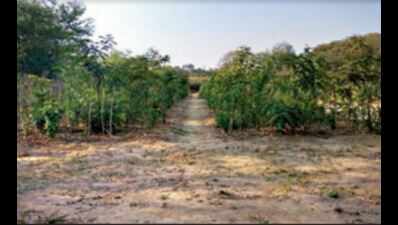
Representative image
On September 24, 2016, 300 volunteers planted 2,000 saplings of over 50 native varieties using this technique.
Today, the saplings have grown into trees that are now 4ft to 12ft tall. Among the many varieties planted here are honge, mahogany, tabebuia rosea, huversee, jackfruit, jamun, toremati, bamboo, mango, dalichandra, Indian almond, nagalinga, atti, neem, jacaranda, sampige, gulmohar and bhunia.
Saplings planted using the Miyawaki technique grow 10 times faster than the regular ones.

Miyawaki technique is all about three years of intensive watering and weeding after planting. The result is a lush, dense, self-sustaining forest. The technique is named after Japanese botanist Dr Akira Miyawaki, whose approach was to plant seedlings of as many native canopy trees as possible. Through competition, these trees undergo a process of natural selection, ultimately leading to the formation of a diverse, natural forest.
After the first three years, the forest does not require any maintenance, in keeping with the botanist’s theory that the best forest management technique is no management at all.
“While the saplings are densely packed together, two saplings of the same type cannot be planted adjacent to each other, as then only one will survive,” explained Durgesh. Given the rigorous maintenance, the process is slightly more expensive than what’s involved in a usual plantation.
Founded by Kapil Sharma about a decade ago, Say Trees has planted over 80,000 saplings across the country. Last year alone it planted 35,000 saplings, 17,000 of which were in Bengaluru. About 15,000 trees were planted in what used to be dumpyards in Koramangala, Kalyan Nagar, Yeshwantpur and Nyandahalli.
This monsoon, the NGO hopes to raise another Miyawaki forest: 20,000 trees in a 6,000sqm plot in Bengaluru. “We must do whatever we can to reduce the impact of global warming. With trees steadily vanishing from in and around our city, we are in great need of these mini-urban forests,” said Durgesh.
COMMITTED TO GOING GREEN
We tied up with Say Trees in 2014. Since then we have planted 4,786 trees on our vacant plots. Many people thought this exercise wouldn’t be successful, but the saplings have been growing well. We are committed to going green and preserving the environment and are, at present, arranging for water and electricity required for their maintenance. Recently, our divisional railway manager visited us and said that we should work towards using all available vacant railway plots for raising these kind of plantations
Srinivasan T | senior section engineer, south western railway
End of Article
FOLLOW US ON SOCIAL MEDIA










Hot Picks
TOP TRENDING
Trending Stories
In City
Entire Website
- GK for students: Top 8 Largest Mammals in the World
- Arvind Kejriwal Resignation Live Updates: 'Kejriwal will be back', says Atishi after staking claim; BJP questions CM-designate's 'background'
- India vs China Highlights, Asian Champions Trophy 2024 Final: Jugraj Singh stars as India beat China 1-0 to clinch record fifth title
- Kolkata Murder Supreme Court Hearing Live Updates: Court extends ex-RG Kar principal Ghosh, cop's custody by 3 days
- Maharashtra schools closed on Sep 18: Here’s why
- Communal tension hits Karnataka towns over Palestinian flags at rallies
- 'If any shame left ... ': AAP slams Swati Maliwal's remark on Atishi, says she should seek RS ticket from BJP
- Work on bridges gains pace to ease Ghodbunder jams
- NMDC Steel Plant Seeks 100 Officers of Vizag Steel Plant
- UGC NET Result 2024 Live Updates: NTA expected to announced final answer key, scorecards shortly
- Battle for 24 seats in first round of J&K assembly polls today
- Postings of 3 HC CJs-designate changed on govt 'sensitive info'
- Can 1st election in 10 years give J&K back its sense of belonging?
- We're 'disturbed' by findings of CBI's RG Kar report: SC
- Census process to resume 'very soon', confirms Amit Shah
- 'I know Gambhir...': Rohit on his understanding with India head coach
- Rs 15cr gold crown from the Ambanis: Meet Mumbai’s richest Ganeshas
- Intel CEO announces major restructuring, tells employees: 'We need to fight for …'
- Delhi gets its 3rd woman CM as Arvind Kejriwal hands charge to Atishi
- J&K polls: Phase 1 voting today; 219 candidates in fray for 24 seats

Popular Categories
Hot on the Web
Top Trends
Dominique PelicotUS Fed Rate CutIndia vs China Champions TrophyUPI Transaction LimitWhere to Watch India vs China Final Hockey MatchUPS vs NPS CalculatorKolkata Commissioner Manoj VermaNEET UG Admission CriteriaAtishiKolkata Doctor Rape CaseArvind Kejriwal Resignation LiveAli Khamenei TweetSuryakumar YadavVince McMahonTech LayoffsDonald TrumpLive Cricket Score
Trending Topics
Munawar FaruquiLuxury BrandCancer CauseKhatron Ke Khiladi 14Chinas EggAtishi Marlena Singh QualificationSunita AhujaGoat CollectionSalman Khan FarmhousePitra Paksha 2024CheetahsKangana RanautAditi Rao HydariDalljiet KaurHoliday DestinationVikas SethiReliance Jio DownApple iPhone 16 ProVirat KohliWordle Answer
Living and entertainment
Latest News
Lava Blaze 3 5G with 50MP camera, MediaTek chipset launched in IndiaAdam Zampa acknowledges slim Ashes hopes as milestone 100th ODI nearsPriyanka Chopra reveals her 'namaste' pose during Miss World 2000 was a trick: 'I was desperately trying to keep my dress up''Could restore sight': FDA grants 'breakthrough status' to Musk’s Neuralink 'Blindsight' implant. What it meansKitchen Tips: How to elevate home cooking to Michelin levelRazorpay becomes first-ever payment aggregator to launch no-code data integration platformPublic health groups raise concern on patent grant to promising, new HIV drug'Wearing undergarments must but...': Delta's 'specific' memo for flight attendantsDid Kareena Kapoor Khan just sign India's BIGGEST film as she marked 25 years in Bollywood? Here's what we know...‘Kheer brought back memories of …’: PM Modi gets emotional recalling birthday rituals with motherCongress manifesto silent on Article 370 restorationHow ‘Oxford returnee’ Atishi became chief minister of DelhiHeart problem? Smart stetho can sense it in just 15 secs"They haven't done a good job”- Wrestling veteran highlights a significant problem with The BloodlinePoonam Kaur calls out MAA over inaction on Trivikram complaint amid Jani Master allegationsIndia Post GDS Result 2024: Merit list 2 released for all regions, state-wise direct links to checkNetflix on Luck director Soham Shah's claim that Squid Games is a copy of his movie: There is no …MamaEarth co-founder Ghazal Alagh shares how stress eating helps her unwind after long days
Copyright © 2024 Bennett, Coleman & Co. Ltd. All rights reserved. For reprint rights: Times Syndication Service