
- News
- City News
- delhi News
- Ashokan pillar on Ridge too suffers monumental neglect
Trending
This story is from December 5, 2016
Ashokan pillar on Ridge too suffers monumental neglect
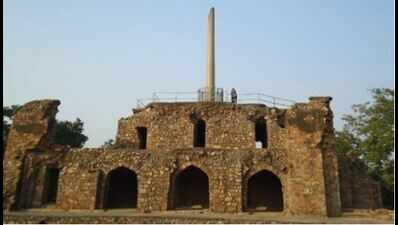
Ashokan pillar at Kotla Ferozeshah.

Archaeological Survey of India has restricted the entry to this pillar to stop people from damaging it, but historians say this one always had a turbulent history. “In the early 18th century, a gunpowder explosion had broken the pillar into five pieces. In 1867, the pieces were put back together, presumably with some sort of mortar,” said historian and Intach convener Swapna Liddle.
There has been considerable wear and tear ever since. Portions of the original inscription are missing, and one side of the pillar has graffiti etched on it. The authorities aren’t sure if these are recent or much older.
ASI officials admitted that there was no documentation or monitoring of the pillar to know its change of status. “With over 3,600 monuments to conserve, it’s very difficult to have periodical reviews on every site. All monuments are reviewed from time to time, but documentation done at fixed intervals isn’t available,” said a senior ASI official.
While the flaking on the Kotla pillar appears to be more recent, it would take a separate investigation to find out how things have come to such a pass at the Bara Hindu Rao pillar.
A close look at the pillar shows cement mortar, which conservationists say accelerates the deterioration of ancient monuments. “When cement mortar is used in centuries-old buildings, they react with water or anything in the air and create salts. These salts can be seen on the facade between the joints of two pieces,” said a noted conservationist, adding, “This irreplaceable loss was totally avoidable with regular scientific monitoring and preventive conservation. The stone pillars require regular attention to mitigate the effects of pollution. Instead, they seem to have suffered from the use of chemicals and cement—both extremely harmful to them.’’
End of Article
FOLLOW US ON SOCIAL MEDIA










Hot Picks
TOP TRENDING
Trending Stories
In City
Entire Website
- 7 Must-Watch Films to Inspire Students
- Florida woman who sold all her possessions for a 3-year luxury cruise banned for WhatsApp messages
- Animal fat in Tirupati laddu: Centre intervenes, temple trust blacklists supplier - Top developments
- Indian Embassy official found dead at Washington DC office under mysterious circumstances
- Rohit Sharma gets angry at team-mate: 'Soye hue hain sab log'
- PM Modi on 3-day US visit for Quad summit: Key agendas, full schedule
- 10 Daily Habits for Students to Keep Their Minds Young and Sharp
- 'When temples are being attacked ... ': Andhra deputy CM Pawan Kalyan on Tirupati laddu row
- NIA conduct raids at several locations across Punjab in terror-conspiracy case linked to Gurpatwant Singh Pannun
- To challenge Ola and Uber, Chennai auto drivers rebuild ride-booking app after crippling hack
- 'Naidu a pathological liar': Jagan Reddy writes to PM Modi on laddu row
- 'Jab dil ke darwaze ...': PM Modi's meeting with Biden an emotional one
- How ultra-bhakts went from BJP’s biggest asset to its biggest problem
- Kejriwal's big claim: PM Modi conspired to prove me dishonest
- UP police books Class 6 student for rioting and attempt to murder
- 'I had to beg for help': Manish Sisodia on financial struggles amid corruption case
- Billionaire fugitive spotted in Belgium. Can India get him this time?
- How India prices of iPhone 16 compare with US, Canada, Singapore, Dubai
- Netflix under scrutiny over visa, tax, and racial discrimination accusations
- Expanding Air India's punctuality woes leave flyers frustrated

Popular Categories
Hot on the Web
Top Trends
IND vs BAN Live ScoreArvind Kejriwal's Janta Ki AdalatRishabh PantRohit SharmaShubhman GillUGC NET Result 2024CBSE NotificationTirupati Laddu RowIsraeli Strikes on HezbollahRandy Orton WifeIsrael Hezbollah WarIND vs BAN Highlights Days 3Tirupati PrasadamEY Pune EmployeeSean DiddySandip GhoshLive Cricket Score
Trending Topics
Daughter's Day WishesDaughter's Day 2024 WishesAbdu RozikMukesh KhannaJayamSana Khan HusbandTirupati Laddoo ControversyGOAT CollectionVaazha OTT ReviewKozhipannai Chelladurai ReviewCheetahsKangana RanautAditi Rao HydariDalljiet KaurHoliday DestinationVikas SethiBest Selling Earbuds Under 1000Apple iPhone 16 ProVirat KohliWordle Answer
Living and entertainment
Latest News
Delhi CM’s statement highlights loyalty dilemma in Indian partiesShivani Sharma talks about the rapid growth of regional'No bunker needed in J&K': Amit Shah says nobody in Pakistan has guts to open fireHrithik Roshan SPOTTED filming intense action sequences for 'WAR 2' in Italy - WATCHKarnataka CM Siddaramaiah warns of legal action against those spreading fake newsMakers of ‘Get Set Baby’ drop a new poster on Unni Mukundan’s birthdayLucky numbers for September 22 to September 28: Your weekly fortunate number revealedUP: Muslim 'healer' arrested for sexually assaulting teen girlThe truth about sugar substitutes: Safe alternative or hidden health risk?Malaysian police arrest hundreds in child abuse probeAryan Khan or dad Shah Rukh Khan, who wore this lather jacket better?Why Rahul Gandhi is off the mark when it comes to SikhsNavya Nanda attends event in Mumbai, poses with Karisma Kapoor and Ananya PandaySatyapal Malik says Maharashtra polls ‘last nail in BJP’s coffin’, backs MVABest anti-ageing workouts for strength and flexibilityPalanpur tea seller's son gets into IIM RanchiCM Dhami promises boost for sports at State Olympic Games in RudrapurYour daily career horoscope: 24th September 2024
Copyright © 2024 Bennett, Coleman & Co. Ltd. All rights reserved. For reprint rights: Times Syndication Service