
- News
- City News
- delhi News
- NCR air pollution: Why Supreme Court asked CAQM to take action against Delhi govt, police and transport commissioner
Trending
NCR air pollution: Why Supreme Court asked CAQM to take action against Delhi govt, police and transport commissioner
The Supreme Court permitted the Commission of Air Quality Management to decide on reopening NCR schools, considering the hardships faced by poor students. The court also mandated strict adherence to GRAP-IV restrictions and directed action against authorities for non-compliance with truck entry bans. Additionally, NCR states were ordered to provide financial aid to construction workers affected by the ban.
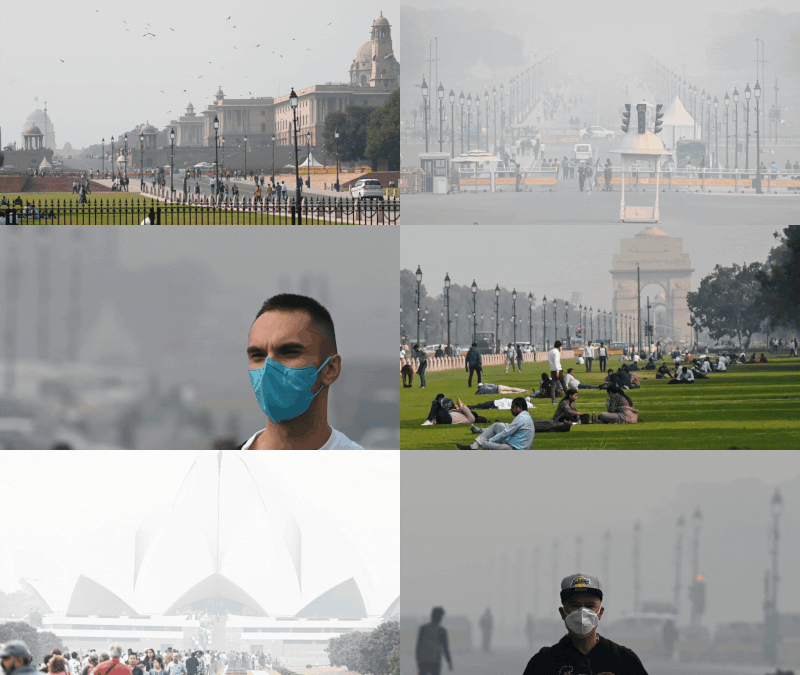
The court criticized authorities for failing to enforce truck entry bans. It ordered action against officials. The court also directed states to financially assist construction workers affected by the ban.
A bench of Justice Abhay S Oka and Justice Augustine George Masih directed CAQM to consider to relaxation in terms of clause 5 and clause 8 of GRAP-IV as well as clause 11 of GRAP-III measures (pertaining to discontinuing physical classes).
The bench also took strong exception that the authorities did not comply with the order of CAQM in enforcing GRAP-IV measures on barring trucks to enter within the territory of the national capital and directed the Commission to initiate proceedings against the state govt, transport commissioner and Delhi police commissioner. This was revealed in a report filed by 13 young lawyers who were appointed as court commissioners and visited over 86 out of the total 113 entry points to check the ground reality. They said that checkposts were put in place after the court passed an order asking them to visit.
Noting that the commission had passed an order to ban entry of trucks on Nov 18 but neither the transport department nor Delhi Police deployed their staff at entry point which was done only after SC passed direction on Nov 21, the bench directed the panel to invoke Section 14 of CAQM Act.
Section 14 says any noncompliance or contravention of any provisions of this Act, rules made thereunder or any order or direction issued by the Commission, shall be an offence punishable with imprisonment for a term which may extend up to five years or with fine which may extend up to one crore rupees or with both:
"It is apparent that the authorities which are mentioned against item numbers 1, 2 and 3 of stage IV of GRAP(state, transport & police commissioners) have made no earnest effort to implement the action in terms of clauses 1 - 3. Some police teams were deputed at a few entry points that also without any specific instruction. In fact the report of the court commissioner indicates that at most of the entry points the police were posted pursuant to the order of this court dated 22nd Nov. There is a serious lapse on the authorities mentioned against clauses 1 - 3. We therefore direct the commission to immediately initiate action in terms of section 14 of the CAQM Act," the court said.
The bench also directed NCR states to extend financial help to construction workers who face hardship due to ban on construction activities. It directed them to release labour cess funds to the affected workers.
"We direct all the states to use the funds which have been collected as labour cess for the welfare of construction workers to provide them subsistence for the period during which construction activities are prohibited," the bench said.
End of Article
FOLLOW US ON SOCIAL MEDIA










Photostories

Hot Picks
TOP TRENDING
Explore Every Corner
Across The Globe
Popular Categories
Hot on the Web
Top Trends
Rhea RipleyIBPS SO Prelims ResultIPL 2025 Sold and Unsold Player ListJohn CenaLebron vs Anthony FightKPSC PDO Hall TicketKarnataka Board TimetableIPL 2025 Full Teams SquadTravis KelceCAT Answer Key 2024RCB Team SquadWorld Chess ChampionshipIPL All TeamsPrithvi ShawSuryakumar YadavJasprit BumrahIPL All Team SquadsLive Cricket Score
Trending Topics
Living and entertainment
Latest News
Rajya Sabha passes bill to promote ease of doing biz in oil, gas sectors3 new criminal laws to ensure justice for women: PM Modi in ChandigarhMayor Eric Adams backs deportation of criminal migrants, seeks collaboration with Trump administrationDon't like to come here due to bad air: GadkariSC chides government for denying pension to wife of soldier who died on LoCWill miss jail, says 104-yr-old as he walks free after 3 decadesEminem’s mother, Debbie Nelson, passes away at 69 due to cancerNo Bishnoi gang link, threats bid to upgrade Pappu security: CopsKaun Banega Crorepati 16: Contestant Anurag Chourasia asks Amitabh Bachchan about the 'King' of his house; Big B instantly replies 'Jaya'Midday meal cooks' pay stuck at 2009 level in 10 states/UTsBank accounts can soon have 4 nominees eachWhat did Nizam of Hyderabad gift as lavish wedding gift to Queen Elizabeth II?HC shields activist: 'India's harmony is not so fragile''Wednesday' Season 2: Release details, plot teasers, and new cast membersTMC, SP stay away from INDIA bloc protestTripura breach: Dhaka summons Indian envoySupreme Court frees man, but he loses 13 yrs in jailLadakh disengagement has set stage for ties to improve: Jai Shankar
Copyright © 2024 Bennett, Coleman & Co. Ltd. All rights reserved. For reprint rights: Times Syndication Service