
- News
- City News
- gurgaon News
- Low wind speed & dip in mercury turn air quality 'very poor' again in Gurgaon
Trending
This story is from November 17, 2023
Low wind speed & dip in mercury turn air quality 'very poor' again in Gurgaon
The air quality in Gurgaon, India, has deteriorated to a "very poor" level due to slow winds, undoing the slight improvements from the previous day. The average air quality index (AQI) in the city was recorded at 363, which is 22% higher than the previous day's reading. The highest pollution levels were observed in Section 51, with an AQI of 406 in the "severe" category. Stubble burning, vehicle emissions, and calm winds are contributing to the worsening air quality. Doctors have warned that prolonged exposure to pollutants can lead to respiratory discomfort and lasting health impacts.
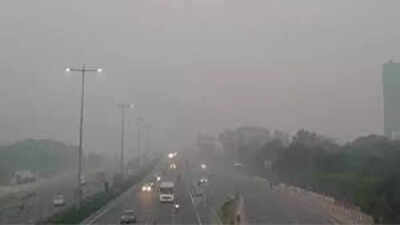
Gurgaon's 24-hour average air quality index (AQI) was recorded at 363, around 22% higher than 297 - still in the 'poor' category of the scale - clocked on Wednesday
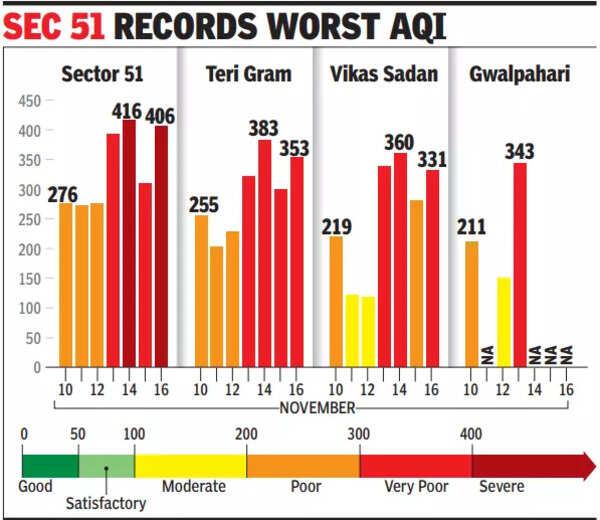
The city's 24-hour average air quality index (AQI) was recorded at 363, around 22% higher than 297 - still in the 'poor' category of the scale - clocked on Wednesday.
Track the pollution level in your city
According to data by the Central Pollution Control Board (CPCB), the air quality monitoring station in Section 51 recorded the highest pollution levels, with the area's average AQI at 406, in the 'severe' category.

"Air quality has deteriorated because of the present meteorological conditions and uncontrolled emissions. Stubble burning will also begin to come down. Pollution from vehicles and industries is adding to pollution and dispersion is not happening due to calm winds," said Sunil Dahiya, analyst at the Centre for Research on Energy and Clean Air (CREA).
Earlier this month, the Supreme Court pulled up governments for failing to curb winter pollution as every year in this season, Delhi-NCR and neighbouring regions get engulfed in toxic smog. "Something has to be done immediately," SC had said.
Satellite data by Nasa that is collated by the Indian Agricultural Research Institute recorded 47,248 instances of farm fires across six states, the majority in Punjab (31,932), between September 15 and November 16 this year.
Pollution across NCR cities is only expected to worsen in the coming days as temperatures dip and wind speed hovers around 4kmph to 6kmph, both conditions that allow smog to linger in the air.
The central government's System of Air Quality and Weather Forecasting and Research (Safar) said the AQI in Delhi-NCR will remain 'very poor' or 'severe'.
On Thursday, Delhi's AQI was 'severe' (419) along with Faridabad (424). Noida (355) and Ghaziabad (376) recorded 'very poor' air days.
Doctors said on Thursday that patients with pre-existing respiratory conditions or other ailments are at higher risk of breathing discomfort.
"Long exposure to pollutants can result in eye irritation, itchy throat, sneezing, runny nose and a mild cough, even for individuals in good health. These symptoms are common among both healthy individuals and those with asthma or other medical conditions, often leading to breathlessness and difficulty breathing. Prolonged exposure, especially in outdoor work settings, can have lasting health impacts. It is very important to take precautionary measures such as wearing masks and restricting outdoor activities during such conditions," said Dr Nevin Kishore, senior consultant and head of pulmonology department at Max Hospital in Gurgaon.
Tiny pollutants PM2.5, according to doctors, are among the most damaging to health when inhaled.
The average PM2.5 level recorded at Sector 51 station was 330g/m³ on Thursday, fifty times the permissible limit of 330 g/m³ in India. At Teri Gram, it was 311g/m³ and in Vikas Sadan, 276g/m³.
End of Article
FOLLOW US ON SOCIAL MEDIA








Photostories

Hot Picks
TOP TRENDING
Popular Categories
Hot on the Web
Top Trends
Stock Market TodayBasit AliBrittany MahomesRavichandran AshwinBabar AzamKanpur Test Match RecordsUGC NET Result 2024Tirupati LadduIndia T20 WC SchedulePPF CalculatorBryonna Burrows Net WorthWomen T20 World Cup Points TableWomen T20 World Cup ScheduleIND vs PAK T20 WC MatchDiddyTop Management Colleges of IndiaLive Cricket Score
Trending Topics
GovindaNavratri Colours 2024Solar Eclipse 2024 TimesNavratri WishesGandhi Jayanti WishesDevara CollectionGOAT OTT ReleaseGandhi Jayanti 2024Rajinikanth Health UpdateNavratri HistoryDevaraGovinda NewsDevara Movie ReviewHealthy RaitasSwatantrya Veer SavarkarColdplay India tour 2025Upcoming Smartphones In OctoberAmazon SaleSony Bravia 55 inch 4k Ultra HD TVWordle Answer
Living and entertainment
Latest News
Aishwarya Majmudar and Hitu Kanodia light up Ahmedabad with electrifying Garba nightLadakh climate activist Sonam Wangchuk released from custody, to head to RajghatThe Amazing Spider-Man films starring Andrew Garfield now streaming for freeXionism In Lux: Why global luxury biz bosses will obsess over China’s communist bossNavratri Day 1 colour: How to style the shade of OrangeManipur: Congress MP writes to Amit Shah for safe release of 2 'abducted Meitei youths'Qualifier Yash upsets second seed Manish at Fenesta OpenAquarius, Daily Horoscope Today, October 03, 2024: Romantic life may experience a few bumps'Scam marathon' under JMM-Congress-RJD rule 'biggest obstacle' to Jharkhand's development: PM ModiPopulation of Hindus & tribals declining in Jharkhand, says PM ModiChange Begins Here, as TOI shines a spotlight on hope and impactNasa switches off instrument on Voyager 2 spacecraft to save powerKTR reason for Naga-Samantha divorce, says Telangana minister; sparks rowVivek Ramaswamy to run for Ohio Governor? He says would 'consider' but ...Indian cinema has a rich legacy of storytelling: Rana DaggubatiAre 3 senior Karnataka mantris jockeying for chief minister's chair?Why record gold loan growth has RBI worriedCSS Profile: 5 steps for US students to fill up this financial aid form successfully
Copyright © 2024 Bennett, Coleman & Co. Ltd. All rights reserved. For reprint rights: Times Syndication Service