
- News
- City News
- guwahati News
- Assam: ‘Foreigner’ parents in detention camps, children roll beedis to eke out a living
Trending
This story is from January 1, 2020
Assam: ‘Foreigner’ parents in detention camps, children roll beedis to eke out a living
Till three years ago, Rahima Begum, 24, from Dhubri spent her days by looking after her three children and making them learn the alphabets, while her husband was away for construction work.
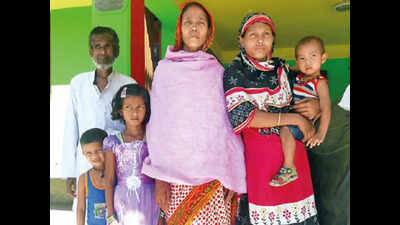
Rahima Begum (extreme right) with her children and parents in Dhubri. Her husband has been lodged in a detention camp for three years
GUWAHATI: Till three years ago, Rahima Begum, 24, from Dhubri spent her days by looking after her three children and making them learn the alphabets, while her husband was away for construction work.
But now Rahima spends eight hours a day rolling beedi (tobacco in tendu leaf). Her three children — Salma, 9, Faruk, 5, and Suleman (4) — also join in, rolling one bundle of beedi after another in the backyard of her house in Gaspara village, along the Indo-Bangla border, 16 km from Dhubri town.
“The younger one is not good in rolling beedis.

Siddique was declared a foreigner in 2016 after he was caught by police while working as a construction worker in Jorhat district. The case went to the Supreme Court, but he was declared a foreigner. Suleman has never seen his father.
“I am waiting for him to come back from jail. I have been told that he would be released after completing three years. I am eager to send my children to school. They are already too old for primary school,” Rahima says, her children busy working on the beedi rolls — their mother has set them a target of rolling 500 beedis a day.
Like Salma, Faruk and Suleman, in another village of Sahebganj in Golakganj revenue circle of Dhubri, 12-year-old Anita Mandal (name changed) rolls about 1,200 beedis a day after her school.
Anita, a Class V student, spends four hours after school to earn about Rs 150 a day. On a holiday, she can roll up to 2,000 beedis. Her parents are in Kokrajhar detention camp.
The Child Labour (Prohibition and Regulation) Act, 1986, prohibits the employment of children less than 14 years. So, none of the children has an identity card issued by the ministry of labour and employment that entitles “beedi” workers to certain benefits.
Sunita Changkakoti, chairperson of Assam State Commission for Protection of Child Rights (ASCPCR), told TOI, “The child rights commission and the state government have to prepare a guideline for every children, so that they can avail of all rights of children. We are definitely going to take up issues relating to rehabilitating these children and their rights at the earliest.”
Anita earns about Rs 2,500 a month by working as a beedi worker. “I wrap a scarf around my mouth so that the tobacco dust does not enter my mouth,” she says.
Of the 19 lakh left out of the NRC in Assam, 1.6 lakh are from the border district of Dhubri. Miguel Das Queah, executive director of Universal Team for Social Action and Help, an Assam-based child rights organization, said, “Rights of children whose parents are in detention camps, or who themselves are there, are not being protected the way it should be by the state. The understanding of child rights is very bleak from the point of view of police to everyone. We need to assist the government to help protect the rights of these children.”
According to a report tabled in Assam assembly, there are 31 children languishing in various detention camps in the state. UTSAH has filed an RTI application to know the status of the rights of children living in these camps and whose parents are lodged there.
Masud Zaman, an advocate from Dhubri town, who has been providing legal assistance to people in detention camps in Assam, feels the state government needs to come forward to protect the rights of children, who are being pushed into an uncertain future while identifying foreigners. “No law of any country has given the rights to the state to keep children away from their parents. The state might say these are not our children and are foreigners. However, till they live in our state, they are entitled to the universal rights for children. But I see the state is totally turning its back to these kids,” Zaman said.
End of Article
FOLLOW US ON SOCIAL MEDIA










Photostories

Hot Picks
TOP TRENDING
Popular Categories
Hot on the Web
Top Trends
IND vs BAN Live ScoreNEET UG CounsellingDolly ChaiwalaKamindu MendisDU ElectionIsrael StrikesRavichandran AshwinHigh Paying Freelance JobsElon Musk Dating MeloniUS FDAKerala Lottery ResultsRohit SharmaTamil Nadu NEET UG CounsellingWho is Dominik Mysterios WifeChina SubmarineIsrael Hezbollah WarLive Cricket Score
Trending Topics
Devara ReviewNavya Naveli NandaPawan KalyanJungle SafariStree 2 OTT ReleaseRose GardenDevara CollectionOTT Release MovieMasala OmeletteEmergencyDevaraTaaza Khabar 2 Twitter ReviewDevara Movie ReviewHealthy RaitasSwatantrya Veer SavarkarColdplay India tour 2025Best Branded HandbagsApple Macbook Air M1Amazon SaleWordle Answer
Living and entertainment
Latest News
Seasonal Rituals According to the Zodiac CalendarPressure Cooker: How Hypertension Can Lead to Heart FailureApple’s Vision Pro 2 may come with M5 chip for powering Apple IntelligenceBest Watches Under 5000: Stylish Picks For EveryoneHoroscope Today, September 28, 2024: Read your today's astrological predictionsNFL Offenses Grounded, But Fans Still Soaring: Why TV Ratings Are Thriving Despite Fewer Passing YardsCauvery authority orders Karnataka, TN to abide by SC orderSS Rajamouli's son SS Karthikeya becomes speechless after watching Jr NTR's 'Devara: Part 1'TapSwap Daily Codes for September 28, 2024: Earn coins and cryptocurrency by completing tasksCameron Green in doubt for India Tests following back injuryWho is Rey Mysterio's wife? Exploring the personal life of the master of the 619Medical Breakthrough: 1st lung cancer vaccine BNT116 clinical trials launched, vaccine based on Covid mRNAWhen Lionel Messi was booed: A rare fan backlash against the football legendWrestling Veteran Supports Rikishi's Take on Jacob Fatu's Backstage Meeting with Triple HMinimum wages for unorganised sector to rise as variable DA upBangladeshi fan hospitalised after 'falling ill' in Green Park stands; Police denies assault speculationCong, PDP & NC 'sinners' for encouraging terrorism in J&K: UP CM Yogi Adityanath'Demons in power': Jagan Reddy cancels Tirumala temple visit amid Tirupati laddu row, says 'denied permission'; TDP reacts
Copyright © 2024 Bennett, Coleman & Co. Ltd. All rights reserved. For reprint rights: Times Syndication Service