
- News
- City News
- lucknow News
- Excavation team unearths old stepwell in UP's Sambhal
Trending
Excavation team unearths old stepwell in UP's Sambhal
A stepwell, or baoli, was unearthed in Sambhal, Uttar Pradesh, near a Shiv-Hanuman temple. The Archaeological Survey of India made the discovery. The baoli is about 400 square meters and has four chambers. Some levels have marble flooring. Excavation is ongoing to uncover the structure, believed to be over 150 years old.
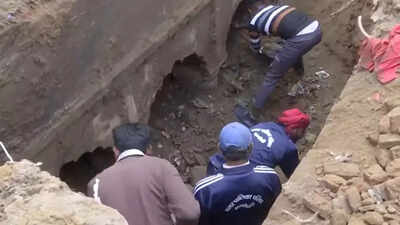
The discovery was made by the Archaeological Survey of India (ASI) in the Chandausi area.
Sambhal district magistrate Rajendra Pensiya confirmed the finding on Sunday, describing the stepwell, known as a 'baoli,' as covering about 400 square meters. The structure includes approximately four chambers and features marble flooring on some levels.
"An area of around 400 square meters, is recorded in the form of Ah-Baoli Talab. It is said that this baoli was built during the time of the king of the grandfather of Bilari's king. The second and third floor is made up of marble and the upper floors are made of bricks. As we saw (from the excavation), around four chambers are there,” Pensiya explained at the site.
Excavation began Saturday following a public meeting that brought the stepwell to the authorities' attention. Efforts are underway to fully uncover the structure, which is currently partially covered with mud and encroached upon.
"The structure is fully covered in mud, the Nagar Palika team is removing the topsoil. At present only 210 square meters are outside and the rest is occupied. Action will be taken to remove the encroachment,” Pensiya stated, estimating the structure’s age to be over 150 years old.
Krishna Kumar Sonkar, the Municipal Corporation's Executive Officer, confirmed the excavation work began immediately after learning about the underground structure. "As soon as we came to know that there is a babri here we started the excavation work here, as we continue the work, we will come to know more about this. We will try our best to restore this, we are working to see what all is here,” Sonkar said.
This discovery follows an ASI survey conducted Saturday at the Kalki Vishnu temple in Sambhal. A four-member ASI team inspected five shrines and 19 wells in the area, including the recently reopened temple. The survey lasted 8-10 hours and covered approximately 24 areas. The ASI will submit a report of their findings.
Stay updated with the latest news on Times of India. Don't miss daily games like Crossword, Sudoku, and Mini Crossword. Spread love this holiday season with these Christmas wishes, messages, and quotes.

About the Author
TOI City DeskEnd of Article
FOLLOW US ON SOCIAL MEDIA











Hot Picks
TOP TRENDING
Explore Every Corner
Across The Globe
Popular Categories
Hot on the Web
Top Trends
Rajasthan BSTC 1st Year ResultWho is Tanush KotianCheteshwar PujaraStonehenge BuiltVinod KambliAircraft Crash in Western MexicoRRB JE Answer KeyPV SindhuBengaluru Digital ArrestKeanu ReevesMohammed ShamiMahila Samman Yojana RegistrationShawn MichaelsPuja Khedkar BailMia BurksJasprit BumrahJapan Shinkansen Bullet TrainsLive Cricket Score
Trending Topics
Allu ArjunMerry Christmas WishesPushpa 2 ReviewChristmas 2024Optical illusionMufasa: The Lion King CollectionUI The Movie Twitter ReviewPushpa 2 OTT ReleaseUI Movie Box Office CollectionBaba Vanga Predictions for 2025Mufasa OTT ReleaseAishwarya RaiSkincare Tips for WinterWeight Loss TipsHair FallNYT ConnectionsKia Syros SuvElon Musk
Living and entertainment
Latest News
Spotlight on NFL stars' wives and girlfriends: Kerry Washington, Ciara, and more‘Class V, VIII exams back, schools must pull up socks’CM inaugurates final stretch of Western BypassShreyas Talpade recalls working with Shyam Benegal: 'He was extremely knowledgeable and an institution in himself' - ExclusiveBigg Boss Tamil 8: Anshitha and Jeffrey share emotional moments during BB memory sharing taskBSNL launches three free services: What’s in it for BSNL and non-BSNL usersVitamin D has no role to play in preventing fractures: New ResearchPakistan plans to purchase 40 Chinese J-35 stealth fighter jetsWill Ja Morant play against the LA Clippers tonight? Latest update on the Memphis Grizzlies star's injury report (December 23, 2024)Aruna Raja on Shyam Benegal's demise: 'I can't help my tears; it is very rare to come across someone like him'- ExclusiveHow Pakistan ‘copied’ design of India’s 1960 Cirus reactorHow Pakistan ‘copied’ design of India’s 1960 Cirus reactorThree siblings drown in lake at MarakanamRevealed! Why are single Chinese women embracing fake baby bumpsCentre plans to take control over NH entrusted to PWDs, may face backlash from statesBadshah's rumoured girlfriend Hania Aamir talks about attending Diljit Dosanjh's concert; reveals Shah Rukh Khan's 'Om Shanti Om' is her favourite filmStudents, parents protest alleged move to close Salem schoolBills QB Josh Allen And Hailee Steinfeld’s Wedding Plans Revealed
Copyright © 2024 Bennett, Coleman & Co. Ltd. All rights reserved. For reprint rights: Times Syndication Service