
- News
- City News
- noida News
- Air quality slips in Noida, office hub worst
Trending
Air quality slips in Noida, office hub worst
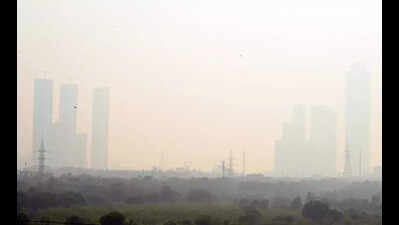
The Indian Institute of Tropical Meteorology (IITM) issued a bulletin on Monday stating that meteorological conditions are predicted to be highly unfavourable for the dispersal of pollutants.
Different monitoring stations in Noida recorded varying levels of air quality. Sector 62 station recorded the worst air quality on Monday with an AQI of 349, followed by Sector 116 (323) and Sector 125 (313) – all in the ‘very poor' category. Sector 1 was the only station that recorded AQI in the ‘poor' category at 290.
In Greater Noida, Knowledge Park 3 recorded an AQI of 309 while Knowledge Park 5 had an AQI of 310 – both in the ‘very poor' category. Neighbouring Ghaziabad's Loni station recorded the worst AQI in the district at 383, followed by Vasundhara at 322 – both in the ‘very poor' category. Sanjay Nagar and Indirapuram saw slightly better air quality, with both stations recording AQI in the ‘poor' category at 285 and 264, respectively.
During the same period last year, Noida recorded two ‘very poor' and two ‘severe' days while Greater Noida saw one ‘very poor' and three ‘severe' days. Ghaziabad had fared slightly better last year, recording two days in the ‘moderate category', one in ‘very poor' and one in the ‘severe' category during the same period.
The IITM bulletin stated that there was a slight drop in maximum temperature across Delhi-NCR. As per the bulletin, on Monday wind speeds ranged from 4km to 8km per hour, with an expected increase to 5km to 15km per hour the following day. IITM officials also said that meteorological conditions were predicted to be highly unfavourable for the dispersion of pollutants in the coming days.
Meanwhile, officials from the Noida Authority said that measures were underway to combat pollution. The Authority's 45 tankers sprinkle treated sewage plant (STP) water across 150km of roads and 12 mechanical sweeping machines cover 350km of roads regularly. Additionally, 38 anti-smog guns are currently operational at various sites.
By late afternoon in Delhi, the number of stations reporting ‘severe' air had risen to 11, and to 16, by 7pm. At 7 pm, Anand Vihar was the most polluted area of the city with an AQI of 442, followed by 435 at East Delhi's Vivek Vihar. Other polluted areas included Alipur, Nehru Nagar in South Delhi, Sector-8 of Dwarka, Bawana, Jahangirpuri, and Wazirpur, among others. The city's average AQI, on a scale of 0 to 500, was 381 on Monday against 382 a day earlier. The PM2.5 level oscillated between 171.8 to 180.7 micrograms per cubic metre on Monday, against the national safe standard of 60 units and WHO's 15 units for 24 hours.
"The hazy weather is indeed smog as many areas were under severe or very poor levels. Tiny pollutants such as PM2.5 in the air can settle deep in the lungs, triggering severe health issues. During this time, when pollution levels are heightened, those with pre-existing health conditions are especially vulnerable to respiratory distress," said Shambhavi Shukla, programme manager, Air Quality Programme, Centre for Science and Environment (CSE).
According to the air quality early warning system, the city may see very poor air quality for the next two days, after which the AQI may turn severe. It added that low wind speed for the next few days won't favour the dispersion of pollutants. According to IITM's Decision Support System (DSS), the contribution of farm fires to the city's PM2.5 levels increased to 19.7% on Monday against 15% a day earlier.
End of Article
FOLLOW US ON SOCIAL MEDIA











Hot Picks
TOP TRENDING
Explore Every Corner
Across The Globe
Popular Categories
Hot on the Web
Top Trends
Elon MuskATACMS MissileSarah McbrideInternational Men DayPatrick MahomesGrizzlies vs NuggetsIND vs AUS Test RecordsAngel ReeseSGL GD Constable Exam DateJharkhand And Maharashtra Assembly Exit PollRafael NadalElection Exit Poll Result Date and TimeJharkhand Election Constituencies CandidatesJharkhand ElectionMaharashtra ElectionAir India Flight TroubleLive Cricket ScoreCBSE Date Sheet
Trending Topics
International Men's Day MessagesInternational Men’s Day WishesPaul Teal Death NewsBharat Dev Varma Death NewsKanguva CollectionWalking BenefitsThe Sabarmati Report CollectionKeerthy SureshBigg Boss 18 PromoKanguva Movie ReviewSingham Again ReviewBigg Boss 18Diljit DosanjhHair GrowthMen's Day 2024 WishesNayantharaBlox Fruit CodesBsnl Recharge PlansNetflix Down
Living and entertainment
Latest News
Stakes high for Hemant Soren, Babulal Marandi as Jharkhand votes in final phase todayMaharashtra goes to polls today: Battle hinges on sops, jobs, quota & cropSmriti Khanna reveals getting trolled for her second baby daughter’s name ‘Aizah’G20 declaration avoids slamming Russia, omits PM's 'no era for war' messagePolice shoot and kill Las Vegas man who called 911 to report home invasion; watch videoFBI issues 'wanted' posters on Vikash Yadav in Punjabi, HindiCracks in Manipur BJP widen as 19 of 37 MLAs skip chief minister meetHow are Nordic countries Sweden, Finland, Norway, and Denmark preparing for potential war amid Russia-Ukraine conflict?Trump picks Cantor Fitzgerald CEO Howard Lutnick as commerce secretaryIPL 2024: Rajasthan Royals to solar-power six homes for every six hit in 'PinkPromise' match against RCB dedicated to womenWhat makes E-4B 'Nightwatch' a key player in US national security?Amit Shah: Undertrials in jail for years to get justice by November 26PMAY (rural) phase-2 houses must be in women's namesDelhi high court summons OpenAI in ANI copyright breach caseIdentify all undertrials eligible for bail, SC tells jail authoritiesGoodbye needles! Your next vaccine can be a puff of airHow doctor who did TN’s first liver transplant ended up in OTKarnataka excise minister may be axed amid scam claims
Copyright © 2024 Bennett, Coleman & Co. Ltd. All rights reserved. For reprint rights: Times Syndication Service