
Trending
This story is from February 8, 2020
Maharashtra opposes NIA plea to shift Elgar Parishad case hearings to Mumbai
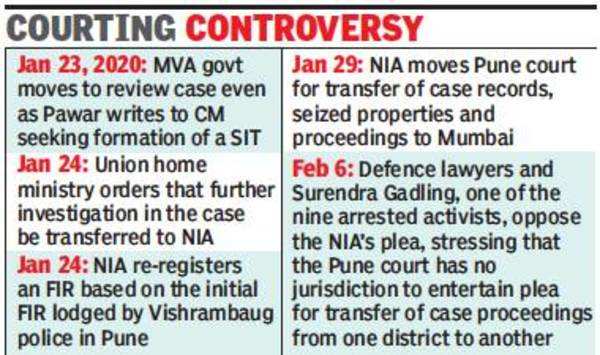
The state prosecution on Friday opposed the National Investigation Agency’s plea for transfer of the Elgar Parishad case records, seized properties and proceeding to the special NIA court in Mumbai, stating that it was “not legally tenable” under the provisions of law.
Representative image
“The NIA’s investigating machinery has not given any legal and sufficient reasons for transferring the case proceedings to the special NIA court in Mumbai,” special public prosecutor Ujjwala Pawar submitted before the special UAPA judge, S R Navander.

She submitted that Section 22 (2) of the NIA Act empowered the state government to constitute one or more special courts for the trial of offences under the act. “The state has established such courts and considering that one of the special courts is in Pune, the application for transfer of records, seized properties etc to the NIA court, Mumbai, is required to be rejected,” she said.
Judge Navander has posted for February 14 an order on the NIA’s plea.
Pawar submitted, “The offence was committed within the local jurisdiction of the Pune court and the investigating authority, after completion of the investigation, filed the chargesheets before this court and as such the matter is fixed for framing of the charges.”
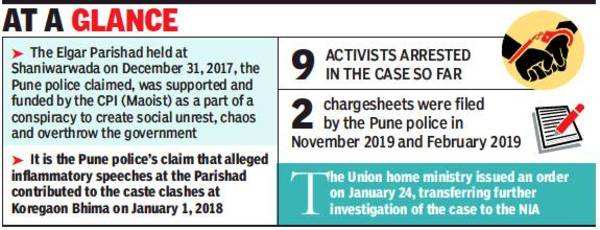
She argued that the police had collected enough evidence not only against the nine arrested activists but also the other two activists (Gautam Navlakha and Anand Teltumbde), whose anticipatory bail pleas were pending before the Bombay high court.
The Supreme Court, while disposing of historian Romila Thapar’s petition seeking a court-monitored SIT probe into the case, had held in September 2018 that “it is not a case of arrest because of mere dissenting views expressed or difference in the political ideology of the named accused”, she submitted.
State govt & central agency battle over court jurisdiction for Elgar Parishad case hearing
Pawar said, “The apex court also held that there is ample evidence against all the accused present before the court as well as the absconding accused and accused Gautam Navlakha and Anand Teltumbde.” The prosecutor then went on to interpret the definition of court under the Unlawful Activities (Prevention) Act (UAPA) and the provisions related to establishment of special courts under the UAPA and the NIA acts and their jurisdictions.
In reply, NIA’s lawyer Namdev Taralgatti submitted that Section 11 of the NIA Act enabled transfer of the case proceeding to Mumbai. “The jurisdiction of this (special UAPA) court is ousted as per NIA Act, besides, NIA, Mumbai office’s jurisdiction covers Maharashtra, Gujarat and Goa, and the same also stands notified in the past,” Taralgatti submitted.
The NIA lawyer cited a Bombay high court ruling in support of his argument that the NIA court in Mumbai had jurisdiction over the matter after the central government’s order transferring investigation into the case from the Pune police to the national probe agency. He also furnished to the court the NIA’s case diary after re-registration of an FIR in Mumbai related to the Elgar case.
On Thursday, defence lawyers Siddharth Patil, Shahid Akhtar and Rohan Nahar, besides, one of the nine arrested activists, Surendra Gadling, had opposed the NIA’s plea on the grounds that the central agency should have moved the Bombay high court as the Pune court had no jurisdiction to entertain the plea for transfer of case proceeding from one district to another.
The court then adjourned the matter after special public prosecutor Pawar sought time to furnish her arguments.

About the Author
Vishwas KothariEnd of Article
FOLLOW US ON SOCIAL MEDIA










Photostories
Hot Picks
TOP TRENDING
Popular Categories
Hot on the Web
Top Trends
Israel Hezbollah WarMost Runs in International CricketVirat KohliIND vs BAN Live ScoreRohit SharmaIndian Team Fastest Test FiftyMohammed SirajUGC NET Result 2024TS DSC Results 2024Women T20 World Cup Points TableWomen T20 World Cup ScheduleShane McMahon Net WorthHezbollah ChiefTourists Not AllowedDiddyTop Management Colleges of IndiaLive Cricket Score
Trending Topics
Devara CollectionMithun ChakrabortyKangana RanautNavratri WishesGandhi Jayanti WishesAnant AmbaniDevara CollectionGandhi Jayanti 2024Masala OmeletteEmergencyDevaraTaaza Khabar 2 Twitter ReviewDevara Movie ReviewHealthy RaitasSwatantrya Veer SavarkarColdplay India tour 2025Smartphone DealsApple Macbook Air M1Amazon SaleWordle Answer
Living and entertainment
Latest News
iVoomi S1 Lite e-scooter launched at Rs 84,999: 180 km range, three-year warranty!Tata Nexon turbo CNG: Variant-wise features with price explainedPMI in India intensifies efforts against Illicit Tobacco Trade to Safeguard Economic Interests and Consumer ProtectionBarbra Streisand pays tribute to late 'A Star Is Born' co-star Kris Kristofferson: 'He was something special'Mumbai vs Rest Of India: Irani Cup tie offers chance for hopefuls and rejects to impress selectorsOlivia Culpo and Christian McCaffrey buy George Clooney's mansion for $14.5 millionKaun Banega Crorepati 16: Amitabh Bachchan believes he is 'Half-Sikh' recalling his maternal roots; reveals his aunts called him 'Amitabh Singh'RG Kar case: Kolkata court extends judicial custody of ex-principal, suspended cop till October 4When Dikembe's shoe size astonished the Mumbai Temple guardHow can Ben Stokes and other overseas players avoid a two-year IPL ban?"Nothing he was doing was believable", Darby Allin picks names wrestler who benefited most from AEW All In 2023 backstage incidentColleagues remember braveheart Delhi Police constable Sandeep: 'Would rush to crime scene alone'Header: Kolkata metro conducts public awareness campaign at Dum Dum metro station5 ways insecurity can ruin a relationshipBengaluru resident exposes fake Flipkart agent attempting to deliver bogus iPhone 15; read online reactionsBihar and Jharkhand among top two states enrolling for contributory pension scheme for farmers"Tyler Huntley’s 'Snoop' Nickname: The Rapper Connection Explained”BTS star V crowned 'Most Handsome Man in the World 2024'
Copyright © 2024 Bennett, Coleman & Co. Ltd. All rights reserved. For reprint rights: Times Syndication Service