- News
- entertainment
- kannada
- theatre
- Here’s your chance to meet Hänsel and Gretel, in real time
Trending
This story is from October 2, 2019
Here’s your chance to meet Hänsel and Gretel, in real time
Swiss theatremaker Cristina Galbiati tells us how this play throws light on the fairy tale through a physical and sensory installation
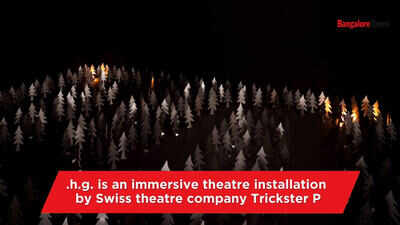

.h.g. has already toured Delhi, Puducherry and Chennai. Tell us about your experience…
Presenting .h.g. in different cities is a great opportunity for us. It is very fascinating to discover how each place has a different energy and a different audience. This mixture of audiences of different ages, cultures and interests is an important element in our work. We always try to find a medium that can be open to diversity and communicate at different levels. In contemporary times, it is pertinent for the arts to take up this challenge and move away from disciplinary distinctions.
There are so many fairy tales, is there are a particular reason to choose Hänsel and Gretel?
Despite being considered a fairy tale for children, Hänsel and Gretel is an extremely brutal story. During the creative process, we came across the research of a German university professor, who devoted much of his work to demonstrating that the fairy tale actually came from a true story, and that idea has strongly influenced the construction of .h.g. The many archetypal elements in it – the childhood house, the forest, the encounter with the evil and the victory over it – intrigued us to investigate how these aspects can also be present in reality. The relationship between reality and metaphor is quite interesting.
More fairy tales coming up?
.h.g. is followed by B (Biancaneve, Snow White in Italian) – a 2012 creation, which is still touring. The third episode of the trilogy on fairy tales is not in place yet. In B too, the spectator moves in solitude from one space to the other guided by earphones. However, unlike in .h.g., where the space is neutral and the focus is on the small details in each room, in B, each space has its own precise characteristic. This installation is more complex and therefore, it is difficult to tour with the piece outside Europe. Having said that, showcasing it in India one day will be a dream come true.
What is your take away from India?
India has a great influence on my work. It is a country that I have had the opportunity to visit assiduously, and there are aspects of its culture that resonate strongly in me. What I strongly find in India is the relationship with matter and materials, and, therefore, with the different atmospheres, which is a central part of our work. There are many Indian artists, who are important references for me. For instance, Bengaluru-based contemporary artist Sheela Gowda’s transposition of a culture and her vision through a strongly physical matter have had an influence on us.
End of Article
FOLLOW US ON SOCIAL MEDIA








Photostories
entertainment videos
Featured In Movies

Popular Categories
Entertainment NewsBollywood NewsTollywood NewsKollywood NewsMollywood NewsMovie ReviewsLatest Hindi MoviesLatest Tamil MoviesMX PlayerParenting TipsHome RemediesWeight LossBeauty TipsParenting TipsHindi VideosHindi Video SongsBhojpuri Music VideosLatest Telugu MoviesBhojpuri Music VideoHindi TV News
Trending in Entertainment
Latest MoviesBollywood MoviesHollywood MoviesTamil Movies 2024Telugu Movies 2024Malayalam Movies 2024Kannada Movies 2024Marathi Movies 2024Bengali Movies 2024Top Rated Movies 2024Best Hindi MoviesBest English MoviesBest Telugu MoviesBest Tamil MoviesBest Malayalam MoviesBest Kannada MoviesBest Bengali MoviesUpcoming Hindi MoviesBest Movies Of All TimeBest Hindi Movies of All Time
Trending in Etimes
Horoscope TodayNumerology Predictions TodayWalking BenefitsBreast Cancer DiagnosisYung Filly Rape CaseTaylor Rousseau GriggBelly FatSean Diddy CombsOzempic PersonalityDepression RiskBelly Fat LossHurricane MiltonToxic FriendshipDonald TrumpElon MuskDussehra 2024Durga Ashtami 2024Multitasking TipsSaraswati Visarjan 2024
Trending in TV
Trending in Lifestyle
Trending in Regional
Movie Reviews
Binny And Family ReviewLove, Sitara ReviewWill & Harper ReviewWolfs ReviewYudhra ReviewJo Tera Hai Woh Mera Hai ReviewKahan Shuru Kahan Khatam ReviewHis Three Daughters ReviewNever Let Go ReviewDancing Village: The Curse Begins ReviewTransformers One ReviewFirst Love ReviewBerlin ReviewThe Buckingham Murders Review
Upcoming Hindi Movies
Upcoming Regional Movies
Latest News
Harris overtakes Trump among suburban voters: Reuters/Ipsos pollDisturbed sleep tops list of complaints received on mental health helplineSamantha Ruth Prabhu shares playtime with Chinmayi Sripaada's daughter, says 'It took her 4.5 seconds to disown her parents'Dilip Kumar-Saira Banu wedding anniversary: How the legendary actor surprised all by marrying his belovedSpiritual fervour all around as Sun God steers Lord's chariot at TirumalaInfosys to no longer send job offer letters and attachments, the company will ...Jaggery vs honey: Which one is better for weight loss?SP-Congress alliance for UP bypolls intact: Akhilesh YadavMy mother would love to have a swayamwar for me: Raj AnadkatRanji Trophy: Focus on Shreyas Iyer as Mumbai begin title defenceHappy Dussehra 2024: Top 50 Wishes, Messages, and Quotes to Share with Your Loved OnesBigg Boss 18: Karan Veer Mehra's comment on Arfeen Khan converting his wife's religion sparks anger; Arfeen says, "Agar ye ghar mein nahi hota main iski band baja deta"India's Steel City (Jamshedpur) mourns loss of iconic steel tycoon Ratan Tata“A fresh approach”: New York Jets' Interim Head Coach Jeff Ulbrich Replaced Nathaniel Hackett as Offensive Play Caller With Todd DowningWomen's T20 World Cup: Don't need to be told about NRR, says Shafali VermaAxe the tainted & non-performers, PM Modi tells Union secretariesLead with AI and transform challenges into opportunities with GrowFast's AI and Analytics based Business Strategy online courseRanji Trophy: All eyes on Manav Suthar
Other Group Sites -
ETimes is an Entertainment, TV & Lifestyle industrys promotional website and carries advertorials and native advertising.