
- News
- lifestyle
- fashion
- style-guide
- Why your heirloom Kanjeevaram saree feels so different from a modern silk shirt
Why your heirloom Kanjeevaram saree feels so different from a modern silk shirt

Not All Silk Is the Same
You know the feeling. You run your hand across a rack of mass-produced silk shirts, and the fabric just sort of slips away. It is smooth, frictionless, and almost entirely devoid of personality. Then, you pull out a heritage Kanjeevaram, a handwoven Tussar, or an Assam Muga.
Suddenly, the fabric has weight. It has texture. It has a downright opinion. Why the jarring tactile difference? We tend to chalk it up to price tags or some vague notion of 'quality.' But the reality is far more biological. The reason silk from different regions feels completely different against your skin boils down to geography, chemistry, and the highly specific life choices of a caterpillar. Here is the science behind the drape.
You Are What You Eat (Even If You’re A Caterpillar)
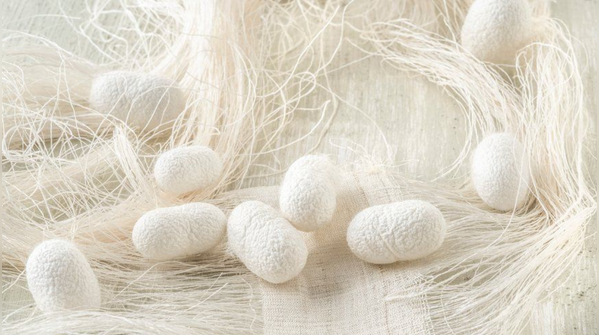
The biggest differentiator in silk texture literally starts at the buffet. Take your standard, slippery-smooth silk. This is Mulberry silk, and the Bombyx mori silkworm that makes it is the coddled royalty of the textile world. Reared indoors in strictly climate-controlled environments, these guys eat one thing and one thing only: mulberry leaves.
Because their diet is incredibly consistent, the worm spins one continuous, perfectly round, unblemished filament. The result? A fabric that feels like liquid glass. Now, take a walk on the wild side. The caterpillars responsible for Vanya silks—like Tussar, Muga, or Eri—are foragers. They live in open forests and munch on whatever oak, castor, or juniper leaves they can find.
This wild diet, rich in tannins and varied nutrients, completely alters the protein structure of the silk they spin. The threads end up shorter, thicker, and highly irregular. That’s exactly what gives raw, wild silk that rich, breathable, almost linen-like "slubby" texture.
(Image Credits: Pinterest)
The 'Terroir' of Textiles
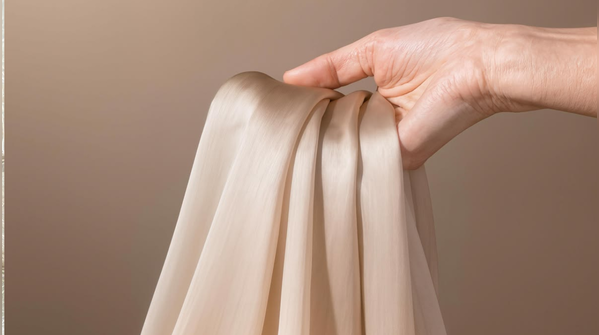
You’ve heard of terroir in vintage wine, right? Well, silk has it too. A strand of silk is essentially made of two proteins: the solid core (fibroin) and the sticky gum holding it together (sericin). The climate where the cocoon is spun directly impacts how these proteins develop and interact.
Look at the damp, heavy humidity of Assam. The native worms there spin Muga silk, which naturally develops a high tensile strength and a gorgeous, golden metallic sheen just to survive the environment. Contrast that with the dry, arid heat of the central Indian belt, like Chhattisgarh or Bhagalpur.
The Tussar silk spun out there is highly porous. It traps air. Because of that, it acts as a brilliant natural insulator—feeling crisp in the winter and blissfully airy during a brutal Delhi summer.
(Image Credits: Pinterest)
The Human Touch: Looms and Boiling Pots
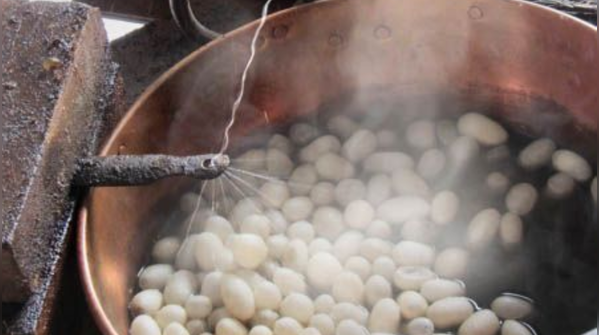
Before silk ever sees a loom, it gets boiled to strip away that sticky sericin gum. If a commercial manufacturer aggressively boils the silk to remove 100% of the gum, you get that ultra-drapey, limp fabric. But regional weavers? They know better. They intentionally leave a specific fraction of that natural gum intact. Retaining a bit of sericin is the secret behind the crisp, paper-like stiffness and architectural volume of certain heritage weaves.
(Image Credits: Pinterest)

Final words
Finally, there is the tension of the weave itself. A mechanical power loom pulls silk threads with unforgiving tension, creating a totally flat, uniform surface. A human handloom, however, has a rhythm. It has microscopic inconsistencies. A human weaver weaves tiny pockets of air into the fabric, giving the final textile a softer drape and an organic, forgiving feel. So, the next time you wear a handwoven silk, remember what you are actually wearing. It isn't just thread. It is a woven record of a wild diet, local humidity, and human hands.
(Image Credits: Pinterest)
Featured In lifestyle

MORE FROM ETIMES
life & style