
- News
- Poverty, the Pope and Mr Piketty: Poverty and income distribution
This story is from November 30, 2015
Poverty, the Pope and Mr Piketty: Poverty and income distribution
Economist Jagdish Bhagwati has an interesting proposition for Pope Francis.
Economist Jagdish Bhagwati has an interesting proposition for Pope Francis.
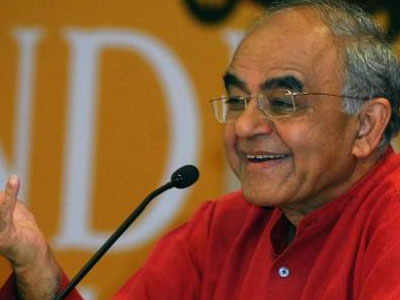
Economist Jagdish Bhagwati has an interesting proposition for Pope Francis. He has offered to write a joint encyclical with the Pope about what should be done to reduce poverty. “Because the Pope, though good-intentioned, is clueless,” said Bhagwati, who shares a Jesuit connection with him by dint of having attended a Jesuit school. In a keynote lecture that elevated economics from esoteric income evaluations to a humourous engagement with social reality, Bhagwati tested the springboards of economist Thomas Piketty’s feted theory on income redistribution, and addressed the question of how the Pope’s global call to reduce poverty could best be answered.
Piketty – whose monumental book could give Bhagwati hernia if he carried it around, he claimed – has only been repeating what India has been working towards since Independence. “The question of where the money is going and how to bring the bottom 30% up to snuff is something we’ve been working on since my time on the Planning Commission almost 50 years ago,” said the Columbia academic at his session, ‘Poverty, the Pope and Mr Piketty: Poverty and income distribution’.
The Pope is not a hypocrite, he practices what he preaches, unlike poster boys for the green economy, like Al Gore who owns a heated swimming pool. But the Pope is behind the times, Bhagwati noted. “In the last 50 years we have actually managed to reduce poverty, and it’s not through a miracle like manna falling from heaven, but through policy interventions,” he said. Policies not unlike what Prime Minister Modi is currently attempting to do by scaling up the successful Gujarat model of trade and investment to a national level.
The problem of income parity won’t be solved he believes, by making the rich poorer. They can evade taxes, as history shows. “Picketty was also wrong in assuming the top 1% is a static group. One can’t predict what will happen to wealth in the future; there are new people coming into the group.”
The old leftist idea that growth was a trickle-down strategy, a spillover of the spoils from the table of the rich to the flagstones of the poor, is a notion best turned on its head. “Instead of trickle-down, I’d call it a pull-up strategy, offering people the opportunity to rise above the poverty line," Bhagwati said.
Gurcharan Das, who engaged Bhagwati in conversation following his address, pointed out that the discussion on equality could distract us from the moral imperative to lift people out of poverty, something the Indian government has been doing since the 90s, at the rate of 1% of the population every year, which went up to 1.8% from 2003-7. Bhagwati observed that economic growth helps implement social legislation too. “A woman who want to get a divorce but worries if she’ll get a job to support herself after that will be better served by an economy with sufficient jobs,” he said, underscoring another benefit of growth: “A growing economy doesn’t need higher taxes. Instead, the budget constraints of the government will improve and social spending will rise.”
Piketty – whose monumental book could give Bhagwati hernia if he carried it around, he claimed – has only been repeating what India has been working towards since Independence. “The question of where the money is going and how to bring the bottom 30% up to snuff is something we’ve been working on since my time on the Planning Commission almost 50 years ago,” said the Columbia academic at his session, ‘Poverty, the Pope and Mr Piketty: Poverty and income distribution’.
The Pope is not a hypocrite, he practices what he preaches, unlike poster boys for the green economy, like Al Gore who owns a heated swimming pool. But the Pope is behind the times, Bhagwati noted. “In the last 50 years we have actually managed to reduce poverty, and it’s not through a miracle like manna falling from heaven, but through policy interventions,” he said. Policies not unlike what Prime Minister Modi is currently attempting to do by scaling up the successful Gujarat model of trade and investment to a national level.
The problem of income parity won’t be solved he believes, by making the rich poorer. They can evade taxes, as history shows. “Picketty was also wrong in assuming the top 1% is a static group. One can’t predict what will happen to wealth in the future; there are new people coming into the group.”
An openness to foreign trade would lead to more growth, which would in turn reduce poverty, a correlation that’s supported by sufficient study. “High rates of economic growth are related to high rates of openness to investment. Each spurs the other. Take a country where wives are bad cooks and husbands bad lovers. “What causes what you can’t say,” he chuckled. "Is she a bad cook because he's a bad lover?"
The old leftist idea that growth was a trickle-down strategy, a spillover of the spoils from the table of the rich to the flagstones of the poor, is a notion best turned on its head. “Instead of trickle-down, I’d call it a pull-up strategy, offering people the opportunity to rise above the poverty line," Bhagwati said.
Gurcharan Das, who engaged Bhagwati in conversation following his address, pointed out that the discussion on equality could distract us from the moral imperative to lift people out of poverty, something the Indian government has been doing since the 90s, at the rate of 1% of the population every year, which went up to 1.8% from 2003-7. Bhagwati observed that economic growth helps implement social legislation too. “A woman who want to get a divorce but worries if she’ll get a job to support herself after that will be better served by an economy with sufficient jobs,” he said, underscoring another benefit of growth: “A growing economy doesn’t need higher taxes. Instead, the budget constraints of the government will improve and social spending will rise.”
End of Article
FOLLOW US ON SOCIAL MEDIA
Hot Picks
TOP TRENDING
Trending Stories
In Section
Entire Website
- GK for students: Top 8 Largest Mammals in the World
- Arvind Kejriwal Resignation Live Updates: 'Kejriwal will be back', says Atishi after staking claim; BJP questions CM-designate's 'background'
- India vs China Highlights, Asian Champions Trophy 2024 Final: Jugraj Singh stars as India beat China 1-0 to clinch record fifth title
- Kolkata Murder Supreme Court Hearing Live Updates: Court extends ex-RG Kar principal Ghosh, cop's custody by 3 days
- Maharashtra schools closed on Sep 18: Here’s why
- Communal tension hits Karnataka towns over Palestinian flags at rallies
- 'If any shame left ... ': AAP slams Swati Maliwal's remark on Atishi, says she should seek RS ticket from BJP
- Work on bridges gains pace to ease Ghodbunder jams
- NMDC Steel Plant Seeks 100 Officers of Vizag Steel Plant
- UGC NET Result 2024 Live Updates: NTA expected to announced final answer key, scorecards shortly
- 8 killed, over 2,700 hurt after 1000s of pagers explode across Lebanon; Hezbollah blames Israel
- ‘Kheer brought back …’: PM gets emotional remembering mother on b'day
- Cow vigilantes killing a Brahmin is the wake-up call India needed
- J&K returns to polling booth after a decade; Phase 1 of voting tomorrow
- Sri Lanka presidential polls: What's at stake for India
- Trump says Biden-Harris rhetoric causing assassination bids; Dems blame Trump
- Can Vijay, a box-office BEAST, become a political GOAT?
- Intel CEO announces major restructuring, tells employees: 'We need to fight for …'
- Escaping riots in Bangladesh & prostitution in Chennai, woman lands in jail
- What are pagers? Devices that led to a wave of blasts in Lebanon

Popular Categories
Hot on the Web
Top Trends
Dominique PelicotUS Fed Rate CutIndia vs China Champions TrophyUPI Transaction LimitWhere to Watch India vs China Final Hockey MatchUPS vs NPS CalculatorKolkata Commissioner Manoj VermaNEET UG Admission CriteriaAtishiKolkata Doctor Rape CaseArvind Kejriwal Resignation LiveAli Khamenei TweetSuryakumar YadavVince McMahonTech LayoffsDonald TrumpLive Cricket Score
Trending Topics
Munawar FaruquiLuxury BrandCancer CauseKhatron Ke Khiladi 14Chinas EggAtishi Marlena Singh QualificationSunita AhujaGoat CollectionSalman Khan FarmhousePitra Paksha 2024CheetahsKangana RanautAditi Rao HydariDalljiet KaurHoliday DestinationVikas SethiReliance Jio DownApple iPhone 16 ProVirat KohliWordle Answer
Living and entertainment
Latest News
Pankaj Kapur is proud of son Shahid Kapoor’s film choices, calls him ‘the finest actor in the country’Mukhtar Ansari died of heart attack, not poisoning: UP's Banda district magistrate's report4 types of tea to improve gut health and ease digestive issuesKhatron Ke Khiladi 14: Shalin Bhanot hosts a fun party for his co-contestants Krishna Shroff, Abhishek Kumar, KaranVeer Mehra and othersDecoding how log analytics systems are enabling brands to derive maximum value from dataKitchen Tips: How to elevate home cooking to Michelin levelAnother Mpox suspected case in India: Man showing symptoms admitted to hospitalTaurus, Daily Horoscope Today, September 17, 2024: Anxiety and stress diminishLiza Colon becomes 1st Latina to win Best Supporting Emmy AwardSelena Gomez recreates practiced applause she learnt from TV show Friends after losing at Emmys 2024Former WWE superstar is no longer listed on their internal rostersBeyond Paychecks: Job satisfaction, work-life balance more important than salary for Gen Z workforce‘You is sleep or you can sleep’: Students prank Benglauru’s ‘pookie professor’ in viral videoHow ‘Oxford returnee’ Atishi became chief minister of DelhiWhy more couples aged 50 or older are getting divorcedThese are the most toxic fresh produce of 2024Pics; Monalisa visits Lalbaugcha Raja with husband Vikrant SinghIndia vs Bangladesh: Bangladesh get down to practice in Chennai ahead of first Test against India
Copyright © 2024 Bennett, Coleman & Co. Ltd. All rights reserved. For reprint rights: Times Syndication Service