
- News
- Relationships News
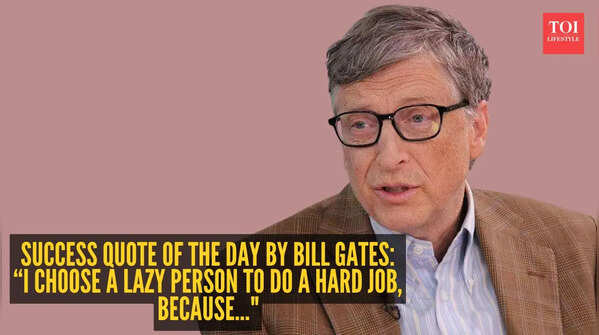
- Success quote of the day by Bill Gates: “I choose a lazy person to do a hard job, because..."
Success quote of the day by Bill Gates: “I choose a lazy person to do a hard job, because..."
The art of strategic laziness
“I choose a lazy person to do a hard job. Because a lazy person will find an easy way to do it.”
— Bill Gates
Let’s be honest: at first glance, this sounds like a total joke. It flips everything we’ve been told about "hustle culture" right on its head. But if you look closer, Gates isn't discouraging people who slack off all day. He’s talking about the ultimate workplace hack: optimization.
In a world that constantly glorifies being completely burnt out and busy, this line champions a totally different kind of skill—the ability to look at a massive, complex mess and find the shortest, most elegant way through it.

Flipping the script on being "lazy"
We usually treat the word "lazy" like a major character flaw. We associate it with procrastinating, avoiding responsibilities, and dodging accountability. But Gates is using it ironically here. The kind of "laziness" he’s praising is actually an aggressive intolerance for inefficiency.
Think about that one person who absolutely refuses to do things the hard way. They’re the ones asking the questions everyone else is too tired to think about:
- Why on earth are we still doing this manually?
- Can we cut out three steps of this approval process?
- Is this project actually necessary, or are we just spinning our wheels?
Their basic desire for comfort acts as a brilliant filter. If a process feels needlessly complicated, they instantly try to fix it. That's not slacking; it's the literal foundation of innovation.

Pointless work vs. hard work
The "lazy but smart" worker doesn't run away from a challenge; they just refuse to do pointless, repetitive labor. When you dump a massive project on their desk, they don't just blindly start grinding away. They pause, take a step back, and look for the underlying pattern.
Instead of brute-forcing the task, they'll build a reusable template, write a quick script to automate data entry, or find a tool that handles the heavy lifting. They are the quiet problem-solvers who redesign messy workflows. They don't just finish the job—they ensure that the next time it needs to be done, it takes half the time and effort for everyone else.

The discipline of finding the easy way
The real takeaway here is that the best solutions are almost always the simplest ones. When a project feels completely overwhelming, working 80 hours a week usually isn't the real fix. The real fix is reframing the problem entirely:
- Automate the boring stuff: If a machine can do it, a human shouldn't be wasting mental energy on it.
- Chop it up: Break a chaotic project down into small, repeatable steps that require zero guesswork.
- Use the right tools: Stop trying to build a house with a hand-screwdriver when power tools exist.
When you treat your personal energy as a scarce resource, you naturally become incredibly disciplined about how you spend it. You stop wasting time on internal friction and focus entirely on maximum leverage.

Why this is a modern superpower
In our modern, tech-driven world, raw endurance will only get you so far. Success isn't about hard work; it is about smart work.
Take a look at your own daily routine. Are there tasks you’re doing the incredibly hard way just because "that’s how we’ve always done it"? It might be time to channel a little bit of that strategic laziness. Ask yourself if there's a faster, smoother, less painful way to get the exact same result. It’s not about dodging responsibility—it's about protecting your peace, reducing your stress, and clearing out the busywork so you can focus on things that actually matter.
Featured In Relationships

