
- News
- City News
- bengaluru News
- Madhubani painter seeks support to keep traditional art form alive
Trending
This story is from May 8, 2022
Madhubani painter seeks support to keep traditional art form alive
Ashok Kumar Das has invited Bengalureans to visit his village Madhubani, in Bihar, to experience the magic of folk art and help keep it alive. As a third-generation Madhubani-style painter, he travels from one city to another carrying 100-150 of his delicate artworks and looking for customers.
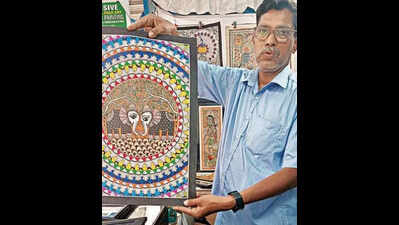
Ashok Kumar Das
At Madhubani, this art form originated with characteristic geometric patterns, symmetry, big winged eyes of painted figures, and vibrant colour schemes.

“My family of seven and I painted all of them, come and see us,” Das said while pointing to the mass of paintings hung on the cotton walls of his makeshift shop. He is participating in the India Art Festival, which will be on at Karnataka Chitrakala Parishath in the city till Sunday.
Every aspect of Madhubani painting is handmade and natural. The paper is prepared from cotton waste while the colours are organic. “The colours are made using materials such as turmeric, peepal, kohl, and flower juice,” he explained to a group of window shoppers. The 58-year-old said he gets a lot of business in Bengaluru, which has a significant market for folk paintings, but language is a barrier for him.
He has been painting for the past 25 years and dates the origin of the art form to Ramayana. “When Rama and Sita returned from Lanka, people from Mithila adorned the walls of their houses with such paintings to welcome them. The village of Madhubani is part of the Mithila region of Bihar where Sita is said to have been born,” he said. “This is neither fine nor contemporary art. It is purely folk and most of the paintings represent Rama and Sita.”
It takes between three and 12 days to complete a Madhubani painting, depending on the intricacy of work. The artist complained about how new businesses have been picking up designs from traditional painters and screen printing them on clothing items to cash in on tags of ‘authentic’, ‘handmade’ and ‘crafty’.
“We paint using matchsticks and earbuds. It is back-breaking work and requires a lot of visual focus. It is very harmful to artists like me when people take our gifts for free and exploit them,” he said. Das earns Rs 2-3 lakh a year from selling his paintings at exhibitions and functions.
“We have 25 families in our village and each one earns a livelihood through Madhubani paintings,” he said.
End of Article
FOLLOW US ON SOCIAL MEDIA






Hot Picks
TOP TRENDING
Trending Stories
In City
Entire Website
- 'We were treated like slaves, made to work for 15 hours a day': Tricked into Ukraine war, 3 from Karnataka return home
- 'My father was on the flight': Jaishankar opens up about 1984 Air India hijack
- Airtel CEO Gopal Vittal sends letter to Reliance Jio, Vodafone-Idea, Tata Tele and BSNL CEOs; here's what he said
- Prince Harry to celebrate 40th birthday away from Meghan Markle
- Haitian immigrant pet-eating row: Ohio woman accused of eating cat is US citizen, video is not from Springfield
- Kejriwal out of jail; 'CBI arrest only to frustrate ED case bail': SC judge
- Donald Trump reveals what Laura Loomer is to his campaign: 'I don't control her'
- Hamster Kombat Daily Cipher Codes and Combo Cards for September 14, 2024: Unlock up to 1 million coins
- Laura Loomer's photo with Donald Trump viral. People ask where's Melania, where's wedding ring
- Garena Free Fire MAX redeem codes for September 13: Win in-game goodies and rewards
- Fake cop gets woman lawyer to strip, part with Rs 50,000
- 'Safe and prosperous J&K is Modi ki guarantee,' says PM in J&K's Doda
- Ham do hamare chaar: Why is south India junking population control?
- Arvind Kejriwal bail: Delhi CM offers prayers at CP's Hanuman Temple
- Audio: Ex TMC MP alleges conspiracy to attack doctors in Kolkata
- Vinesh backed out? Salve reveals what happened after CAS verdict
- Did doctors make a mistake in making Mamata wait for 2 hours?
- Sexual harassment probe opened against SAP CTO: What the company said
- India vs Pakistan Live: Asian Champions Trophy hockey
- ‘Ashamed’ Bengaluru auto driver denies slapping woman passenger

Popular Categories
Hot on the Web
Top Trends
Trending Topics
Korean TeaSector 36 ReviewGreen Apple BenefitsPriyanka Chopra TattooKottukkaali OTT ReleaseNational Parks In IndiaGhaziabad Juice SellerGOAT CollectionVikas Sethi DeathMalayalam ProducersIndia's Best Dancer 4Simi GarewalDilli BabuIndian National ParksLaung BenefitsVikas SethiApple iPhone 16Donald TrumpAadhar Card Update By Sept 14Wordle Answer
Living and entertainment
Latest News
Regina Cassandra calls herself a 'serial dater,' had many relationships :'But I’m taking a break now'Kaun Banega Crorepati 16: Can you guess the answer for this Rs 3,20,000 question on Navy, which contestant Naman Jain incorrectly answered?Exclusive - Has Palak Sindhwani aka Sonu from Taarak Mehta Ka Ooltah Chashmah breached her contract; Neela Film Productions to issue a legal notice to the actress?Ford drives into India for 3rd timePIL: Publicise laws, penalties to curb crimes against womenGrowth potential 7.5% or more: RBI governorHindus take to Bangladesh streets to stop attacks and demand justiceE-commerce speeds up to catch up with Quick commerce'Will take digital public infrastructure stack to 50 nations'Justin Timberlake faces DWI charges: Court-ordered apology, fine and community serviceDonald Trump on another debate with Kamala Harris: 'Maybe, if I got in the right mood ... 'Border Gavaskar Trophy: When Ricky Ponting's on-air analysis of Prithvi Shaw turned into match realitySebi gives clean chit to NSE, ex-executives in co-location caseRusty or Ready? Falcons' Cousins Falls Flat in $180M NFL DebutEdible oil import duty hiked by 20%Lucky houseplants for each Zodiac, as per a renowned astrologerBest Phones Under 35000 To Smoothly Carry Out Multiple Tasks On A BudgetOnam is a time when everyone comes together to celebrate: Manju Warrier
Copyright © 2024 Bennett, Coleman & Co. Ltd. All rights reserved. For reprint rights: Times Syndication Service