
- News
- City News
- madurai News
- Stone inscription found near Madurai confirms co-rule by Pandiya brothers
Trending
This story is from February 13, 2020
Stone inscription found near Madurai confirms co-rule by Pandiya brothers
A stone inscription discovered in a village on the Madurai – Virudhunagar border confirms the theory that the Pandiya dynasty was once ruled simultaneously by two brothers, Jatavarman Kulasekara Pandiya and Maravarman Sundarapandiyan.
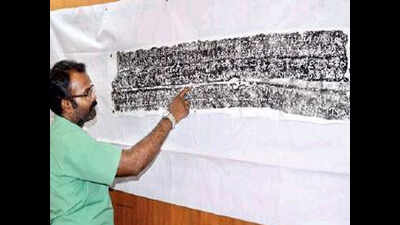
Marudhu Pandian, curator of the Madurai Government Museum, explains to reporters about the stone inscription found near Kalkurichi near Madurai
Curator of the government museum in Madurai, Dr M Marudhu Pandiyan, deciphered the inscription with the help of other experts including archaeological officer B Asaithambi, R Udaiyakumar, a research scholar, and archaeologist Dr S Santhalingam.

The Tamil script found on the stone says, ``Sri Anna mennu nadai’’, similar to the verse found in a stone inscription at Ponamaravathi in Pudukottai district, dating to Maravarman Sundarapandiayan 1 (1216-1238). The inscription refers to Saka year 1139, which is equivalent to 1217 CE, and also mentions that it is the 28th year of Jatavarman Kulasekara Pandiya’s reign. Usually, the date of Kulasekara Pandiya’s rule is confined to 1190 to 1216 CE, but this stone inscription extends his rule by one more year, 1217 CE. History also has it that his younger brother Maravarman Sundarapandiyan I was coronated in 1216 CE.
In the newly discovered inscription, the Pandiya king is referred to as Thennavan and compared to Karna of Mahabharatha, for his liberal donations. It speaks about donation of wetlands for cultivation of Sennel paddy at Kulatththi Vaykkaal at Kalkurichi. The name of the person who engraved the stone inscription, Poovan Irrattayan alias Sola Gangan, is also engraved in it.
``This stone inscription is of historical importance as it is confirmation of the fact that two kings ruled the Pandiya dynasty at a specific time, which is also mentioned in some other inscriptions discovered earlier. Officially it is stated that Jatavarman Kulasekara Pandiya’s rule was from 1190 CE to 1216 CE, making it a 26-year rule, but the stone inscription speaks of 28 years of rule. So, he must have co-ruled the dynasty with his younger brother for an extended period’’ Dr Marudhu Pandiyan added.
End of Article
FOLLOW US ON SOCIAL MEDIA





Hot Picks
TOP TRENDING
Trending Stories
In City
Entire Website
- Arvind Kejriwal Resignation News Live Updates: 'I don't have lust for power' Arvind Kejriwal to resign from the post of Delhi CM in two days
- Arvind Kejriwal Resign Live Updates: 'I don't have lust for power' Arvind Kejriwal to resign from the post of Delhi CM in two days
- Famous NFL Superstars Who Are Friends Of Taylor Swift
- GK for Students: Why is International Day Of Democracy celebrated on September 15?
- Kolkata rape-murder case: Ex-principal Sandip Ghosh, policeman arrested for destruction of evidence
- Bengaluru woman sparks controversy with comments about Swiggy delivery executive, internet reacts
- 'Nafrat ki dukaan pe ...': PM Modi attacks Congress over 'brutality' in US
- Top 10 sports stars turned power couples: From Agassi-Graf to Conner-Comaneci
- Hamster Kombat Daily Cipher Codes and Combo Cards for September 15, 2024: Unlock up to 1 million coins
- Neeraj Chopra finishes second, misses out on title by 0.01 meters at Brussels Diamond League Final
- 'Don't have lust for power': Kejriwal to resign from Delhi CM post in two days
- Hindus should only engage with Hindus in property deals: BJP MLA Nitesh Rane
- She called 9/11 an ‘inside job’. Why is she part of Trump campaign?
- It took 'Didi', not CM Mamata to get junior doctors to Kalighat
- Watch: Siddaramaiah's security breached as man runs towards stage
- What had happened when Bangladesh last toured India for a Test series
- Is your boss/workplace toxic? And what can you do about it?
- Melinda Gates reveals the 'best part' of not working with ex-husband Bill Gates
- Woman visits Delhi's Vasant Kunj flat for job ‘interview’, gets raped
- UPI transaction limit to change from Sept 16! Check new limits

Popular Categories
Hot on the Web
Top Trends
Trending Topics
World Largest HorseEID WishesOnam WishesPriyanka Chopra TattooKottukkaali OTT ReleaseEngineers Day WishesGoat CollectionHair LossSudha MurtyMalayalam ProducersIndia's Best Dancer 4Simi GarewalDilli BabuIndian National ParksLaung BenefitsVikas SethiApple iPhone 16Donald TrumpAadhar Card UpdateWordle Answer
Living and entertainment
Latest News
PM Modi's Sunday roadshow in Jamshedpur cancelled due to heavy rainHow to identify a real friendTCS teams up with Tata Electronics for ‘made-in-India’ chips4 types of tea to improve gut health and ease digestive issuesKashmir will soon get a government, but those blinkers are going to stayWeekly Career Horoscope, September 15 to September 21, 2024: Read your weekly astrological work predictions for all zodiac signs'Hindi must be made acceptable, not imposed'Zodiac Signs That Crave a Luxurious LifestyleMegha Akash marries Saai Vishnu, celebrities and fans extend their wishesCoin Master free spins and coins for 15 September, 2024: Earn 7 million coins using today’s linksOnam 2024: Pearle Maaney, Sajan Surya, Malayalam TV celebs send warm wishesISL: Odisha's home run broken as Chennaiyin script 3-2 comeback win in season opener at KalingaMassachusetts state police recruit dies during boxing training exerciseDeepika Padukone gets discharged from the hospital, twins with Ranveer Singh in white as they bring home their newborn baby girl37 year old beats fatty liver condition with unbelievable weight lossWhat You’re Always Doing, According to Your Zodiac SignCouncillor's bro, 4 others held for hurling stones at Vande BharatCancer, Weekly Horoscope, September 15 to September 21, 2024: Encounter a busy week filled with unexpected challenges
Copyright © 2024 Bennett, Coleman & Co. Ltd. All rights reserved. For reprint rights: Times Syndication Service