
- News
- City News
- nagpur News
- CIRCOT introduces lint-based cotton marketing for better prices
Trending
This story is from January 4, 2020
CIRCOT introduces lint-based cotton marketing for better prices
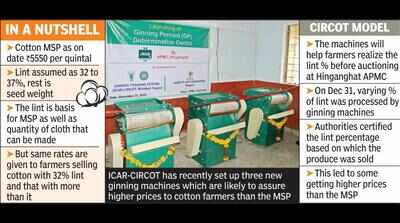
The concept aims to change the way cotton is traded in the country beside promoting quality enhancement using best varieties.

Presently, the farmers get rates only on the basis of raw cotton which consists of lint and seeds. The lint percentage is around 32 to 37% while the rest is the seed weigh. The lint is priced at Rs115 per kg while seeds fetch around Rs25 per kg by ginners.
Irrespective of the lint percentage, growers get a flat rate which is Rs5,550 per quintal as on date.
The research body has pushed for marketing the lint after processing — that is segregating the lint from the seed before it is weighed for auction. This will enable growers bringing better quality cotton to get more than the MSP per quintal.
The CIRCOT led by its director PG Patil implemented the project at Hinganghat through its regional Ginning Training Centre (GTC) off Amravati Road. A GTC team comprising principal scientists SK Shukla, SV Ghadge, scientists K Pandian and SS Kautkar along with NGO Agro Plus visited the cotton hub to roll out the project.
Shukla said the aim is to increase percentage of saleable lint to not less than 38%. “Countries like US and Australia are marketing cotton at 42% lint. The three lab model ginning machines have been given by CIRCOT free of cost to APMC. This will facilitate ginning per cent (lint out-turn) for growers,” he said.
He said NGO Agro Plus president GH Wairale played a major role in convincing stakeholders, including growers to go for lint-based auction. APMC chairman Om Dalia, director Sudhir Kothari and Prashant Mohta from the industry too appreciated the concept.
Wairale said a couple of samples were processed before them and the lint percentage varied from the 33 to 35. “Cotton traders are purchasing the yield presuming 33 to 34%lint content at a flat rate of Rs5,550 per quintal. But, after ginning they realize 36 to 42% lint. The additional 2 to 6% lint benefit goes into the pocket of the traders instead of the farmers. This is because of lack of awareness among farmers and the pricing authority,” he said.
Wairale said the NGO had been pursuing the Mumbai-based textile commissioner to adopt lint-based marketing.
He said cotton marketing, too, must be done scientifically as for milk and sugar. “Cotton prices are decided on visual method by looking at staple length, micronair, grade etc. Milk prices are decided on fat %, while sugar cane rate on sugar per cent,” he said, adding new concept will add up to Rs500 per quintal of earnings to growers.
End of Article
FOLLOW US ON SOCIAL MEDIA






Hot Picks
TOP TRENDING
Trending Stories
In City
Entire Website
- Malaika Arora's father Anil Arora dies by suicide in Mumbai
- 7 Key Reasons Why UPSC is the Toughest Exam in India
- 9/11 Remembrance Day: Key moments from the deadliest attack on US
- Howard University: 10 landmark firsts of the institution that shaped Kamala Harris
- Earthquake of magnitude 5.8 strikes Pakistan, tremors felt in Delhi, neighbouring areas
- Who were Barack Obama's challengers in 2008 and 2012 US presidential elections?
- 'A in INDIA alliance': Rahul Gandhi's slip-up during address to Indian-Americans goes viral
- Trump vs Harris: Betting markets reveal who’s expected to win the US presidential debate
- IGNOU December 2024 Term-End Exam: Registration Details, Important Dates, and Fee Structure
- Top 10 TED Talks to Boost Confidence and Success for Female Students
- 200 deaths/day, $1.5tn per year: How China is destroying US with fentanyl
- Harris emerges unscathed from debate, dancing around her flip-flops
- iPhone success shows India can beat China to become world's factory
- Communal violence erupts in Karnataka during Ganesha idol immersion
- After Kolkata docs set new demands, Mamata govt says 'not ready to accept'
- Omar fighting for chair, I’m fighting for people of Kashmir: Er Rashid
- Why Kolkata rape-murder victim’s mother accusing Mamata of lying?
- Apple iPhone 16 vs iPhone 15: Which iPhone to buy and why
- Biryani row: Administration moves boy to new school, to waive Rs 37k in fees
- 16 fall ill during fitness test for Jharkhand excise constable jobs

Popular Categories
Hot on the Web
Top Trends
Trending Topics
Deepika PadukoneMalaika Arora Father DeathArbaaz KhanJayram RaviAishwarya Rai BachchanSlat WaterWeight GainGOAT CollectionVikas Sethi DeathMalayalam ProducersIndia's Best Dancer 4Simi GarewalDilli BabuIndian National ParksLaung BenefitsVikas SethiiPhone 16Dubai Princess Sheikha MahraMG Windsor EvWordle Answer
Living and entertainment
Latest News
Jiiva and wife escape with minor injuries after a road accidentThe Zodiac Signs Most Naturally Inclined to HealingWhy Banyan trees survive for centuries and spread indefinitely?Telangana government pushes for increased flood relief from CentreWalking dog in Goa? Mouth guard, leash soon to be mustNBA 2K25 locker codes September 2024: Locker codes revealed and know how to reveal themDonald Trump and Kamala Harris shake hands as they meet for first time on debate stage: Watch the 'awkward' momentBRS pushes for disqualification of turncoat MLAs after High Court rulingKamala may have won debate. But election is still too close to callCommunal violence erupts in Karnataka during Ganpati Visarjan, section 144 imposedVarun Dhawan shares unfiltered reaction to Janhvi Kapoor's 'Daavudi' song from 'Devara: Part 1': 'So freaking good...''On basis of fairness and equality': Bangladesh seeks good relations with India, says YunusMpox kills two, six other confirmed cases in Cameroon: GovernmentJalen Ramsey demands action against Miami Police following Tyreek Hill's pulled from car49ers RB Christian McCaffrey misses win over JetsWWE Superstar Blames the Company for Failing to Utilize Omos’ Potential7 Common veggies that are loaded with iron and essential nutrientsAir India Express and Scoot launch exciting flight sale for domestic and international travel
Copyright © 2024 Bennett, Coleman & Co. Ltd. All rights reserved. For reprint rights: Times Syndication Service