
- News
- City News
- ahmedabad News
- Plants show signs of exhaust-ion
Trending
This story is from May 28, 2023
Plants show signs of exhaust-ion
While the impact of vehicular pollution is well-documented in humans — hampered lung functions and increase in morbidity — a recent city-based study highlighted that the toxic fumes do the same to the plants.
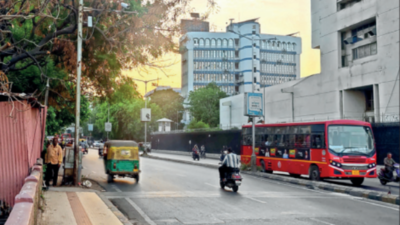
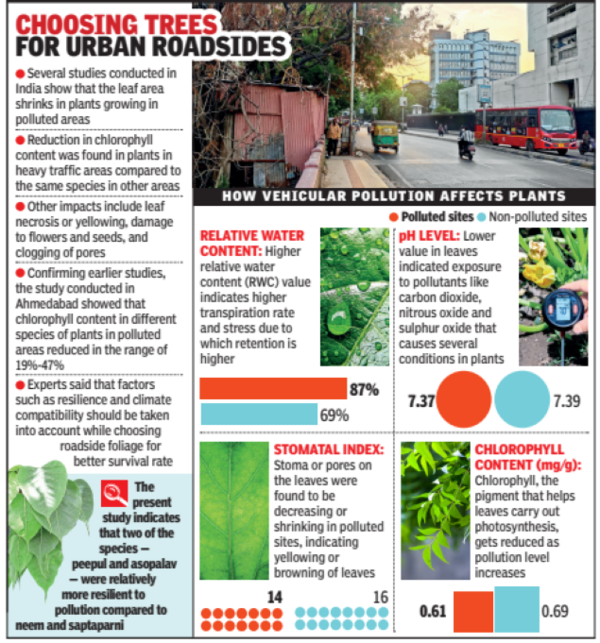
Several studies conducted in India show that the leaf area shrinks in plants growing in polluted areas
Of the four species taken into consideration for analysis, those planted in areas with heavy traffic saw marked difference from those in non-traffic zones.

The study, ‘Physiological responses of some tree species under roadside pollution in Kalupur area of Ahmedabad, Gujarat’ by Dharti Nagar, Sandhya Verma and Hitesh Solanki from the department of botany, bioinformatics, and climate change impacts management at Gujarat University, was published recently in the journal, International Association of Biologicals and Computational Digest.
Leaves collected from Kalupur and another area, located17 km away, were studied. The species chosen included peepal (sacred fig), saptaparni (blackboard tree), neem, and Asopalav (Indian mast tree) due to its high prevalence in the city.
A few earlier studies have also chosen some of these trees, providing a ready comparison.
Solanki, a faculty at the department, said that the results indicated that the leaves collected from more polluted areas had fewer open pores, and were not so healthy in terms of water, pH and chlorophyll levels.
The chlorophyll content was 19% to 47% less in the same species that were 17km apart from each other.
“Two of the species that showed relatively higher resilience were peepal and asopalav.,” said Solanki, adding: “The findings match with the outcome of the studies of similar nature conducted in 2012-13. The study not only shows how plants survive in polluted areas — their presence is a necessity for a better environment — but also identifies species which might be more suitable for a city like Ahmedabad.”

About the Author
Parth ShastriEnd of Article
FOLLOW US ON SOCIAL MEDIA






Hot Picks
TOP TRENDING
Trending Stories
In City
Entire Website
- Centre seeks review of SC's mineral royalty judgment
- 'At 2:30 in the night, Rohit Sharma texted me and asked...'
- Schools closed across various states till 16th September: Here’s why
- Live wire snaps, boy recalls science lesson, saves lives with sister
- Many parts of Chennai face power supply disruption due to fire at Manali substation
- Aadhaar card update: Do you have to compulsorily update details on your Aadhaar every 10 years?
- Kevin Spacey allegedly demands $100,000 to vacate Baltimore residence, new owner says actor tries to 'paint himself as victim’
- Who is Jared Isaacman? Billionaire who stepped out of SpaceX capsule for first private spacewalk
- NMC approves expansion: GMC to offer 200 MBBS seats and more PG seats in 2024-25
- Veteran CPM leader Sitaram Yechury passes away
- Delhi court issues release order for Delhi CM Arvind Kejriwal in excise case
- 'Can't attend office': SC's bail conditions for Delhi CM Kejriwal
- Five things to keep in mind before betting on Bajaj Housing Finance
- Haryana: It’s Bhupinder Singh Hooda way or the highway in Congress
- Shreyas Iyer bats wearing sunglasses, falls for duck
- Vande Metro launch date, schedule: New Indian Railways train is here!
- ‘Old Boys Club promotes men over women who aren’t part of it’
- Refund on iPhone 15 & 14: Apple's policy says conditions applied
- Ford to restart manufacturing of vehicles in Chennai plant after 3 years
- Virat Kohli slogs it out, Jasprit Bumrah goes full throttle

Popular Categories
Hot on the Web
Top Trends
Trending Topics
Alia BhattMalaika Arora Father DeathArbaaz KhanNatasa StankovicMr Bachchan OTT ReleaseNational Parks In IndiaSelena GomezGOAT CollectionVikas Sethi DeathMalayalam ProducersIndia's Best Dancer 4Simi GarewalDilli BabuIndian National ParksLaung BenefitsVikas SethiApple iPhone 16SpaceXAadhar Card Update By Sept 14Wordle Answer
Living and entertainment
Latest News
Salman Khan surrounded by bodyguards as he arrives at Malaika Arora's mother's house to offer his condolences - WATCHJulie Chen to miss Big Brother live eviction for first time, taps Jerry O'Connell to hostBonedi baris hope for a peaceful start to PujoNIA raids pro-Khalistan preacher Amritpal Singh's relative's house in AmritsarA vision unfolds: How Levitation is crafting tomorrow’s enterprise solutionsTovino Thomas praises Prithviraj Sukumaran as director: "One of the brilliant directors I have ever worked with"Tragedy strikes at fundraiser: Mother of two dies after marshmallow-eating competitionMan shot near Delhi's Greater Kailash-I gym, gang war suspected8 animals that reproduce without matingHow a balanced pH helps maintain your skin’s youthful appearanceStree 2 box office collection: Shraddha Kapoor and Rajkummar Rao starrer clocks Rs 539 croreISL-11 opener: Familiar foes back in businessBiden to host fourth quad summit with PM Modi, Albanese, and Kishida in Delaware on September 21: White HouseSanthy Balachandran turns screenwriter for Kalyani Priyadarshan and Naslen starrerDivya Bansal explores themes of human resilience, love and positive transformation in debut poetry bookFinancial graft probe against Sandip Ghosh: ED raids in Chinar Park, Tala & Kalindi in Kolkata‘Ajayante Randam Moshanam’ actor Tovino Thomas gets emotional: We faced numerous challengesZodiac signs: What they regret and why
Copyright © 2024 Bennett, Coleman & Co. Ltd. All rights reserved. For reprint rights: Times Syndication Service