
- News
- Elections
- Assembly Elections
- Election Infographics
- Assembly elections 2026 infographs: Tamil Nadu, West Bengal, Assam, Kerala, Puducherry
Assembly elections 2026 infographs: Tamil Nadu, West Bengal, Assam, Kerala, Puducherry
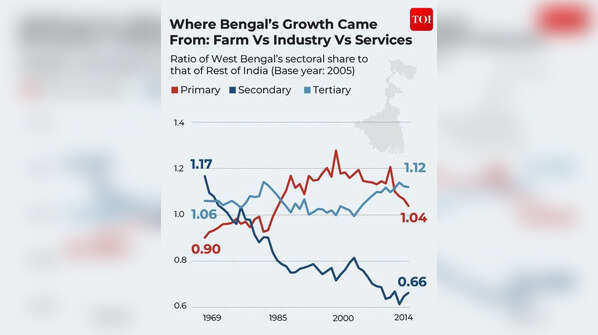
West Bengal's Growth Drivers Over Time
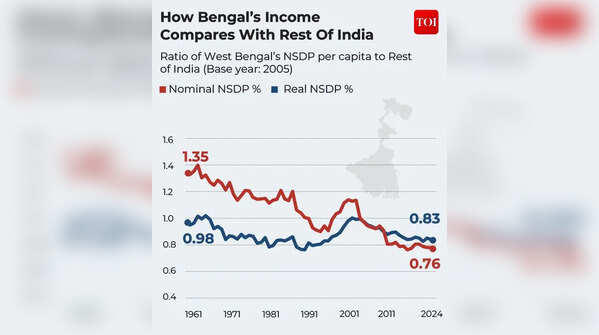
NSDP Per Capita Ratio: Bengal vs Rest of India Trend Analysis
The chart shows a clear long-term shift from relative income strength to sustained underperformance.
Both nominal and real NSDP ratios indicate Bengal’s gradual divergence from the national growth trajectory.
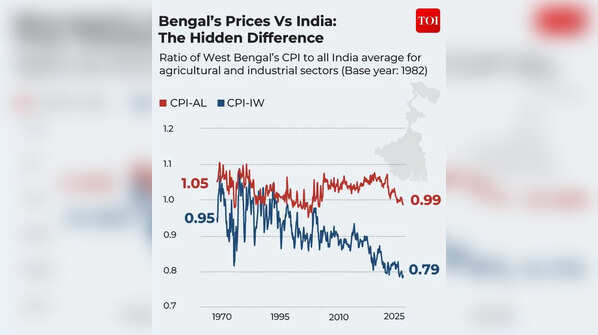
West Bengal vs India CPI Gap
West Bengal’s agricultural worker prices have largely stayed close to the national average over time.
However, industrial worker prices show a steady decline relative to India, indicating a widening sectoral gap in cost trends.

Timeline of Narayansamy vs Bedi clash in Puducherry
Ahead of the Puducherry assembly polls 2026, the long-running clash between V Narayanasamy and former LG Kiran Bedi remains a defining political flashpoint. Appointed in May 2016, Bedi quickly locked horns with Narayanasamy over administrative powers, refusing to act as a “rubber stamp”. By 2017, the CM publicly accused her of overstepping constitutional limits and obstructing governance. Disputes escalated over welfare schemes, funding, and bureaucratic control, with both sides citing constitutional provisions. The standoff continued until Bedi’s eventual removal, marking one of Puducherry’s most high-profile Centre–state confrontations.

Mamata vs Suvendu: The rematch in Bhabanipur
The 2026 West Bengal election is a high-stakes rematch between Mamata Banerjee and Suvendu Adhikari, who defeated her in Nandigram in 2021 by just over 1,900 votes. Banerjee contests from Bhabanipur banking on welfare schemes, while Adhikari doubles down on corruption charges and BJP’s Rs 3,000 monthly aid pitch to women.

Welfare politics in Tamil Nadu
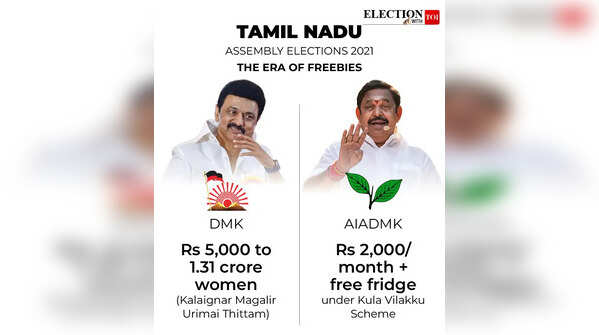
Tamil Nadu Assembly elections 2021: The era of freebies
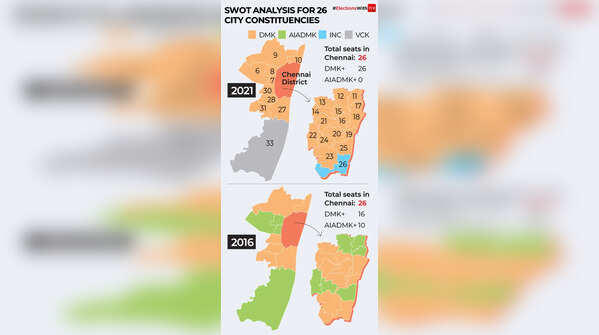
SWOT analysis of 26 city constituencies for Tamil Nadu elections

TVK SWOT analysis

AIDMK-BJP front SWOT analysis

DMK Front SWOT Analysis
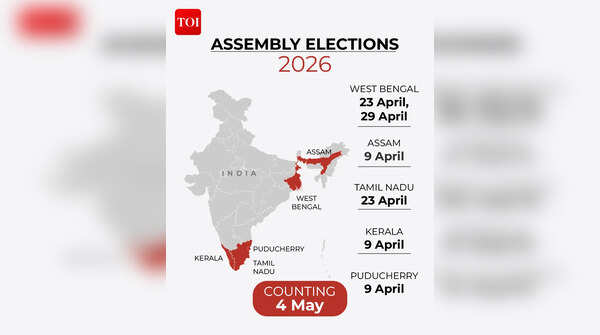
Assembly election 2026 Map
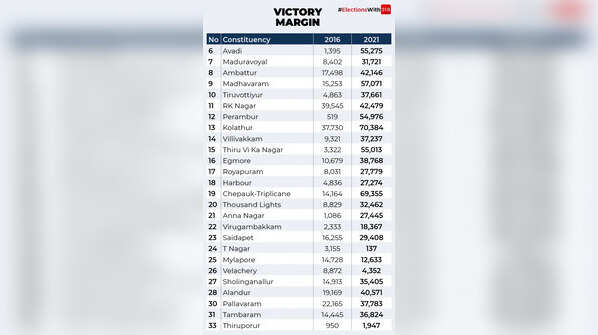
Tamil Nadu polls: Victory margin in 2021
A comparison of election victory margins across various constituencies in 2016 and 2021 reveals notable trends. Several constituencies saw significant increases, with Perambur rising from 519 to 54,976 votes and Avadi from 1,395 to 55,275 votes. In 2021, Kolathur recorded the highest victory margin at 70,384 votes. However, a few areas, including T Nagar, Mylapore, and Velachery, experienced a decrease in their winning margins compared to 2016.
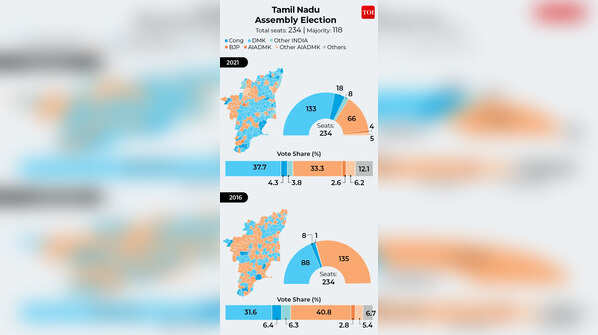
Tamil Nadu assembly polls: 2021 snapshot
In 2021, the DMK alliance secured a majority with 133 seats and a 37.7% vote share, while the AIADMK alliance won 66 seats with a 33.3% vote share. In contrast, the 2016 elections saw the AIADMK alliance in power with 135 seats and a 40.8% vote share, while the DMK alliance managed 88 seats with a 31.6% vote share. The 2021 results thus marked a reversal from 2016, with the DMK alliance making significant gains to form the government.
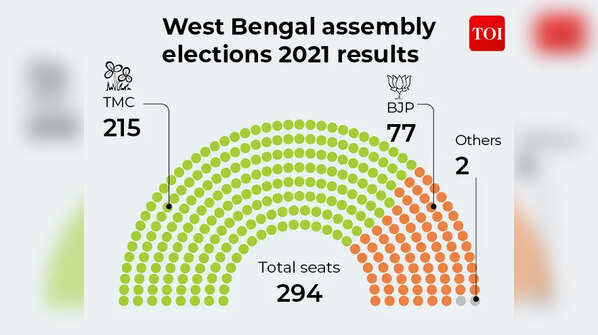
West Bengal assembly elections 2021 results
In the 2021 West Bengal Assembly elections, the All India Trinamool Congress secured a dominant victory by winning 215 out of the total 294 seats. The Bharatiya Janata Party emerged as the principal opposition with 77 seats, marking a significant rise from its previous performance, while other parties together won 2 seats.
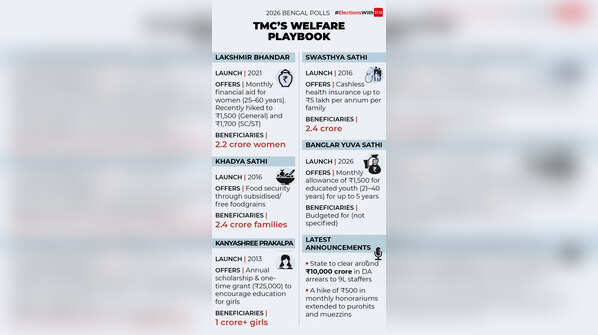
West Bengal polls: Mamata Banerjee's populist schemes
The welfare push by the Trinamool Congress government in West Bengal ahead of the 2026 polls includes several flagship schemes and new announcements. Key programmes include Lakshmir Bhandar for financial assistance to women, Swasthya Sathi for health insurance coverage, and Kanyashree Prakalpa aimed at supporting girls’ education. A new initiative, Banglar Yuva Sathi, was launched in 2026 to provide a monthly allowance to educated youth. Additionally, the government announced the clearance of Rs 10,000 crore in dearness allowance arrears for staff and increased honorariums for specific religious workers.
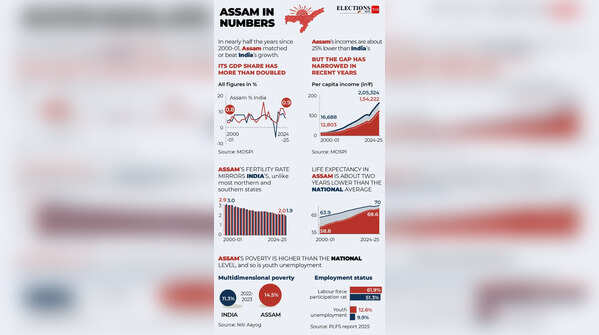
Assembly election 2026: Assam in numbers
Assam’s development indicators show a mixed but improving trajectory when compared to the national average. The state’s share in GDP has more than doubled over time, and its fertility rate has now aligned with the national average. Although per capita income remains about 25% lower than India’s, the gap has narrowed significantly in recent years. Life expectancy in Assam is still around two years below the national average. At the same time, the state records higher multidimensional poverty levels at 14.5% compared to 11.3% nationally, along with lower labour force participation rates than the rest of India.

Assam assembly polls: The big face-off
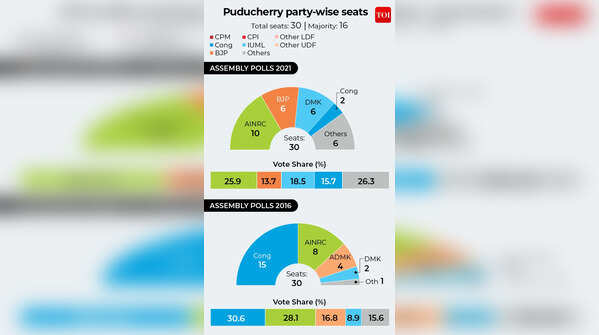
Puducherry party-wise seats
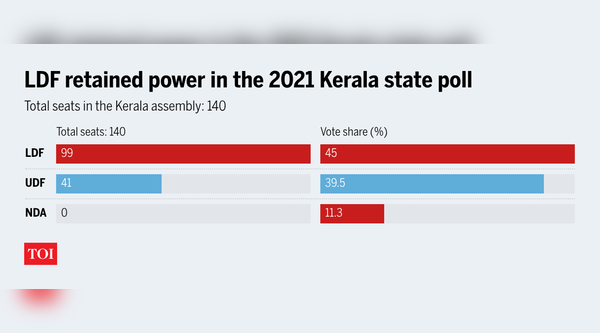
LDF reatined power in the 2021 Kerala state poll
Featured In Elections

