
- News
- City News
- kolkata News
- 150 admirers, including kin, walk to celebrate 100 years of Kazi Nazrul Islam’s ‘Bidrohi’
Trending
This story is from December 27, 2021
150 admirers, including kin, walk to celebrate 100 years of Kazi Nazrul Islam’s ‘Bidrohi’
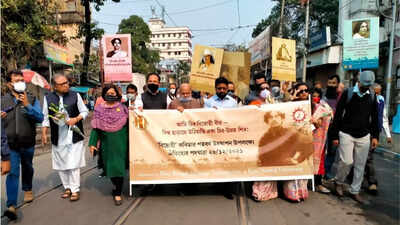
The rally started from Subodh Mallick Square and ended in Taltala Lane

Kazi Anirban told TOI that a year-long celebration of the poem has created ripples in Bangladesh, South Korea, the United States and Canada. “My sister Anindita lives in New Jersey and has organized an online event to mark the poem’s centenary. I feel it is significant that Kolkata organized such an event too. My grandfather’s words ring true even in the contemporary context.” The response to Sunday’s rally was “overwhelming”, he said. Members of the Facebook group Purono Kolkatar Golpo, Swarnali Chattopadhya and Jayanta Sen, joined the rally as well. The poet’s granddaughter, Mishti Kazi, came all the way from Bangladesh to attend the rally.
Anirban walked down memory lane and remembered the genesis of ‘Bidrohi’ in 1921. Nazrul lived in this Taltala house along with close friend and Communist leader Muzaffar Ahmad. “Muzaffar Ahmad had fallen asleep when my grandfather had started writing this poem with a pencil. Next morning when Muzaffar asked my dadu why he chose to use a pencil, my grandfather had replied saying using a pencil was the best option in case he ran out of ink and lost his emotional tempo,” Anirban said.
WBHC chairperson Suvaprasanna remembered meeting the poet. “I have never been to the Taltala house though I had the good fortune of meeting the poet at the Christopher Road house where he used to live with his son, Sabyasachi. I have been to that house on two of his birthdays. I am so happy to see so many people walking to celebrate the poem’s centenary,” he said.
‘Bidrohi’ was first published in the Bijoli little magazine. “As far as I know, nowhere in the world has there ever been such a celebration of a poem’s centenary. This poem is a big example of how a good piece of writing can transcend the barriers of religion, caste and nationalities to inspire people,” Suvaprasanna said.

About the Author
Priyanka DasguptaEnd of Article
FOLLOW US ON SOCIAL MEDIA









Hot Picks
TOP TRENDING
Trending Stories
In City
Entire Website
- UPS vs NPS Calculator: Is A Switch From National Pension Scheme to Unified Pension Scheme Really A No-Brainer? Check Calculations, Benefits - Top Points
- Monster vs Monster: WWE announced massive match for this week's Monday Night Raw
- UPI transaction limit to change from September 16! Here are the new limits for various UPI payments
- File movement linked to weight of money: Nitin Gadkari
- Apple's biggest 'iPhone update' for year 2024, iOS 18, rollout starts today - September 16: India time and how to prepare your iPhone for iOS 18 download
- Arvind Kejriwal's resignation: Who will be next Delhi CM? Atishi seen as top choice
- UP medical aspirants converting religion to secure MBBS seats: A look at NEET UG admission criteria around minority reservation rules
- Protests against students wearing hijab in school play, principal forced to apologize for promoting religious harmony
- Pitru Paksha 2024 Date and Time: Know Significance of Shradh Paksha
- Andhra suspends 3 IPS officers for 'framing', arresting Mumbai actress
- 2 attempts to 'kill' Donald Trump in 2 months: How it may impact US presidential elections
- After 2 hours, meeting between docs & CM Mamata concludes
- Did doctors humiliate Mamata, or did she make it an ego issue?
- Watch: BJP MLA falls on rly tracks while flagging off Vande Bharat train
- Putin moves to make Russian army 2nd largest in the world
- 'No India vs Pakistan final': Pak fans rue defeat in ACT semis
- Will Atishi replace Arvind Kejriwal as Delhi CM?
- Apple's biggest 'iPhone update' for year 2024 rollout starts today
- Make It Priceless: Gift them a customized TOI Front Page. Know More
- Shiv Sena MLA booked for bounty on 'chopping Rahul Gandhi's tongue'

Popular Categories
Hot on the Web
Top Trends
Who is Ryan RouthUPI Transaction LimitArvind Kejriwal ResignationNEET UG Admission CriteriaKolkata Doctor Rape CaseBorder Gavaskar TrophyRohit SharmaSports Stars Turned Power CouplesIBPS RRB Clark PO ResultDonald TrumpBianca Belair Net WorthIndia vs Korea HighlightsBMW Accident Madhya PradeshUPS vs NPS CalculatorPrince HarryMiami Dolphins OwnerLive Cricket Score
Trending Topics
Living and entertainment
Latest News
4 types of tea to improve gut health and ease digestive issuesWho was Illia 'Golem' Yefimchyk, the Belarusian bodybuilder who consumed 2.5 kg of meat and 108 sushi pieces daily before his death at 36?Vempalle Shareef's story is now a lesson for degree students in Andhra PradeshGovt launches programme to tackle glacial lake outburst flood threat in Himalayas, all 190 high-risk lakes to be monitoredWhen Shah Rukh Khan performed 'Kanyadaan' at Farah Khan's wedding- See PICSAstrological Influence on Zodiac Signs' Career ChoicesBike rally held to raise voter awareness in Jammu and Kashmir's Doda ahead of assembly electionsFalcons' Predictable Offense and Cousins' Prime-Time Woes Spell Trouble in PhiladelphiaFather-son duo Eugene and Dan Levy's dazzling entrance at the EmmysLiza Colon becomes 1st Latina to win Best Supporting Emmy Award'Oh no!': Hilarious goof-up leads to missed catch, leaves bowler in smile. WatchJr NTR on shooting under water scene for 35 days in 'Devara Part 1': It is an important sequence!Last Lunar Eclipse of 2024: What it means for your zodiac signTop NFL Superstars Who Are Vegan: Derrick Morgan, David Carter, Theo Riddick and moreKSCA Invitational: Arjun Tendulkar takes match haul of 9 wickets in big Goa CA XI winAbhishek Kumar shares selfies with Alia Bhatt; recalls the time when he worked as a crowd artist in ‘Humpty Sharma Ki Dulhaniya’Jessica Gunning wins her 1st Primetime Emmy for 'Baby Reindeer'Shocking! Man celebrates birthday by lying among massive Pythons
Copyright © 2024 Bennett, Coleman & Co. Ltd. All rights reserved. For reprint rights: Times Syndication Service